
TL;DR
Did my AI prompts leak through OpenRouter?
A researcher hid fake passwords and keys in about 2 million AI prompts and found some AI providers leaked them, so OpenRouter dropped three providers. Prompts you type into some AI apps can travel further than their privacy labels promise. Keep passwords, keys and client details out of AI chats.
What did the researchers find?
On Thursday, November 19, 2026, HD Moore, chief research officer at security firm Dragos, published the results of a five-month experiment. From July to November, his team sent nearly 2 million prompts to AI services, each carrying a "canary," a one-of-a-kind fake secret such as an Amazon Web Services (AWS) key, a password or a private web address. Each canary went into exactly one prompt, so if anyone ever used it, Moore could tell which company it passed through.
According to Moore's write-up and Ars Technica's report, the canaries surfaced in three ways:
- Break-ins. At least three AI hosting providers showed signs that attackers were inside and copying the prompts they received. At one provider, attackers reused "a couple hundred" of the planted AWS keys, and Moore says every request his team sent during certain windows in late October was stolen.
- Resellers keeping prompts. Some resellers, companies that offer other firms' AI models at low prices, logged customer prompts, and the planted credentials were later used by others.
- Ignored privacy settings. Several providers didn't honor flags like "Zero Data Retention" (ZDR, a promise not to store your prompt after answering it) or "no data collection." Moore says one Chinese AI lab's systems fetched the secret web addresses from more than half of the prompts sent to its models, including about two-thirds of those marked no-collection or ZDR.
Was OpenRouter hacked?
No, according to OpenRouter. The company is an "AI router," a middleman many apps use to send your prompt to whichever model or provider fits best. In a statement posted Saturday evening, it said the findings "did not show any breach or unauthorized access of OpenRouter."
It still made changes. OpenRouter says it has:
- Removed three providers from its service.
- Taken 125 endpoints (specific model-and-provider connections) off its ZDR list, some of them only as a precaution.
- Notified all potentially affected customers.
OpenRouter hasn't publicly named the three providers it dropped. Ars Technica, citing OpenRouter's email to customers, reported that the exposure involved prompts sent to MiniMax models, either directly or through the resellers AtlasCloud, Novita and StreamLake. Novita, Phala and Together AI have posted their own incident notices, which OpenRouter lists on its blog. OpenRouter also says it is adapting the researchers' method so it can run these checks on an ongoing basis and will require proof before putting any removed endpoint back on the ZDR list.
What happened at Together AI?
Together AI, another AI hosting company, disclosed a separate problem on Saturday. In its incident post, it says an AI coding agent committed a credential to a public code repository, which let someone download stored samples of prompts from June and July. The leaked samples came mainly from requests to the MiniMax M3, GLM-5.2 and Kimi K2.6 models on June 24 and July 4, 8 and 14. Together says it hasn't found further leakage and is still reviewing what was exposed. It hasn't said how many customers were affected.
Does this mean my ChatGPT chats leaked?
Nothing in the research or the company notices points to that. The problems were with AI hosting providers and resellers that sit behind apps and AI routers, and none of the reports name a big first-party chatbot app as leaking prompts. The catch is that you often can't see which companies an AI app uses behind the scenes. Every hop opens your prompt to read it, and each company may log it under its own rules, as Ars Technica explains. If you've had a leak from a single AI host on your radar before, this research shows the same risk spread across many of them.
X reactions
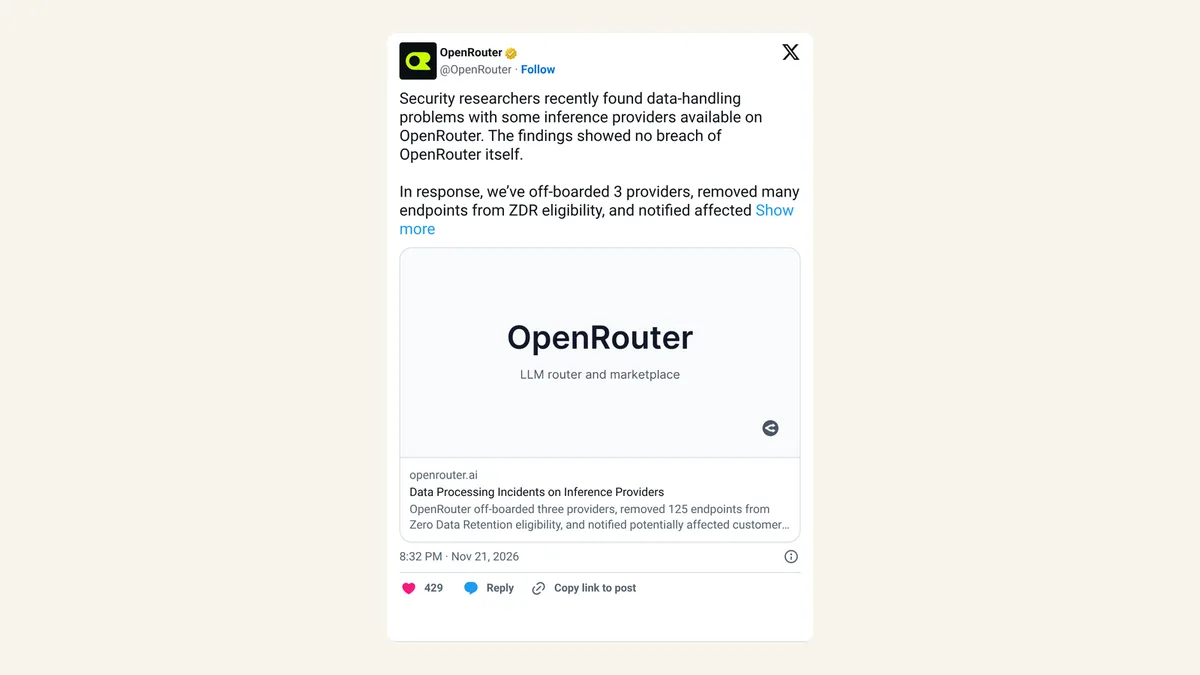
Security researchers recently found data-handling problems with some inference providers available on OpenRouter. The findings showed no breach of OpenRouter itself.
— OpenRouter (@OpenRouter) November 21, 2026
In response, we've off-boarded 3 providers, removed many endpoints from ZDR eligibility, and notified affected customers.
We're now building the researchers' testing into ongoing checks. Full update and provider write-ups on our blog: https://t.co/AjtVbHKsim
the OpenRouter situation for anyone curious:
— Michael (@michael_chomsky) November 21, 2026
-someone managed to access outputs sent to MiniMax
-researcher discovered this by sending a secret links
-40 to 130 hours later someone opened the secret links
-oop, this means that someone accessed your outputs!!
-AltasCloud/Novita/StreamLake were forwarding requests to MiniMax???? what the helly?
ugh.
Our take
A "Zero Data Retention" badge is a promise from a company you've probably never heard of, and this research shows some of those promises weren't kept. Moore's method was simple, and it's a little alarming that it took an outside researcher to run it. OpenRouter is right to make these checks permanent and to demand proof before restoring the label.
For everyday users, the lesson is boring but solid. Treat anything you paste into an AI tool as something a stranger might read, especially in cheap apps that don't say which model they use. Businesses that picked the lowest-price provider should weigh what a leak would cost them too.
— Artificially Nerdy
What to do now
- Keep secrets out of prompts. Passwords, API keys and customer details don't belong in any AI chat. Our guide to locking down AI API keys has more on keeping them safe.
- Check your inbox if you build apps on OpenRouter. It says it notified every potentially affected customer.
- Developers can pick providers on purpose. Moore advises against accepting default provider pools and suggests choosing the upstream provider yourself.
- Ask the AI apps you use which company actually runs the model. A clear answer is a good sign.
FAQ
What is a canary token?
A fake secret, like a password or web link, that exists in only one place. If someone uses it, its owner knows exactly where it leaked from.
Which provider is safest for private prompts?
Moore says running models on your own servers is safest but expensive. The next best option, he says, is going directly to a top-tier provider with one contract and one privacy policy, though that still doesn't guarantee nothing leaks.
Were real customer passwords stolen?
The planted keys were Moore's own, tied to empty AWS accounts. Real prompts went through the same systems, though, and Together AI confirmed real stored prompt samples were downloaded.
Will the removed endpoints get Zero Data Retention back?
Only after providers give "appropriate assurances and validation," according to OpenRouter.
Sources
- OpenRouter: Data Processing Incidents on Inference Providers — November 21-22, 2026. No breach of OpenRouter, 3 providers off-boarded, 125 endpoints removed from ZDR, customers notified, provider notice list.
- Dragos: AI Supply Chain Security: What Canary Tokens Found — HD Moore, November 19, 2026.
- Ars Technica: Researcher plants 2m canaries into the AI supply chain — Dan Goodin, November 20, 2026, updated November 21. Findings, Moore quotes, AtlasCloud/Novita/StreamLake from OpenRouter's customer email.
- Together AI: Security event: prompt leakage for requests in June and July of 2026 — November 21, 2026.
- OpenRouter Zero Data Retention docs
- OpenRouter on X — November 21, 2026, about 8:32pm ET.
- Michael (@michael_chomsky) on X — November 21, 2026, about 12:12am ET.