
TL;DR
Is the Riemann Hypothesis proof confirmed?
Lean math groups say the Claude-assisted proof of the Riemann Hypothesis is correct. Computer checkers went through all 17 million lines. It's the clearest case yet of AI-assisted work that people can fully check, but mathematicians still have to explain the ideas. Nothing to do yet.
Who certified the Riemann Hypothesis proof?
On Saturday, November 21, 2026, the Lean and Mathlib communities published a joint statement, endorsed by the Lean FRO and the Mathlib Initiative, the groups that look after the Lean software and its math library. Lean is a programming language that checks every step of a math argument by computer, and Mathlib is its large shared library of already-checked math.
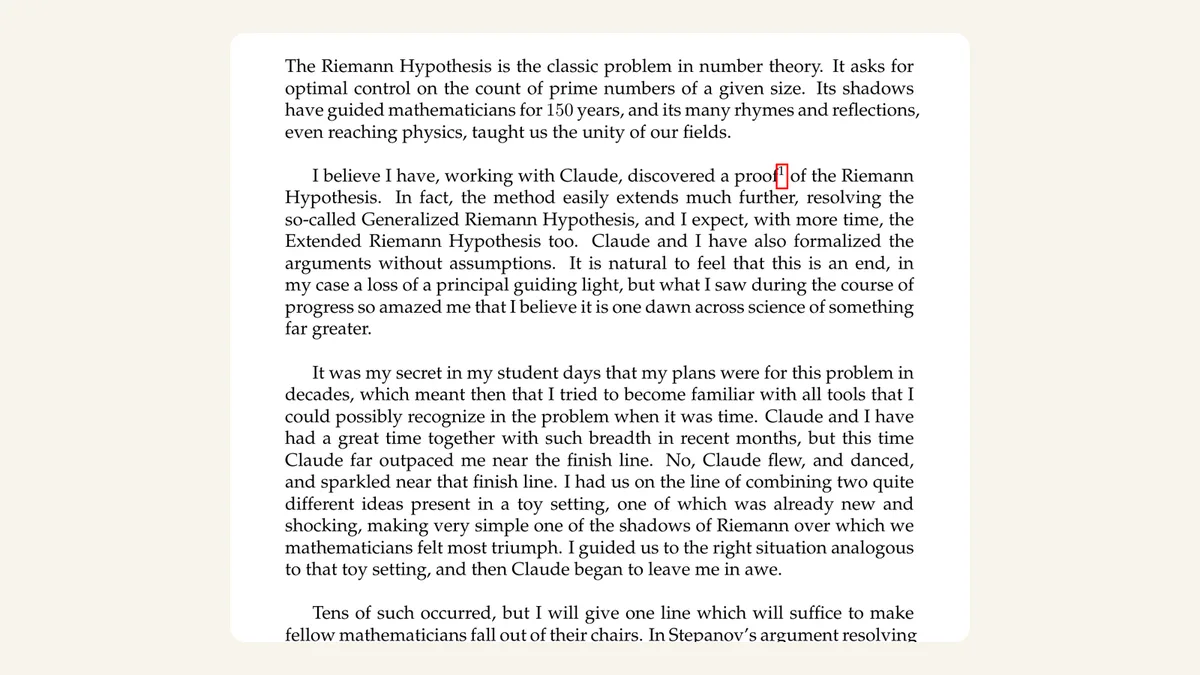
The statement is blunt: "We have full confidence that Alpöge's proof of the Riemann Hypothesis is correct." The groups say they "certify that both the statement and the proof of the Riemann Hypothesis are correct." That came one day after Alpöge, a mathematician at Anthropic, released the proof he says he built working with Claude. The original claim and the first checks were Friday's news. Saturday's statement is the formal sign-off.
What does "certified in Lean" actually check?
The Lean groups list four checks, and they say all four pass:
- The question is stated correctly. Mathlib already contains a definition of the Riemann Hypothesis that experts in Lean and number theory have vetted. A proof is only worth something if it proves the right thing.
- The code builds. Dozens of people compiled the library without errors and got the same raw proof file each time. MIT's verification page, run by mathematician Andrew Sutherland with help from Claude Code, reports all 175,187 modules compiling with zero errors.
- It proves exactly that question. The community wrote a separate file holding only Mathlib's version of the statement, then used two separate comparison tools to confirm Alpöge's theorem matches it exactly.
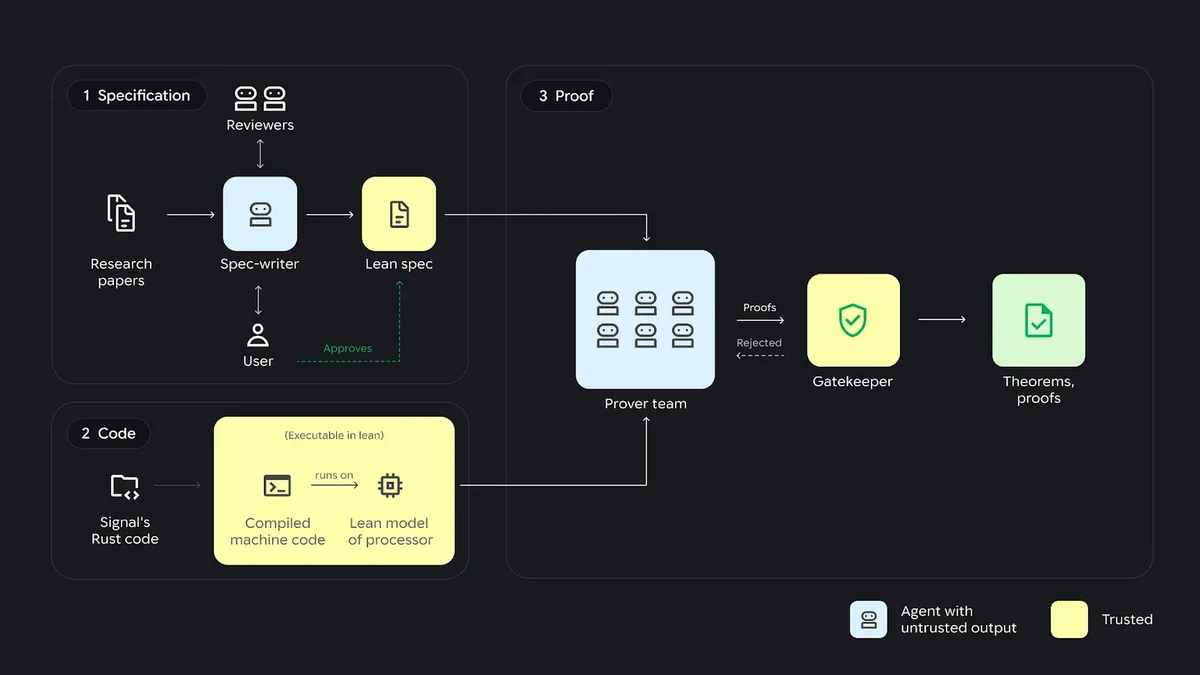
- The proof itself is valid. The exported proof, a frozen copy of the proof that can't run any hidden code, passed Lean's official kernel (the small core program that makes the final call) plus several other checkers written by outside contributors in different programming languages.
Two of those checkers, called con-leche and con-ron, come with their own formal proof that they can't accept a false proof. The statement says that addresses the worry that a flaw in Lean's own logic could be exploited. MIT's page adds that a sandboxed rebuild reproduced the 61.5-gigabyte export byte for byte, and that the proof uses only Lean's three standard axioms, the basic starting rules every Lean proof is allowed to assume.
What doesn't certification mean?
Certified in Lean means formally verified by computer. It does not mean peer reviewed, the process where other mathematicians read and judge a paper before a journal publishes it. Lean confirms that every step follows from the last. It doesn't tell anyone why the proof works, and the Lean statement itself says it looks forward to the math community's work to "help explain the new ideas in this proof."
A few loose ends remain. As of 11:35pm ET Saturday, MIT's page still listed two of its own runs as "running": a check of the export with Lean's kernel in its default and extra-careful "paranoid" modes, and a full end-to-end comparison run. The Lean statement already says Lean's official kernel checked the export, so those runs are extra confirmation. The Clay Mathematics Institute, which offers US$1 million for a proof, had not made any statement about the prize by Sunday morning.
X reactions
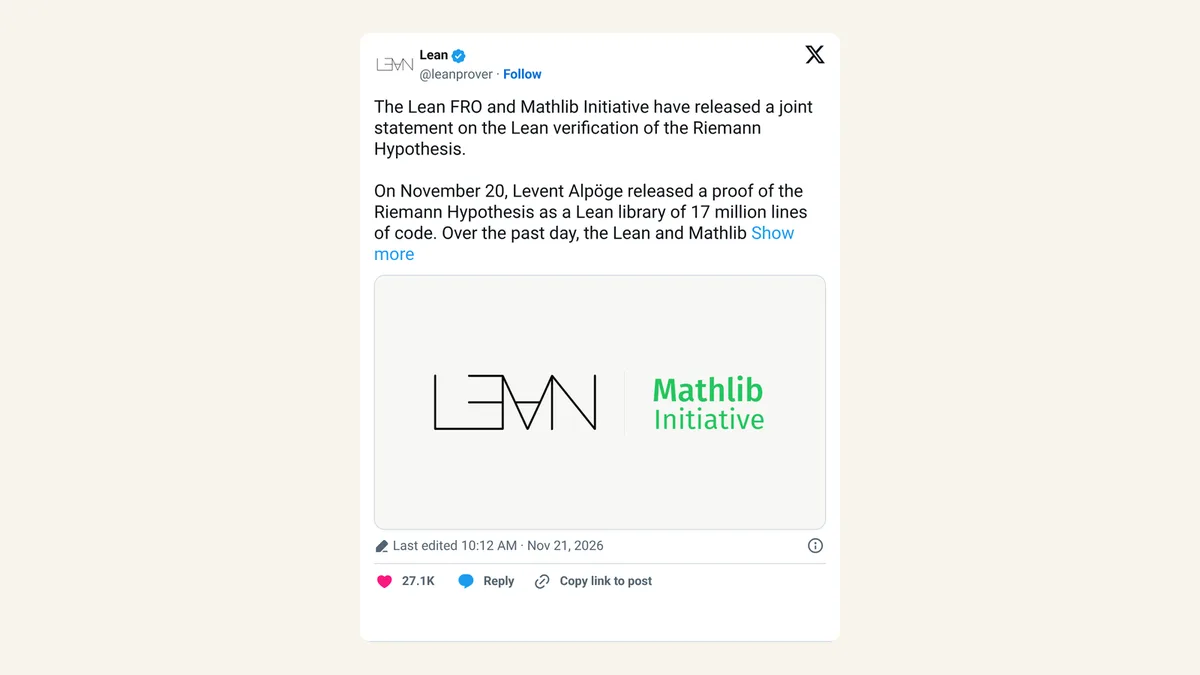
The Lean FRO and Mathlib Initiative have released a joint statement on the Lean verification of the Riemann Hypothesis.
— Lean (@leanprover) November 21, 2026
On November 20, Levent Alpöge released a proof of the Riemann Hypothesis as a Lean library of 17 million lines of code. Over the past day, the Lean and Mathlib communities worked together to verify it. The statement certifies the proof as correct and describes how it meets all necessary verification criteria.
Congratulations to Levent on this achievement, and thank you to everyone in the community who contributed to the verification.
Full statement: https://t.co/edxEbkodw7
The Lean and Mathlib communities have certified Levent Alpöge's Claude-assisted proof of the Riemann Hypothesis. In a joint statement endorsed by the Lean FRO and Mathlib Initiative (21 Nov 2026): "We have full confidence that Alpöge's proof of the Riemann Hypothesis is correct"
— syncoda (@syncoda) November 22, 2026
Our take
This is a stronger sign-off than most famous proofs ever get. A human referee can miss a step in a long paper. Here, several checkers built by different people, two of them proven unable to accept a false proof, all agree on the same 17 million lines. On the narrow question of whether the proof is correct, it's hard to ask for more.
The bigger lesson for everyone else using AI is about checking. This worked because math has a machine that can say yes or no to every step. Most AI output, from a summary to a contract draft, has nothing like that, so the burden stays on you. Ask AI for things you can verify, like linked sources, numbers you can recompute or code you can run, and treat anything you can't check as a draft.
— Artificially Nerdy
How to read the headlines this week
- Read the Lean statement yourself. It's short, written in fairly plain English, and linked in Sources below.
- Watch the wording. "Certified in Lean" and "formally verified" are accurate. "Peer reviewed" and "prize awarded" aren't, at least not yet.
- Look for the explainers. The next big step is mathematicians explaining the new ideas, and that's where the human story of this proof will come from.
- Borrow the habit for your own AI work. Before you trust an AI answer, ask how you would check it.
FAQ
How long did it take to verify the proof?
About a day. Alpöge released the proof on Friday, November 20, and the joint statement was posted Saturday, November 21.
How old is the Riemann Hypothesis?
Mathematician Bernhard Riemann posed it in 1859.
Could there be a hidden bug in the proof code?
The checks ran on an inert export of the proof, out of reach of any malicious code in the Lean files, and several separately written checkers all accepted it. That makes a hidden bug very unlikely, which is why the Lean groups say they have "full confidence."
Did Anthropic say anything about the certification?
Not as of early Sunday. The certification comes from the Lean and Mathlib communities, not from Anthropic.
Sources
- Lean community blog: Lean verification of the Riemann Hypothesis — joint statement by the Lean and Mathlib communities, endorsed by the Lean FRO and Mathlib Initiative, November 21, 2026. Quotes, four criteria, comparison tools, checkers, inert export.
- MIT verification page — Andrew Sutherland, updated 04:35 UTC November 22, 2026 (11:35pm ET November 21). Module count, byte-for-byte rebuild, export size, axioms, runs still "running."
- Levent Alpöge's note — the author's remark on the proof.
- Lean (@leanprover) on X — November 21, 2026, about 10:12am ET.
- syncoda on X — November 22, 2026, about 2:29am ET.