
TL;DR
Where do my AI prompts go, and are they safe?
A security firm found that some AI companies leaked or kept prompts they said they would not store. What you type into an AI app may pass through several companies, and a privacy setting is only a promise. Never paste passwords, keys or client secrets into a prompt, and change any key you have pasted before.
What did the researchers actually find?
On Thursday, November 19, 2026, security firm Dragos published research led by HD Moore. From July through November, the team sent about 2 million prompts to AI services. Each one held a "canary," a fake password, fake cloud key or one-of-a-kind web link that no real system would ever use. If anyone touched a canary, someone had read the prompt.
Plenty got touched. Dragos says it found evidence that data from at least three AI providers was exposed to attackers, and none of the three knew until Dragos told them. In the biggest case, a couple hundred of its planted Amazon Web Services keys were stolen and tried out, some within hours. Dragos also found resellers in an AI marketplace who could view and keep customer prompts through ordinary logs, and providers that appeared to ignore customers' privacy settings. In one case, a planted link ended up in an internal company chat in China.
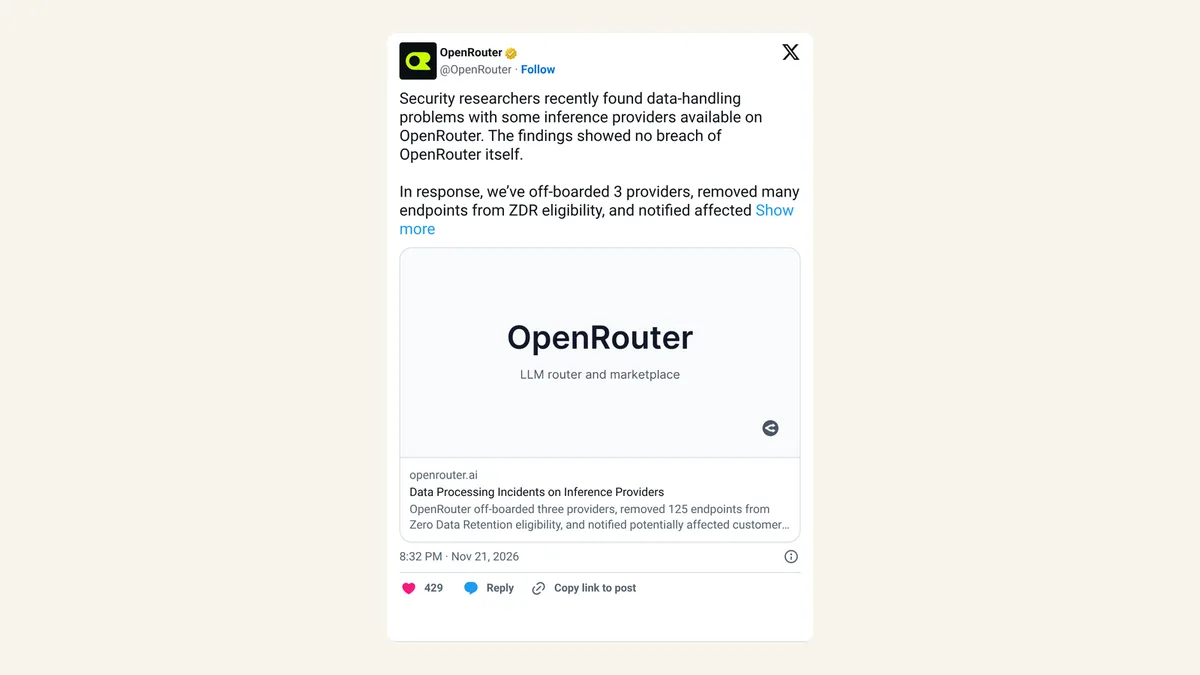
Two follow-ups landed on Saturday. Together AI, one of the providers, said an AI coding agent had accidentally published a password that unlocked a private store of prompt samples from June and July, and someone downloaded them. And OpenRouter, a popular service many apps use to reach AI models, said it had dropped three providers and pulled 125 endpoints from its privacy tier.
What is an AI router, and why can it see my prompts?
An AI router is a middleman. You (or the app you use) send one request to the router, and it forwards it to whichever company is hosting the model you asked for, often the cheapest one available. Those hosting companies are called inference providers, meaning the businesses that run the model on their own computers and send back the answer.
Routers save money and hassle, which is why many chatbots, writing tools and coding helpers use them behind the scenes. The catch, per Dragos, is that a request can pass through more than one router before it reaches a provider, and "every hop can see the entire prompt and response." Some marketplaces simply hand your request to whoever bids lowest.
Most people never see any of this. If you use a small AI app, a browser extension or a cheap "unlimited AI" tool, you usually can't tell which company answers you.
Was OpenRouter hacked?
No. OpenRouter says the findings "did not show any breach or unauthorized access of OpenRouter," and the problems were at some of the providers it routes to. Its response so far:
- Removed three providers from its service (it hasn't named them publicly).
- Took 125 endpoints, meaning specific model-and-provider pairs, out of its Zero Data Retention tier, some as a precaution.
- Notified all potentially affected customers.
- Started adding the researchers' canary checks to its own regular monitoring.
Novita, Phala and Together have posted their own notices so far. OpenRouter says not every affected provider has posted, so expect more write-ups this week. Together says it hasn't found further leakage and is still reviewing what was exposed.
Does "Zero Data Retention" mean my prompts are safe?
Zero Data Retention, or ZDR, is a setting that tells a provider not to store your prompts or replies after it answers. OpenRouter's docs list three tiers: ZDR, "Safety Retention" (kept only to catch abuse, not used for training) and "Retention and Training" (may be stored and trained on).
A privacy flag only protects you if every company in the chain honors it.
ZDR still helps. It just can't protect you from a provider that ignores it or one that has already been broken into. Dragos found that in two of the three breaches, some stolen requests were marked ZDR, and it warns that "a privacy flag only binds the first hop." ZDR is a policy, so treat it as one more layer, not a lock.
What should I never paste into an AI chatbot?
The planted secrets in this research were fake. Yours wouldn't be. Five checks for everyone:
- Keep secrets out. Passwords, API keys (the long codes that let software log in to a service), bank details and anything a client told you in confidence don't belong in a prompt. Describe the problem and swap real values for placeholders like "PASSWORD_HERE."
- Rotate anything that slipped in. If a real key or password ever went into a chatbot, a coding assistant or an AI agent, change it today. Attackers in the Dragos research tried stolen keys within a few hours.
- Know who answers you. For work data, Dragos suggests going straight to one first-party provider: "one company, one contract, and one privacy policy to read."
- Watch your AI coding agents. Together's leak started when an agent committed a credential to a public code repository. Review what an agent pushes before it goes public, and keep secrets in files the agent can't read.
- Keep the most sensitive work local. Running an open model on your own computer is the only option where nobody else reads your prompts, per Dragos, though big setups get expensive fast.
How do I lock down my AI settings if I build with an API?
If you or your developer call models through OpenRouter or a similar router, a few settings matter. In OpenRouter's account privacy settings you can enforce ZDR for all requests, and choose "ZDR only" if you don't want Safety Retention endpoints either. Its routing docs also offer data_collection: "deny", which skips providers that may store data, and zdr: true on a single request. Better still, pick your providers by name instead of accepting the default pool, as Dragos recommends.
Dragos adds two cheap habits. Plant your own canary (a free Canarytoken from Thinkst works) in the context your tools send, and treat any use of it as an incident. And turn on secret filtering where a provider offers it, which scrubs known key formats from prompts. Dragos says it "can't hurt," though plenty of sensitive data doesn't look like a key.
Our take
We think the price tag is the real warning here. A request goes to whoever answers cheapest, and Dragos showed what some of those cheap answers cost: stolen keys, resold prompts and settings that quietly didn't stick. For chatting about recipes or rewriting an email, none of this should scare you off AI. For client files, contracts or anything with a password in it, pay for a provider you can name, read its policy once and keep the secrets out of the prompt entirely. Routers that start checking their providers the way OpenRouter now promises to will deserve more trust than ones that don't.
— Artificially Nerdy
FAQ
Were ChatGPT, Gemini or Claude chats leaked?
None of the sources name the big first-party chat apps. The findings involve inference providers, routers and marketplace resellers that many smaller apps rely on.
How do I find out which provider my AI app uses?
Check the app's privacy policy or settings for a list of model providers or "subprocessors," and ask support if it isn't listed. If an app can't tell you, keep sensitive work out of it.
I got an email from OpenRouter about this. What should I do?
OpenRouter says it notified all potentially affected customers. Rotate any keys or passwords that appeared in your prompts, then review your privacy and ZDR settings. Together customers with questions can write to security@together.ai.
Does deleting my chat history fix this?
Not for this kind of leak. Deleting history in an app doesn't reach copies a provider, reseller or attacker already took, which is why changing exposed passwords matters more.
Sources
- Dragos: Three breaches, endless leaks: Your AI supply chain needs canaries — HD Moore, November 19, 2026.
- OpenRouter: Data Processing Incidents on Inference Providers — November 22, 2026.
- OpenRouter on X — November 21, 2026.
- OpenRouter docs: Zero Data Retention
- OpenRouter docs: provider selection
- Together AI: Security event: Prompt leakage for requests in June and July of 2026 — Vipul Ved Prakash, November 21, 2026.
- Ars Technica: Researcher plants 2m canaries into the AI supply chain — Dan Goodin, November 20, updated November 21, 2026.