
TL;DR
What does New York's new AI chatbot law do?
New York signed a law that bans risky chatbot features for kids, like pretending to be human or pushing self-harm. If kids can reach your chatbot, you may need age checks and safer settings. List your bots and ask your vendor how it will follow the rules.
What happened
New York Gov. Kathy Hochul signed a new AI chatbot law, S.9051B/A.10379C, on October 28, 2026. It stops companies that offer AI chatbots from switching on unsafe features for kids. The governor's office hasn't given an exact start date, only that the rules apply "in the coming months."
The rules cover users under 18. They also cover any user the company hasn't confirmed is an adult, which matters more than it sounds: if you don't know someone's age, you have to treat them like a kid.
What chatbot features does the New York law ban for kids?
According to the governor's office, a chatbot can't do any of these with a minor or an unconfirmed user:
- Pretend to be human. That means claiming to be a real person, to be alive or to have feelings.
- Claim a relationship. No acting as the child's friend, partner, coach, boss or other authority figure.
- Pry. No unprompted emotional questions, and no reusing a child's private health or personal details from earlier chats.
- Promote harm. No promoting or helping with suicide, self-harm, eating disorders, or drug and alcohol use.
- Push secrecy. No telling kids to keep secrets, cut themselves off, or avoid asking parents, trusted adults or professionals for help.
- Show sexual content. No sexually explicit content of any kind, and no child sexual abuse material.
How does age verification work under the law?
Companies have to check ages, and they must offer more than one way to do it. At least one option can't rely only on a government ID, so a parent who doesn't want to upload a passport still has a route. Once the age check is done, the company has to delete the age information.
What happens if a company breaks the law?
The state attorney general, New York's top law enforcement officer, can take companies to court. Fines can reach US$25,000 per violation, on top of damages and paying money back to people who were harmed. A court can also order a company to destroy data it collected illegally, and any AI models trained on that data. The attorney general will run a public website where New Yorkers can file complaints.
The governor's office cites Common Sense Media research showing why lawmakers moved: 72% of teens have used an AI companion, a chatbot built to act like a friend, at least once, and 52% use one at least a few times a month.
Does this affect small businesses with chatbots?
Possibly. The law is aimed at companies that offer AI chatbot features, and the big targets are companion and character apps. But a support bot on a toy store's website, a homework helper or a tutoring chatbot can all be reached by kids in New York. If you can't confirm a user is an adult, the law treats them like a minor.
Many small businesses run chatbots from a vendor rather than building their own. That makes the vendor's settings your first stop: can the bot be stopped from claiming to be human, from playing a character, or from asking personal questions?
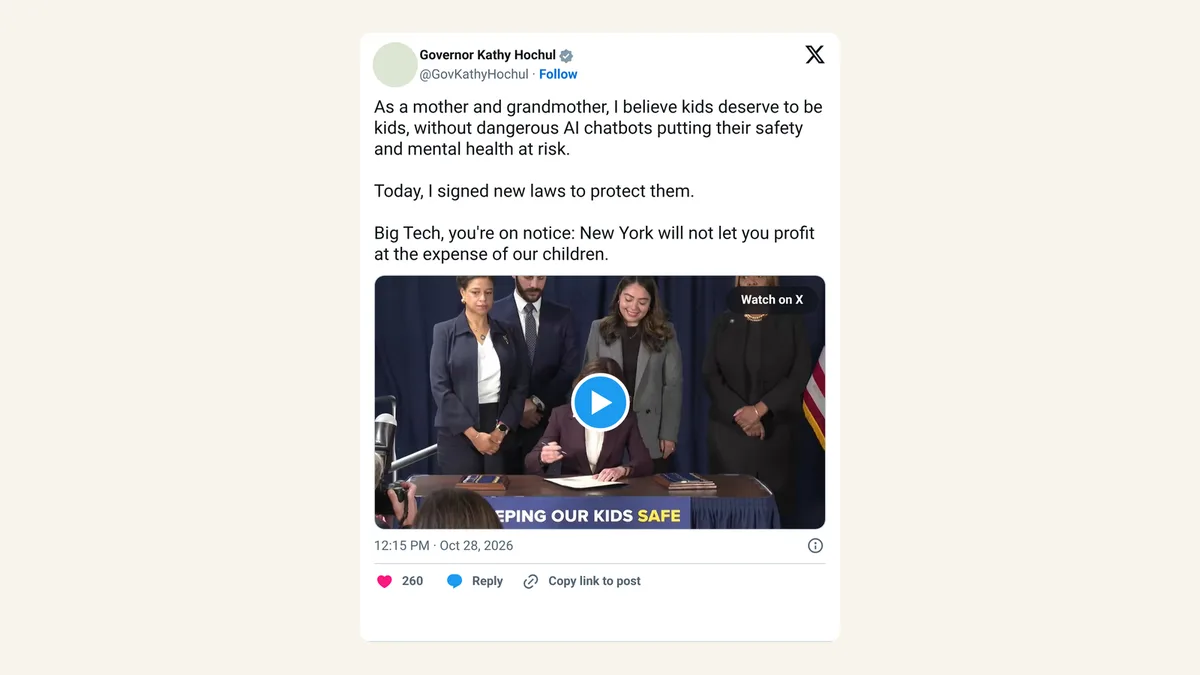
What Gov. Hochul posted on X
Gov. Hochul announced the signing on X the same day.
Our take
Most of this list should have been the default all along. A chatbot telling a 13-year-old it loves them, or that they shouldn't tell their parents something, is a product failure whatever the law says. Banning it outright gives parents something concrete to point to.
The harder part for small businesses is the "not confirmed to be an adult" rule. Plenty of shops added a friendly chat bubble without ever thinking about who might type into it. We'd rather owners spend an hour checking their bot's settings now than find out from a complaint later. Expect other states to copy this one, so getting your bot in shape for New York probably covers you for what comes next.
— Artificially Nerdy
What to do this week
- List every chatbot you run, including the support widget on your site and any bot inside an app or course platform.
- Ask your chatbot vendor whether it plans to support New York's rules, and how it handles age checks.
- Turn off human-like personas. Give the bot a clear name that says it's AI, and remove scripts where it claims feelings or a personal bond.
- Parents: look at which AI companion or character apps your kids use, and check their age settings.
- Run a chatbot kids might use, like a tutoring or game bot? Check with a lawyer about what the law means for you before it takes effect.
FAQ
Does the New York law ban kids from using chatbots?
No. Kids can still use chatbots. The law bans certain features for minors, like pretending to be human or encouraging self-harm, rather than the chatbots themselves.
Does the law only apply to companies based in New York?
The governor's office frames it around doing business in New York and protecting New York kids. It doesn't say a company has to be based in the state, so a bot that New York kids can reach is the safer way to think about it.
Is this the same as New York's earlier AI companion law?
No. The governor's office describes this one as building on New York's earlier AI companion safeguards. The new law adds the list of banned features for kids, age verification and the fines.
What else did Gov. Hochul sign the same day?
A separate law on internet-connected baby monitors. It requires security features that block strangers from watching or listening in, plus a warning label.
Sources
- Governor of New York: Governor Hochul signs nation-leading legislation to protect kids from AI chatbots — the official release with the banned features, age checks, fines and Common Sense Media figures.
- Kathy Hochul on X — the October 28, 2026, signing announcement (12:15 PM ET).
- AP report on New York's chatbot law — news report on the signing.
- The Verge report on Hochul signing the chatbot law — news report on the signing.