
TL;DR
Will AI models take work from real models and photographers?
Glif launched an "AI modeling agency" that turns one product photo into ads starring AI people. Cheap product shoots and quick social clips will feel it first, while bigger shoots and portraits look safer for now. If you model or shoot, build up the work AI can't fake. If you buy ads, label AI people honestly.
Will AI models replace real models?
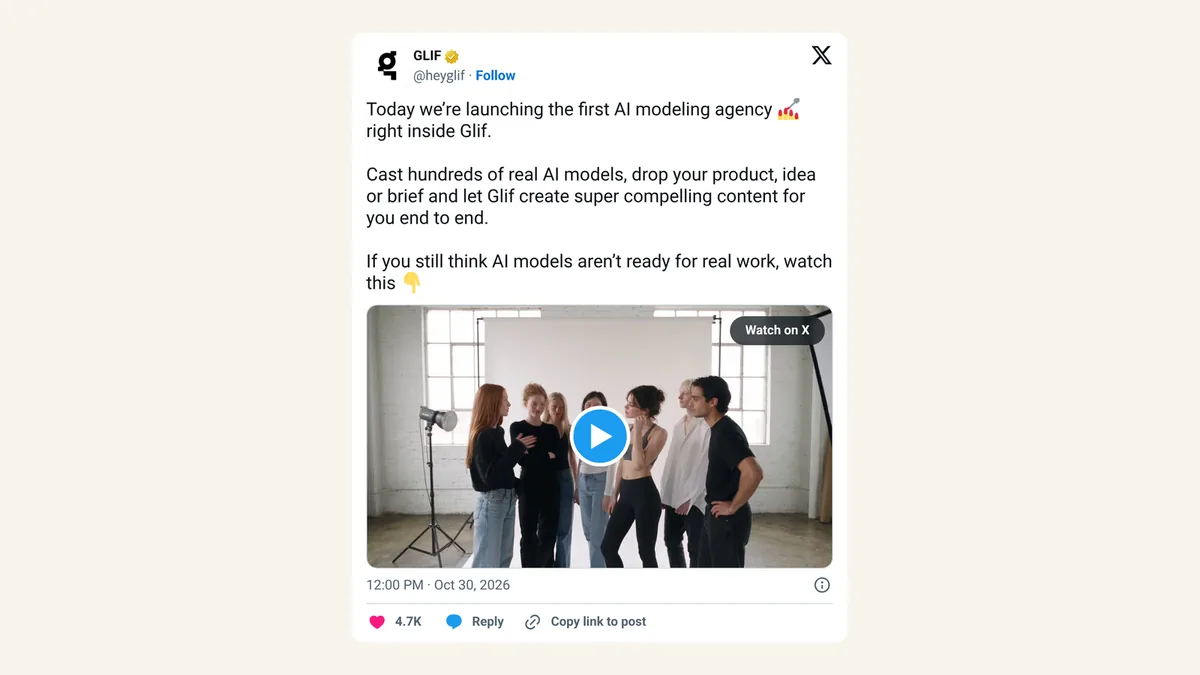
Not all of them, and not overnight. But a slice of the work is already moving. On October 30, 2026, Glif, an AI creative app, launched what it calls "the first AI modeling agency". You pick a character from a cast of 165 AI people, add one product photo and a short brief, and Glif makes the ad for you, from unboxing clips to 30-second app ads with captions.
Glif's launch post on X had about 2.6 million views by this morning, so plenty of business owners saw it. Many of them have probably paid a local photographer and a model for exactly this kind of job.
That's the part that deserves care. The people on the other side of these shoots are freelancers paying rent, and most of them didn't ask for a new competitor that works for free and never gets tired.
Which modeling and photography jobs are most at risk from AI?
Look at what Glif shows off on its own Characters page: "Freja unboxes my sneakers on camera," "Carys sells my study app in 30 seconds." Those are small, fast, low-budget jobs. Think product photos for an online shop, UGC clips (user-generated content, the casual "I tried this" videos you see on TikTok and Instagram), and simple social ads.
That work has long been where newer models and photographers start. It pays the bills between bigger bookings and builds a portfolio. So the pressure lands first on the people with the least savings to fall back on.
The bigger jobs look safer for now. A fashion house paying for a campaign wants a real, known face, and a wedding couple wants their own day on camera. AI can't attend a wedding, and a brand built on one famous person still needs that person.
The first jobs AI takes are often the ones that helped people get started.
What does government data say about jobs for models and photographers?
The US Bureau of Labor Statistics (BLS), the government's main jobs data agency, already names AI in its outlook for both jobs. The numbers point to a slow decline rather than a collapse.
For models, BLS counts about 4,200 jobs in 2025, with median pay of US$48,470 a year. It projects a 2% decline from 2025 to 2035 and says AI "that allows companies to reuse images of products and models, may also limit demand." The count is small, and its biggest employer is education (think art class models), at 30%, with self-employed models at 8%. We suspect a lot of the casual ad and social work these tools target barely shows up in that number.
For photographers, BLS counts about 145,000 jobs, and 67% of them are self-employed. Median pay is US$44,660 a year, with a 1% decline projected. BLS says stock photos "are projected to be partially replaced by artificial intelligence (AI)-generated images." It also expects portrait demand to stay, and says companies "will continue to require commercial photographers' services."
Both jobs still have openings every year, about 700 for models and 10,700 for photographers, mostly as people retire or switch careers. So there is still work, just a bit less of it.
Is AI in ads affecting photographers already?
People in the trade are talking about it. A Reddit thread on r/WorkReform is titled "We've reached the point where even ads don't hire people," and photo assistants on r/Photoassistants have a thread asking "What are the biggest industry changes that you see going on right now?"
We don't have hard numbers on how many shoots have been lost to tools like Glif, and we haven't seen anyone publish them yet. The BLS outlook was written before this launch. What we do know is that the tools keep getting easier, and the cheap end of the market is the one most likely to try them first.
How can models and photographers compete with AI?
We think the people who do best will lean into what a generated face can't offer. A few practical moves:
- Sell the real thing. Real customers, real staff, real places. A local gym or salon showing its actual members and team has something AI can't make up.
- Offer the hybrid job. Many small shops will want AI ads and a few real photos. A photographer who can do both, and knows the platform rules, is easier to hire than either option alone.
- Put rights in your contracts. Spell out whether a client can reuse your photos or a model's likeness to train or feed AI tools. BLS already flags image reuse as a pressure point for models.
- Chase the work that needs a person in the room. Events, portraits, headshots, live demos and trade shows all still need someone to show up.
Should small businesses use AI models in their ads?
For trying out ideas, we can see the appeal. Trying three ad concepts before paying for one real shoot is a sensible way to spend a small budget. Glif doesn't list a price for this feature yet, so check before you build a plan around it.
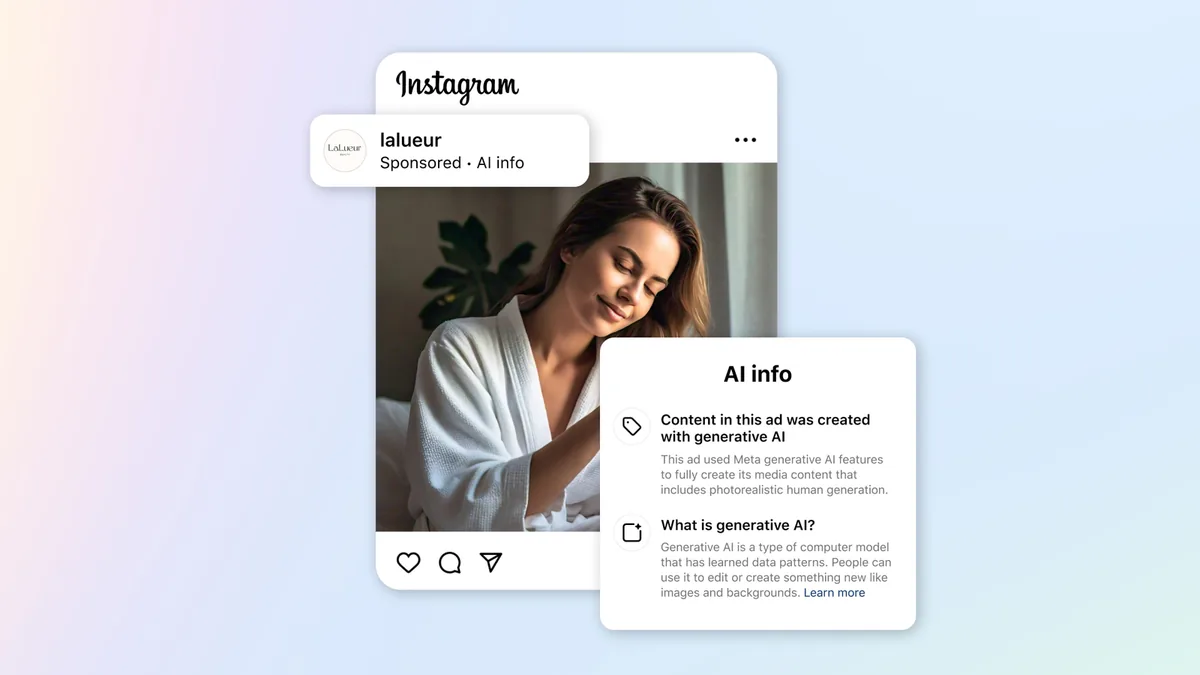
Where we draw the line is pretending. An AI person should never pose as a real customer giving a review. Meta labels ads made with its own AI tools that show a realistic AI human, YouTube asks creators to disclose realistic synthetic people, and the FTC's rule on fake reviews bans testimonials that misrepresent who the reviewer is.
When the idea works, we'd book the real shoot. Your customers can tell a brand that shows real people, and the local photographer you hire is often a customer too.
FAQ
Do AI models get paid?
No. Glif's characters are AI-made people, not real models, so there's no booking fee or model release in the usual sense. Glif hasn't published a price for its modeling agency feature yet.
Can an AI ad use a real model's face?
Glif's cast is made of original AI characters. Using a real person's face or likeness without permission raises consent and legal questions, so models should check what their contracts allow clients to do with their photos.
Is stock photography more at risk than other photo work?
BLS thinks so. Its outlook says stock photos are projected to be partly replaced by AI-generated images, while portrait work and commercial ad shoots are expected to keep demand.
How much do models and photographers earn in the US?
BLS puts the 2025 median at US$48,470 a year for models and US$44,660 for photographers. Pay varies a lot, and many people in both jobs work part time.
Sources
- Glif: Characters: the cast of 165 AI characters and example ads, checked November 1, 2026.
- Glif changelog: Glif Characters, September 28, 2026: the first version of the cast.
- GLIF on X, October 30, 2026, 12:00pm ET: the launch post (about 2.61 million views by Nov 1 morning).
- US Bureau of Labor Statistics, Occupational Outlook Handbook: Models: jobs, pay, 2025–35 outlook and the AI note.
- US Bureau of Labor Statistics, Occupational Outlook Handbook: Photographers: jobs, self-employment share, pay, outlook and the stock photo note.
- Meta: Expanding GenAI Transparency for Meta's Ads Products, YouTube Help: Disclosing use of GenAI content and the FTC rule on consumer reviews and testimonials, 16 CFR 465.2.
- Reddit threads on r/WorkReform and r/Photoassistants (titles only).