
TL;DR
What is Google's Genie 4?
Google DeepMind showed Genie 4, an AI that makes 3D worlds you can walk through, with sound and characters who talk. It hints that quick video drafts and game mockups will soon be much easier to make. There's nothing to do yet unless you want to join the waitlist.
What is Genie 4?
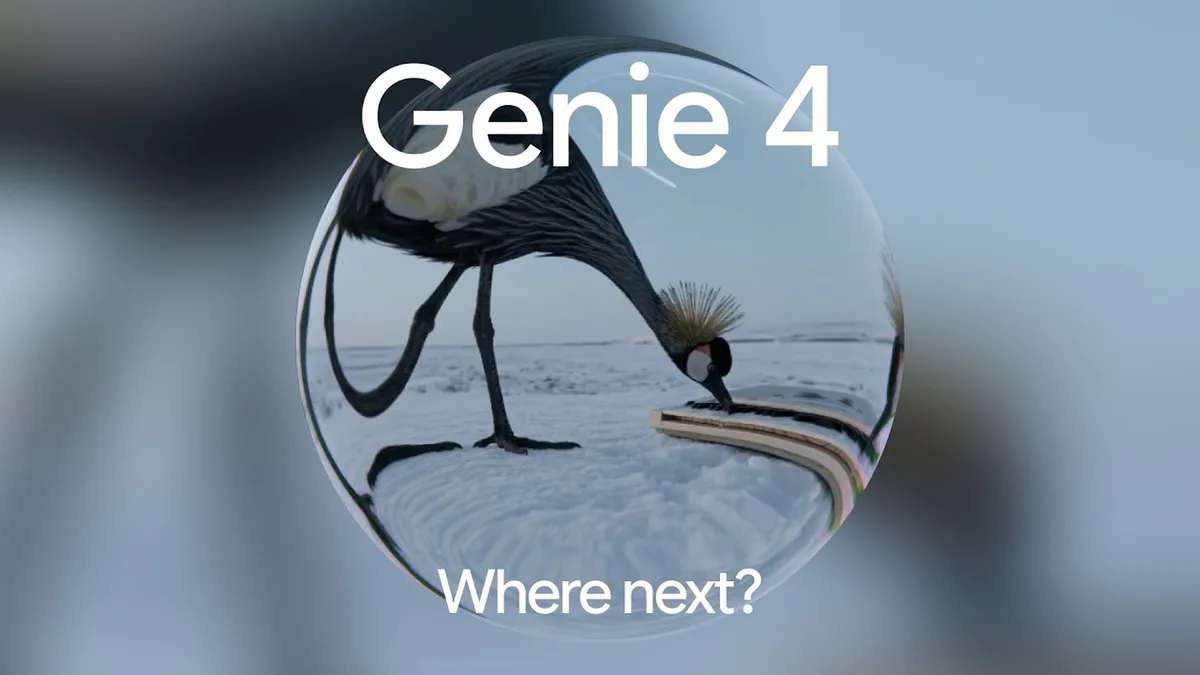
Genie 4 is a "world model," an AI that generates a scene and keeps simulating it as you move around, rather than rendering a fixed video clip. Google DeepMind announced it on Tuesday, October 27, 2026. You steer with normal keyboard controls for walking and the camera, and you can type a prompt mid-scene to change the weather, move the camera or add a new person or object.
The big new trick is sound. Google DeepMind calls Genie 4 its first real-time world model to make audio natively, meaning the sound is generated along with the picture. Each world gets its own background noise and music, and characters can talk and react to what you do. According to Google, it also handles physics, such as collisions and things moving through the air, and human movement more realistically than before.
Behind the scenes, Google's Gemini models do the planning. A Gemini model (Gemini 3.8 Flash, per Google) watches the frames as they're made, breaks a goal into steps and checks that each step worked, so a scene stays on track.
How is Genie 4 different from Genie 3?
According to TechCrunch, Genie 3 arrived as a research preview a little over a year ago, and Genie 4 can keep a scene consistent for up to two minutes, double Genie 3's limit. It adds native audio and talking characters, looks far more photorealistic, and lets you make free-form edits while the world is running.
When can I use Genie 4, and what will it cost?
Not yet, for most people. Right now Genie 4 is a research preview for "trusted testers," the small group of partners who get early access to Google's experimental tools. Google says it's coming next to:
- Google AI Ultra subscribers, through Project Genie, Google's tool for making interactive worlds from text or image prompts.
- Early-access partners on the Gemini API and Google AI Studio, the routes developers use to build with Google's models.
TechCrunch reports that rollout to those groups should happen "in the coming weeks," while Google's own post just says "coming soon." Google hasn't announced a price or a date for wider access. There's a waitlist on the Google DeepMind blog. All video and audio from Genie 4 carries SynthID, Google's invisible watermark for spotting AI-made content.
What could Genie 4 mean for creators and small businesses?
Google says the full product is still unclear. Its trusted testers are already trying uses that sound a lot like everyday creative work:
- Storyboards and "draft mode" for video. According to Google DeepMind, filmmakers are using it to step into a live scene and run several "takes," changing camera angles, lighting, dialogue and action as they go. Google engineer Diego Rivas told reporters the real-time part matters most "in the ideation phase, in the storyboarding phase."
- Game and experience prototypes. Game developers are exploring how fast they can go from an idea to something explorable, trying out looks and mechanics with plain-English prompts before writing any game code.
- Training robots and AI agents. This is Google's bigger goal: safe, endlessly varied practice worlds for machines before they meet the real one.
For a solo creator or a small brand, the near-term picture is pitching and planning. Picture walking a client through a rough version of an ad's setting, with sound, before anyone books a location. That's a guess at where this goes, and Google hasn't promised any of it as a product feature.
What can't Genie 4 do yet?
Google lists the gaps itself. Details and objects can shift or "drift" the longer a simulation runs, after lots of prompt edits, or as you move around the scene. Complex physical interactions, accurate audio, readable text inside the world, spatial accuracy and long-term consistency are all still being worked on. So anything with a logo, a price tag or a street sign is a bad fit for now, since the letters may come out as alphabet soup.
What people said on X
Google DeepMind's launch post passed about 2.4 million views by Wednesday morning. CEO Demis Hassabis followed up that evening with the waitlist news.
Our take
Genie 4 is the most impressive demo of the week and the least useful thing in your toolbox today. Both can be true. Most readers can't touch it, there's no price, and the likely first door is Google's top-tier AI Ultra plan.
The direction is what matters. Tools like this point to describing a scene, walking around inside it and hearing it before you spend a cent on a shoot. For small creative shops, that could make pitching and storyboarding much cheaper.
The limits are real, though. Two minutes of consistency and text that won't stay legible mean nothing here is ready for finished client work. Watch it, join the waitlist if you're curious, and keep making things with the tools you already have.
— Artificially Nerdy
What to do this week
- Join the waitlist only if you're curious. It's linked from the Google DeepMind blog post. Joining costs nothing and doesn't commit you to a plan.
- Don't upgrade to Google AI Ultra for this yet. Google hasn't said when Ultra subscribers get it or what it will cost to use.
- Video and ad makers: jot down one storyboard or pitch you'd love to "walk through" before filming. That's the job to test first when access opens.
- Everyone else: nothing to do. Check back when Google announces wider access.
FAQ
Is Genie 4 free?
Google hasn't announced pricing. The first consumer route is Project Genie for Google AI Ultra subscribers, which is Google's top paid AI plan.
Can I make a video game with Genie 4?
Not a finished one. Testers are using it to make quick, explorable prototypes of game ideas before writing code. Scenes stay consistent for up to about two minutes, per TechCrunch, so it's a sketching tool for now.
Can I use Genie 4 footage in client work or ads?
Google hasn't published commercial-use terms for Genie 4 yet. All its video and audio will carry a SynthID watermark, which helps identify AI-made content.
How is a world model different from an AI video generator like Veo?
A video generator makes a fixed clip from your prompt. A world model keeps generating the scene as you move and give new instructions, so it reacts to you in real time. Google offers both: Veo for clips, Genie for interactive worlds.
Sources
- Google DeepMind: Genie 4, a new generation of world simulation, the official announcement with features, tester use cases, limits, SynthID and the waitlist.
- Google blog: Introducing Genie 4, Google's companion post.
- TechCrunch: Google's Genie 4 world model adds audio, more realistic worlds, and real-time steering, coverage of the press briefing, including the two-minute consistency figure, the rollout timing and quotes from Diego Rivas.
- Google DeepMind on X, the October 27, 2026, launch post (12:10 PM ET).
- Demis Hassabis on X, his October 27, 2026, post on the trusted-tester rollout (7:59 PM ET).