
TL;DR
What is Gemini 4 Neon?
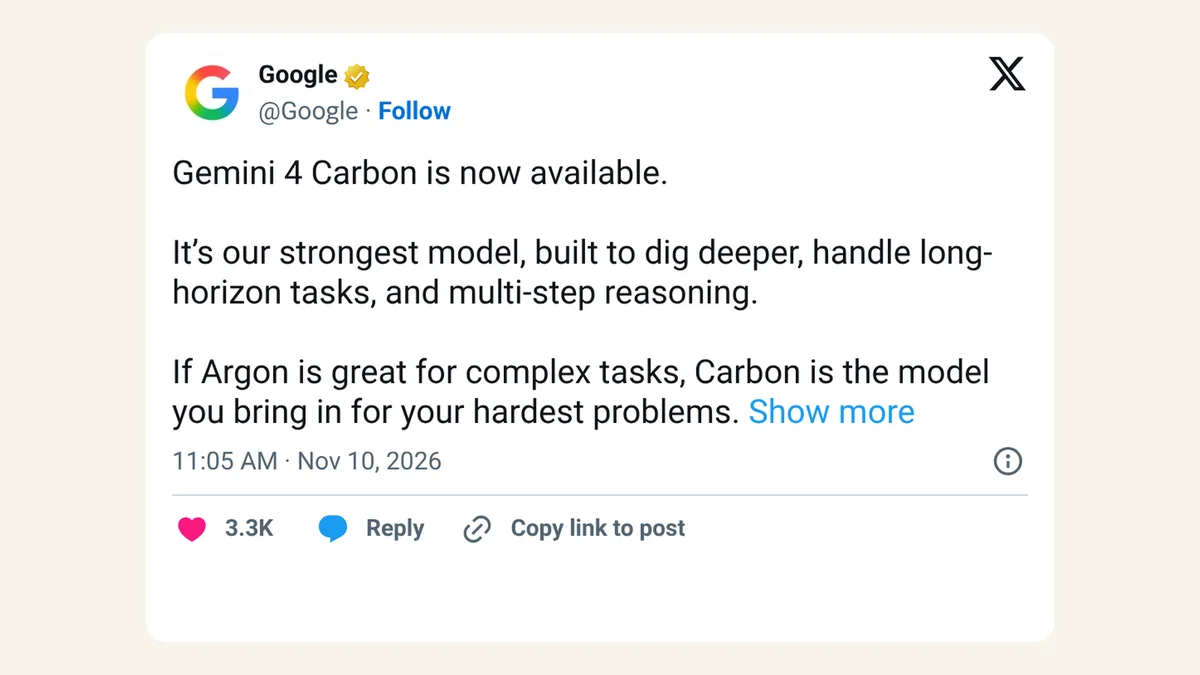
Google released Gemini 4 Neon on November 18, 2026. It sits between Gemini 4 Carbon, Google's model for the hardest work, and the fast everyday Hydrogen. It's rolling out now to Google AI Pro and Ultra subscribers in the Gemini app. If you pay for one of those plans, look for it in the model menu.
What did Google release?
On Wednesday, November 18, 2026, Google introduced Gemini 4 Neon. Google CEO Sundar Pichai posted about it on X at 4:33pm ET, and the model began rolling out the same day, so not everyone has it yet.
Google describes Neon as "frontier-level intelligence," meaning close to the most capable models, with fast end-to-end task completion for coding, office work and science. In the Gemini 4 family, Carbon handles your hardest, long-horizon projects and Hydrogen handles fast everyday jobs. Neon balances the two. It arrives a day after OpenAI released GPT-6.2 Astra and Sol.
What does Neon do better, according to Google?
- Writing and documents. Google says Neon writes clearly with a natural, direct tone, reads uploads like spreadsheets, PDFs and photos more precisely, and turns dense material into reports and summaries. It can pull in details from Google apps like Gmail and Docs.
- Research. It often brings in details from across the web to keep answers current, for jobs like comparing vendor prices before a big purchase.
- Tasks in Gemini. Tasks, where Gemini works through multi-step jobs for you, can now run on Neon. Google says that gets complex jobs done more quickly than larger models while "stretching usage limits further."
- Fewer made-up answers. Google says Neon recorded its lowest fabrication rate yet in internal Google Antigravity checks.
Who can use Gemini 4 Neon?
| Where | Who gets it |
|---|---|
| Gemini app (mobile, desktop and web) | Google AI Pro and Ultra subscribers, from the model drop-down |
| Gemini API in Google AI Studio and Android Studio | Developers on the paid tier |
| Google AI Studio | All Pro and Ultra subscribers can try it |
| Google Antigravity | Paid Google AI Pro and Ultra subscribers |
| Gemini for business | Via the API or the model drop-down |
| Neon for cyber | Vetted defenders in Google's Fairwind Program, over the next few days |
What does Neon cost in the API?
| Gemini 4 Neon | Price per million tokens |
|---|---|
| Input | US$3 |
| Cached input | US$0.15 (a 95% discount) |
| Output | US$15 |
Neon has a 1 million-token context window, the amount of text it can take in at once, and four thinking levels so teams can trade depth for cost. Tokens are the chunks of text AI models read and write.
How do the benchmarks look?
These are results Google chose to highlight, many from outside leaderboards:
- Artificial Analysis Intelligence Index: #3 overall with a score of 61 at its highest "xhigh" thinking level, just behind larger, slower models.
- Vals Index: #2, at 70.9%.
- Artificial Analysis Coding Agent Index: #1, at 58.6.
- Zapier AutomationBench and Andon Labs' Vending-Bench 2: #1 on both, at 56.3% and US$16,843 in a simulated business.
- Cost: at its default "high" level, Google says Neon costs 32% less per task than Carbon, and roughly 50% to 80% less per task than top competing frontier models.
The jargon, in one line each
| Term | What it means |
|---|---|
| Frontier-level | Close to the most capable AI models available |
| Thinking levels | Settings that let the model reason longer for harder jobs, at higher cost |
| Context window | How much text, files or data a model can work with at once |
| Cached input | Text the API has already processed and can reuse for less |
| Google Antigravity | Google's coding tool where AI agents build and edit software |
X reactions
Google's Gemini app account confirmed who gets Neon, and benchmark group Vals AI pointed to a change in how it researches.
Starting today, Gemini 4 Neon is available to Google AI Pro and Ultra subscribers on mobile, desktop, and web.
— Google Gemini (@GeminiApp) November 18, 2026
This new model excels at work that requires frontier-level reasoning and fast responses. 🧵
One of the most notable changes from Gemini 4 Hydrogen is how Gemini 4 Neon does research. On Legal Research, Hydrogen made about 220 tool calls and 88 case-law searches per question. Gemini 4 Neon made about a third fewer of each, yet wrote longer answers than either Hydrogen or Gemini 4 Carbon, averaging around 4,900 words.
— Vals AI (@ValsAI) November 18, 2026
Our take
If you pay for Google AI Pro or Ultra, Neon looks like the sensible middle pick: try it on the reports, spreadsheets and price comparisons you'd normally hand to Carbon, and keep Carbon for the truly hard jobs. Running Tasks on Neon could also make your plan's limits last longer, if Google's claims hold.
The rankings are Google's own selection, and two AI labs shipped new models two days running. Judge Neon on your own files before you change plans or tools.
— Artificially Nerdy
What to do this week
- On Google AI Pro or Ultra? Open the Gemini app and check the model drop-down. If Neon isn't there yet, it's still rolling out.
- Try it on one real document, like a spreadsheet you need summarized or a vendor price comparison.
- Use Tasks in Gemini? Run your next multi-step task on Neon and see if it finishes faster.
- Build on the Gemini API? Price your workload at US$3 in and US$15 out per million tokens, and reuse prompt text to get the cached rate.
FAQ
Is Gemini 4 Neon free?
Google hasn't said so. In the Gemini app, it's rolling out to Google AI Pro and Ultra subscribers, and in the API it's on the paid tier.
Is Gemini 4 Neon better than Gemini 4 Carbon?
No. Google positions Carbon for the hardest, long-horizon projects and Neon as the faster, cheaper middle option. Google says Neon costs 32% less per task than Carbon at its default setting.
How much does Gemini 4 Neon cost in the API?
US$3 per million input tokens, US$0.15 per million cached input tokens and US$15 per million output tokens, with a 1 million-token context window.
Why don't I see Neon in my Gemini app?
Google says it's rolling out starting November 18, 2026, so it may take time to reach every Pro and Ultra account.
Sources
- Google: Introducing Gemini 4 Neon — Koray Kavukcuoglu, November 18, 2026. Availability, API price, context window, thinking levels, benchmarks, cost per task, Gemini app features, Tasks on Neon, Fairwind Program.
- Google Gemini (@GeminiApp) on X — November 18, 2026, 4:37pm ET.
- Sundar Pichai (@sundarpichai) on X — November 18, 2026, 4:33pm ET.
- Google DeepMind (@GoogleDeepMind) on X — November 18, 2026, 4:34pm ET. Between Carbon and Hydrogen, rolling out now.
- Vals AI (@ValsAI) on X — November 18, 2026, 4:35pm ET.