
TL;DR
What is DeepSeek's Super Agent, and should my team use it?
DeepSeek released a free, open-source coding agent. You ask it for work in GitHub or team chat, and it often replies with a pull request. It's a research prototype, so it suits developers who like to try new tools. Most teams can wait, and curious ones can try it on a test repo.
What did DeepSeek release?
On Saturday, October 31, DeepSeek published dsh-superagent-prototype on GitHub under the MIT license, a permissive license that lets anyone use, change and share the code, including in commercial work. It came alongside DeepSeek's design write-up, Exploring Super-agent Design: Towards a More Autonomous Agent System, and kept trending through Monday.
The repo's first line sets expectations: "Research prototype for reference only, not an official DeepSeek product." DeepSeek says the public code isn't identical to its internal version, and some ideas from the write-up "are directions for future development and are not implemented in this prototype."
How does DeepSeek's Super Agent work?
The README calls it "a proactive coding agent for one GitHub repository." It watches GitHub and, optionally, the team chat app Feishu. When someone on its allowed list asks for work, it opens a work item, handles it in its own session and folder, and answers in the original conversation, for example with a pull request (a proposed code change a teammate reviews before it's merged). A web panel shows what needs a person's attention.
DeepSeek's guiding rule is to "take as little human attention as possible, and give as much value as possible." The agent acts only when asked or when a rule the team wrote allows it. Its authorization doc says messages and comments can't change who is allowed to give it work, a basic guard against someone slipping instructions into an issue.
What do you need to run it?
It runs as a bundle for DeepSeek Harness, DeepSeek's own agent runtime, so there's nothing to sign up for. The setup guide lists Node.js, pnpm, git, tmux, Python, the GitHub CLI and Harness itself, plus a model provider connected to Harness. Setup has many steps, and DeepSeek suggests asking your own coding agent to read SETUP.md and walk you through it one question at a time.
According to secondary coverage, Bloomberg framed the release as aimed at Anthropic's Claude Code.
X reactions
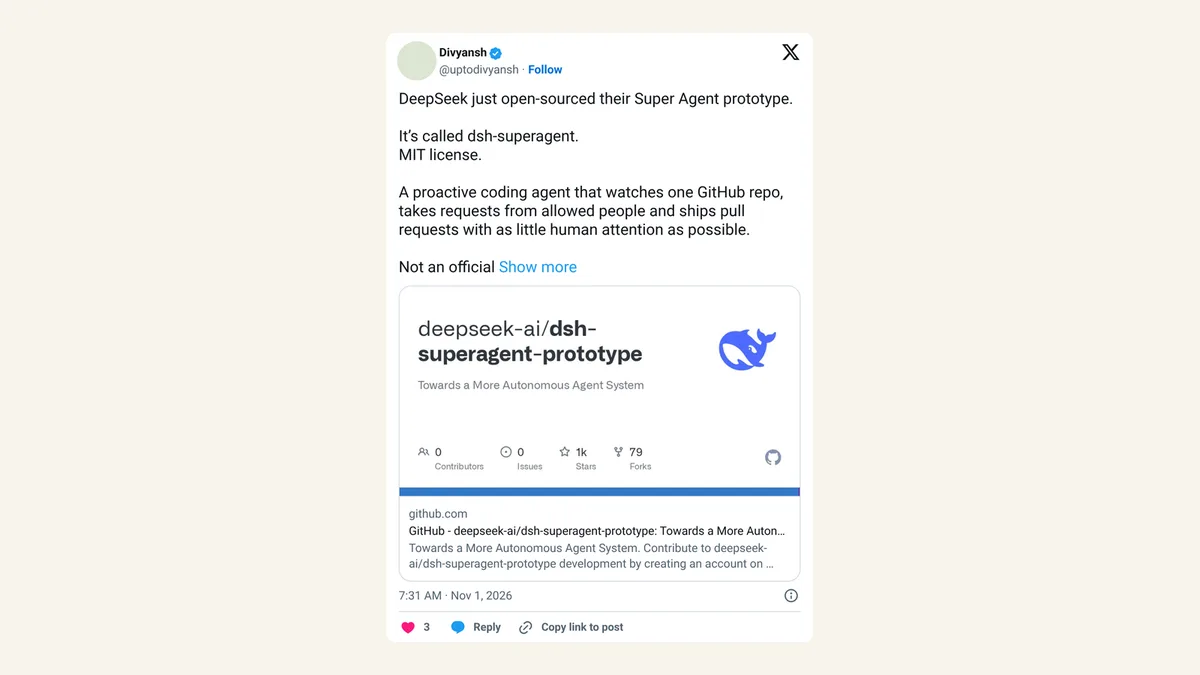
DeepSeek just open-sourced their Super Agent prototype.
— Divyansh (@uptodivyansh) November 1, 2026
It’s called dsh-superagent.
MIT license.
A proactive coding agent that watches one GitHub repo, takes requests from allowed people and ships pull requests with as little human attention as possible.
Not an official product yet, just a research prototype they put out yesterday.
Our take
We think the design notes are worth more than the code right now. DeepSeek has written down hard questions most always-on agent tools gloss over: who may hand the agent work, what happens to follow-up messages, and when it should stay quiet. Teams building their own setups can borrow those ideas today.
As a tool, it's early. DeepSeek itself warns of bugs and uneven code, and the Harness requirement keeps it inside DeepSeek's world. Small teams should treat it as a free look at where coding agents are going and keep their real repos out of it for now.
— Artificially Nerdy
What to do now
- Most small teams: wait. DeepSeek calls it research code that may still contain bugs.
- Read the docs first. The numbered files in the repo's docs folder, starting with philosophy and authorization, are useful even if you never install it.
- Try it on a throwaway repo, never one with production code or secrets.
- Keep the allowed list short so only people you trust can give the agent work.
- Review every pull request it opens the same way you'd review a new hire's. For more guardrails, read our 7 rules for keeping an AI agent on a short leash.
FAQ
Is dsh-superagent free for commercial use?
The MIT license allows commercial use, as long as you keep the copyright and license notice. You still pay for whatever AI model you connect to Harness.
Does it work with Slack or Microsoft Teams?
DeepSeek's README names only GitHub and Feishu as sources. The docs include a cookbook for adding a new source, so others are possible with your own work.
Can I use it without DeepSeek Harness?
Not as released. It's packaged as a Harness bundle, and the setup guide treats Harness as a requirement.
Sources
- DeepSeek: dsh-superagent-prototype on GitHub — README, SETUP.md, docs/002-authorization.md, docs/006-deployment.md, LICENSE (MIT). Latest commit October 31, 2026.
- X post: Divyansh (@uptodivyansh), November 1, 2026, 7:31am ET.