
TL;DR
Can AI do expert-level work yet, according to the GDPx benchmark?
SemiAnalysis released GDPx, a test of 206 long expert tasks. The best AI model finished only 12% of them. That means AI still can't do hard pro work alone, most of all in finance and law. Keep using AI for drafts and research, and let a person make the final call.
What is the GDPx benchmark?
GDPx is a new benchmark, a standard test used to compare AI models, from the research firm SemiAnalysis. It went public on Sunday, November 1, 2026, with a thread on X and a long write-up on the SemiAnalysis newsletter.
The test has 206 tasks across 11 fields that SemiAnalysis picked because they're among the most valuable kinds of work: chip design, cybersecurity, biology, finance, legal, quant trading, AI self-improvement, hardware design, materials science, alignment (keeping AI systems safe and on task) and software engineering. SemiAnalysis built them with 14 data partners, small companies that write realistic tasks for training and evaluating AI.
Every task is meant for an agent, meaning an AI that works through a job step by step on its own, opening files, running code and writing documents. Each task gets up to 8 hours, and some get less. The finance tasks, for example, sit inside a full replica of a private equity deal, with the spreadsheets and documents an analyst would have had at each stage.
Which AI model scored best on GDPx?
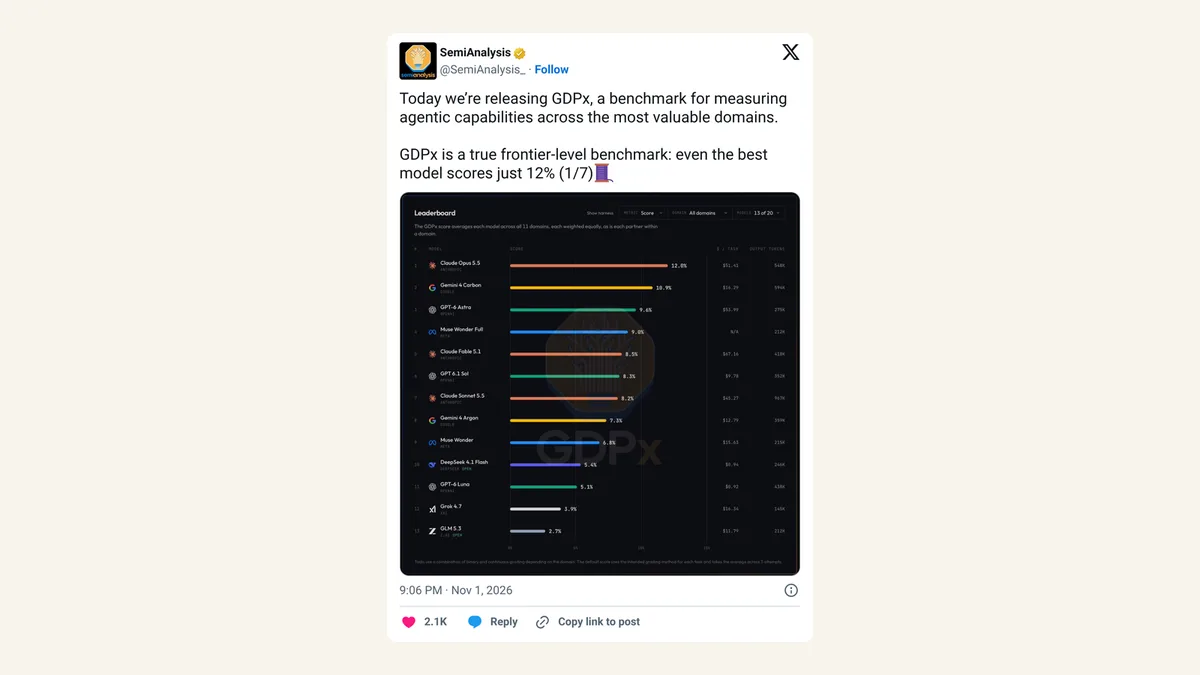
Anthropic's Claude Opus 5.5 came first, with Google's Gemini 4 Carbon close behind at about a third of the cost per task. Scores are pass@1, the share of tasks a model gets right on a single try, averaged over 3 tries, with all 11 fields counted equally.
| Model | GDPx score | Average cost per task |
|---|---|---|
| Claude Opus 5.5 | 12.0% | US$51.41 |
| Gemini 4 Carbon | 10.9% | US$16.29 |
| GPT-6 Astra | 9.6% | US$53.99 |
| Muse Wonder Full | 9.0% | not listed here |
| Claude Fable 5.1 | 8.5% | not listed here |
| GPT 6.1 Sol | 8.4% | not listed here |
| Claude Sonnet 5.5 | 8.2% | not listed here |
| GLM 5.3 (lowest of the 13) | 2.7% | not listed here |
The main board has 13 models. The full list, with per-field scores and costs, is on the official GDPx leaderboard.
Each model ran inside its maker's own agent app where one exists, such as Claude Code for Opus 5.5, Codex for GPT-6 Astra and Antigravity for Gemini 4 Carbon. SemiAnalysis says Opus 5.5 won quant trading, hardware design and chip design, Carbon was best at biology and edged out a win in software engineering, and GPT-6 Astra won AI self-improvement and materials science.
Why did every AI score zero on finance and legal tasks?
SemiAnalysis says its "finance and legal tasks are so challenging that basically every model scores exactly 0." Both fields use pass-or-fail grading, because in high-stakes work one wrong cell in a spreadsheet can sink the whole job. Under that strict grading, every model scored 0%, so the leaderboard also shows partial credit for those two fields.
The legal example SemiAnalysis published shows why. An agent had to mark up a draft company charter for the lead investor in a funding round, the way a law firm partner would assign it. In 20 runs across four models, none produced a usable markup. The average partial score was 18%, and the best single run, from Opus 5.5, reached 57%.
Can AI do expert work yet?
On this test, mostly not. Even the leader solved about one task in eight, and these are the long, messy jobs experts get paid for, with scattered files, competing goals and no hand-holding.
That fits how many people already use AI at work. It's quick at the pieces around a task, like finding documents, writing first drafts and checking that numbers add up. Pulling those pieces into a finished, correct result that a client would sign off on is where it still falls short.
What are the limits of the GDPx results?
A few things to keep in mind before you read too much into the ranking:
- It's SemiAnalysis's own test, run by SemiAnalysis. Nobody else has rerun it yet.
- Safety filters pulled some scores down. SemiAnalysis says Opus 5.5 and GPT-6 Astra have lower overall scores because their safety classifiers (filters that block risky requests) sometimes kick in on the cybersecurity, biology and alignment tasks.
- You can't use Gemini 4 Carbon yet. It isn't generally available, so its cheap cost per task is something to watch, not something you can buy today.
- It covers 11 fields. SemiAnalysis left out areas like government, real estate and insurance on purpose, so it says nothing about most everyday jobs.
X reactions
SemiAnalysis opened its launch thread with the headline number, and Google CEO Sundar Pichai quoted it a couple of hours later with a nod to Carbon's price.
Today we’re releasing GDPx, a benchmark for measuring agentic capabilities across the most valuable domains.
— SemiAnalysis (@SemiAnalysis_) November 1, 2026
GDPx is a true frontier-level benchmark: even the best model scores just 12% (1/7)🧵
Great to see high quality benchmarks with headroom and look at that cost line for Carbon🚀
— Sundar Pichai (@sundarpichai) November 1, 2026
Our take
We like this test a lot more than the usual leaderboard brag. Tasks with real files, real deadlines and real experts writing the grading rules are much closer to the question people actually ask, which is whether AI can do their job. A 12% top score is a healthy dose of humility for anyone selling "AI employees" this year.
We'd still hold the exact ranking loosely until someone else reruns it, and the safety-filter penalty means a more cautious model can rank lower than a looser one. The number we'd watch is Carbon's cost. Getting close to first place for about a third of the price is the kind of gap that changes which tool a small business picks once it ships.
— Artificially Nerdy
What to do now
- Keep AI on the prep work. Research, first drafts, summaries and number checks are where today's models help most.
- Put a qualified person on anything with money or legal weight. Contracts, investor documents and financial models still need a human to review and sign off.
- Check costs, not just rankings, if you pay for AI by usage. A slightly lower score at a third of the price can be the better deal; our chatbot comparison lays out the plans.
- Be wary of "replace your analyst" pitches. Ask any vendor to show results on long, realistic tasks like these, not short quiz questions.
- Wait on Gemini 4 Carbon until Google makes it generally available, then compare it on your own work before switching.
FAQ
Who wrote the GDPx tasks?
SemiAnalysis worked with specialist partners for each field, such as Living Context for finance and Chakra Labs for legal. The write-up itself is by Max Kan, Andrew Megalaa and Dylan Patel.
How is GDPx different from OpenAI's GDPval?
SemiAnalysis argues that GDPval tasks hand the model all the context in one neat prompt. GDPx instead drops an agent into a realistic set of files and asks it to work for up to 8 hours, closer to how the job happens at a real company.
Can I see the GDPx tasks myself?
Some of them. The SemiAnalysis write-up walks through sample tasks for each field, and the official leaderboard lets you explore the scores by model and field.
Does a 12% score mean AI is useless for my work?
No. GDPx tests whole, hard, multi-hour jobs from start to finish. Models can still save time on smaller parts of the work, as long as someone checks the result.
Sources
- SemiAnalysis: GDPx: Measuring Frontier Model Capabilities Across the Most Valuable Domains — November 2, 2026. Domains, partners, method, field winners, safety filter note, finance and legal results and the legal sample task.
- GDPx official leaderboard — scores and cost per task.
- SemiAnalysis on X: GDPx launch thread — November 1, 2026, 9:06pm ET.
- Sundar Pichai on X — November 1, 2026, 11:34pm ET.