
TL;DR
Will AI replace paralegals?
A new AI test called GDPx found the best models scored basically zero on finance and legal tasks. Even so, US data expects no growth in paralegal jobs through 2035. AI looks set to take routine work first, so openings may shrink. If you're a paralegal, get good at checking AI work and owning the hard calls.
Will AI replace paralegals?
Not wholesale, and not on the evidence we have today. But the job is changing, and the people doing it are right to be worried about what comes next.
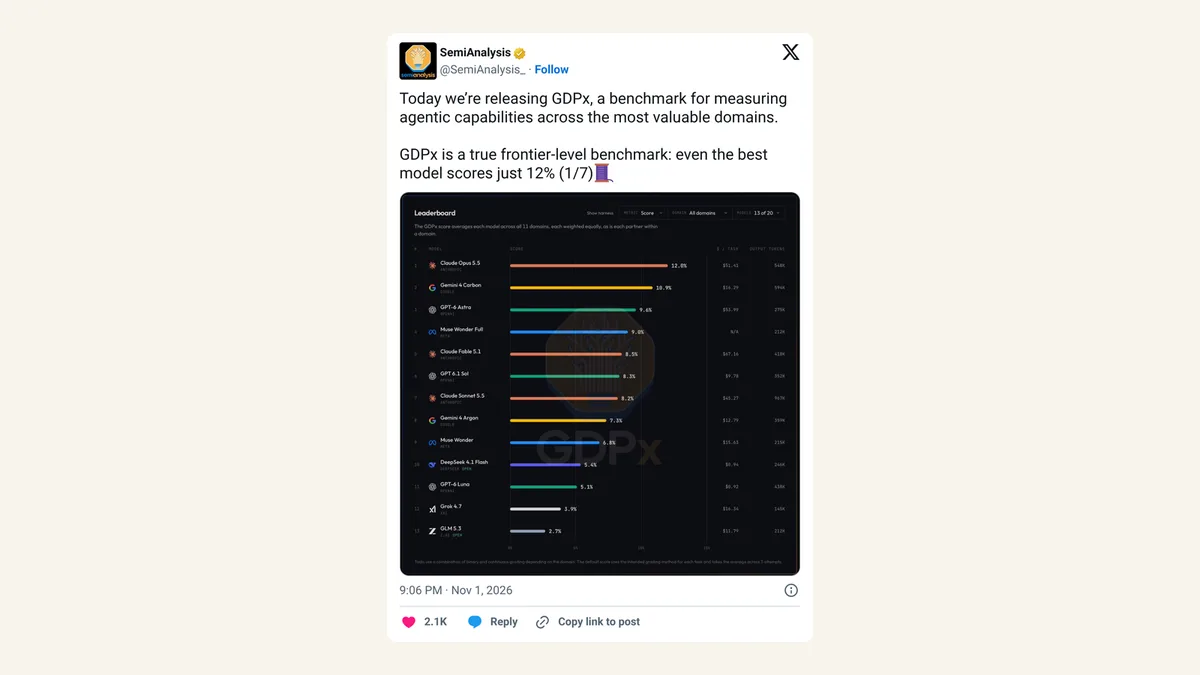
Two pieces of news landed close together. On Sunday, November 1, 2026, the research firm SemiAnalysis released GDPx, a benchmark (a standard test for comparing AI models) built from long, realistic expert tasks. On its hardest legal and finance work, the best models scored basically zero. Meanwhile, the US government's own job outlook already says AI will hold back hiring for paralegals and legal assistants, the people who do much of the research, drafting and document work behind lawyers.
Those two facts look like they point in opposite directions. They don't, once you look at which parts of the job each one is about.
How did AI do on legal tasks in the GDPx benchmark?
Badly, when the bar was "would a law firm partner accept this?" SemiAnalysis wrote that its "finance and legal tasks are so challenging that basically every model scores exactly 0." The legal tasks came from Chakra Labs, whose experts include senior partners at large US law firms, and they cover areas like M&A, venture capital, corporate governance and data privacy.
The one legal task SemiAnalysis published in detail asks an AI agent (an AI that works through a job on its own, opening files and writing documents) to redline a draft company charter for the lead investor in a funding round. A redline is the marked-up set of edits a lawyer sends back on a draft. In 20 runs across four models, none produced a usable redline. The average partial score was 18%, and the single best run, from Claude Opus 5.5, reached 57%.
The misses are telling. All 20 runs failed to protect the client against the company using a subsidiary to get around the charter's protections. In 14 of 20 runs, the AI took the client's email about what they wanted and applied it without flagging that those terms reopened points both sides had already agreed. Those are judgment problems: spotting what the other side could do, and noticing when following instructions would hurt the client.
What does government data say about paralegal jobs?
The US Bureau of Labor Statistics (BLS), the government's main jobs data agency, counts 404,900 paralegal and legal assistant jobs in 2025. It projects a 0% change from 2025 to 2035, a loss of 1,100 jobs, while jobs overall grow 3%. Median pay was US$62,890 a year in May 2025.
BLS is direct about why. It says demand "is expected to be limited by advances in technology, including artificial intelligence (AI)." There will still be about 40,800 openings a year, mostly from replacing people who retire or move on. So the field isn't disappearing. It's just not expected to grow, and new hiring will lean on filling seats people leave.
AI fails the judgment test and still squeezes the job, because so much of the job was never the judgment.
Which paralegal tasks is AI taking over?
Chakra lists six kinds of legal work across its GDPx tasks: legal research, drafting, redlining, term extraction (pulling key terms out of contracts), issue spotting and risk assessment. Our reading is that the first few are where AI already helps most, and the last two are where GDPx shows it falling down.
An X user who says he spent years in banking said much the same about finance. "Agents are great at the pile around a deal: pulling docs, first drafts, checking numbers tie," wrote Jake Builds Bots, reacting to the GDPx finance result. "The judgment call on the model is still the job."
That pile around the deal is a big share of what junior paralegals have long been hired to do. If a firm's one senior paralegal can now get through the first pass of document review or a draft summary with AI's help, the firm may not replace the junior person who leaves. That's how a 0% growth forecast happens without anyone being fired on a single dramatic day.
Paralegals are already talking about it. On Reddit, an r/LawFirm thread asks "Is the paralegal role dying or just changing?" and a post on r/paralegal is titled "Being replaced by AI :(". Behind titles like those are people with rent, student loans and years of training, and their worry deserves a straight answer rather than a cheerful one.
How can paralegals stay hireable as AI spreads?
We think the safest place to stand is right where GDPx says AI is weakest. A few practical moves:
- Become the person who checks the AI. Firms using AI drafts need someone who can catch a missed clause or a term that quietly reopens a deal. GDPx shows those are exactly the errors models make.
- Learn the tools your firm uses. Knowing how to set up a document review or research request with AI, and how to verify it, makes you faster than either the tool or a person working alone.
- Lean into issue spotting and client context. Knowing what this client cares about, and what the other side tends to try, is hard to put into a prompt.
- Pick a specialty. Deep knowledge of one practice area, like real estate closings or immigration filings, is harder to swap out than general document work.
- Keep a record of your judgment calls. When you catch something an AI draft missed, note it. That's your case for a raise, or your best story in the next interview.
For law firm owners, the decision is about the pipeline. Junior paralegal work is where people learn to spot problems. If AI takes all of it, there may be no one ready to do the checking in five years.
FAQ
Is it worth becoming a paralegal in 2026?
It can be, with clear eyes. BLS still expects about 40,800 openings a year, and median pay was US$62,890 in May 2025. Expect hiring to favor people who can work with AI tools and check their output.
Do law firms already use AI for paralegal work?
BLS names AI as a reason demand for paralegals will be limited, which suggests the shift is underway. We don't have reliable numbers on how many firms use AI for this work today.
Are legal assistants affected the same way as paralegals?
BLS groups paralegals and legal assistants into one job category, so its figures and its AI note cover both.
Could AI pass these legal tests next year?
Possibly. SemiAnalysis calls GDPx a living benchmark and plans new versions every 3 to 6 months, so the next round will show whether models are catching up. For now, no model produced a usable redline on its published legal task.
Sources
- SemiAnalysis: GDPx: Measuring Frontier Model Capabilities Across the Most Valuable Domains, November 2, 2026: finance and legal results, Chakra Labs' legal tasks and the Series B redline sample.
- US Bureau of Labor Statistics, Occupational Outlook Handbook: Paralegals and Legal Assistants: jobs, 2025–35 outlook, pay, openings and the AI note.
- Jake Builds Bots (@JakeBuildsBots) on X, November 1, 2026, 10:36pm ET.
- Reddit threads on r/LawFirm and r/paralegal (titles only).