
TL;DR
Did Claude prove the Riemann Hypothesis?
A mathematician at Anthropic says he and Claude proved the Riemann Hypothesis, an 1859 puzzle about prime numbers. Early computer checks pass, but it is not an accepted proof yet. Nothing to do yet, except check AI work with a tool it can't fool.
What happened with Claude and the Riemann Hypothesis?
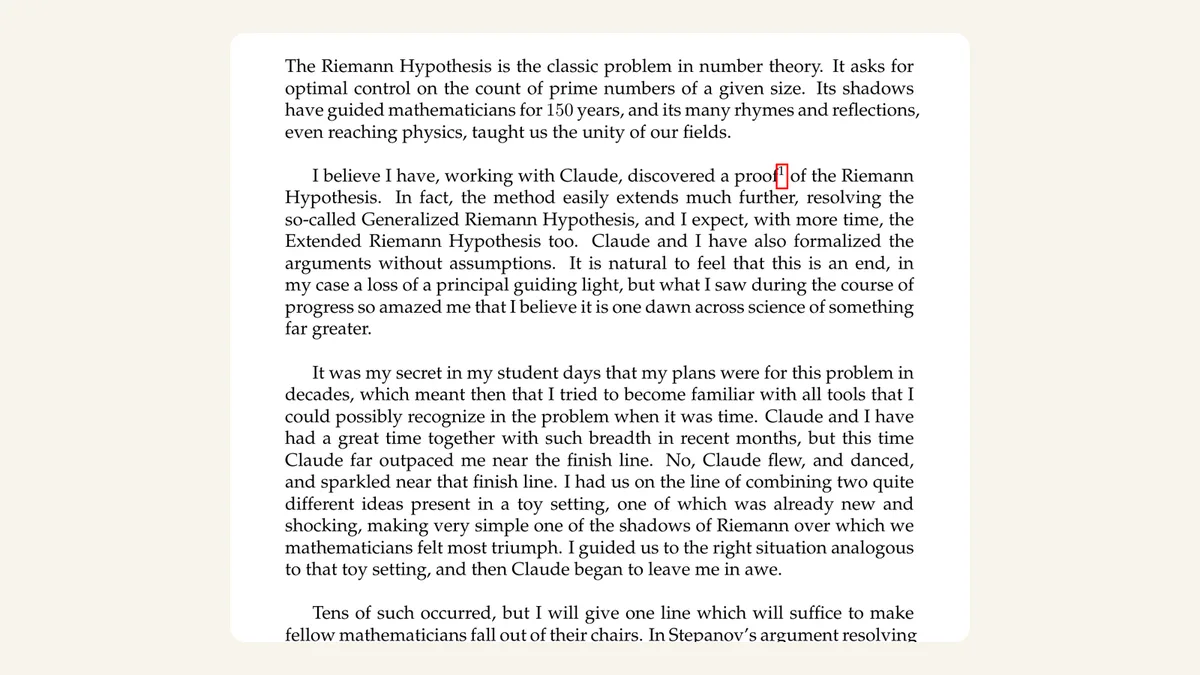
On Friday, November 20, 2026, Levent Alpöge, a mathematician who works at Anthropic, posted a four-page note on his website. In it he says that, "working with Claude," he found a proof of the Riemann Hypothesis and of a wider version called the Generalized Riemann Hypothesis.
The Riemann Hypothesis was first posed in 1859 and is about how prime numbers are spread out along the number line. It is one of the seven Clay Millennium Prize problems, each with a US$1 million prize, and only one of those seven (the Poincaré conjecture) has ever been officially solved, according to The Verge.
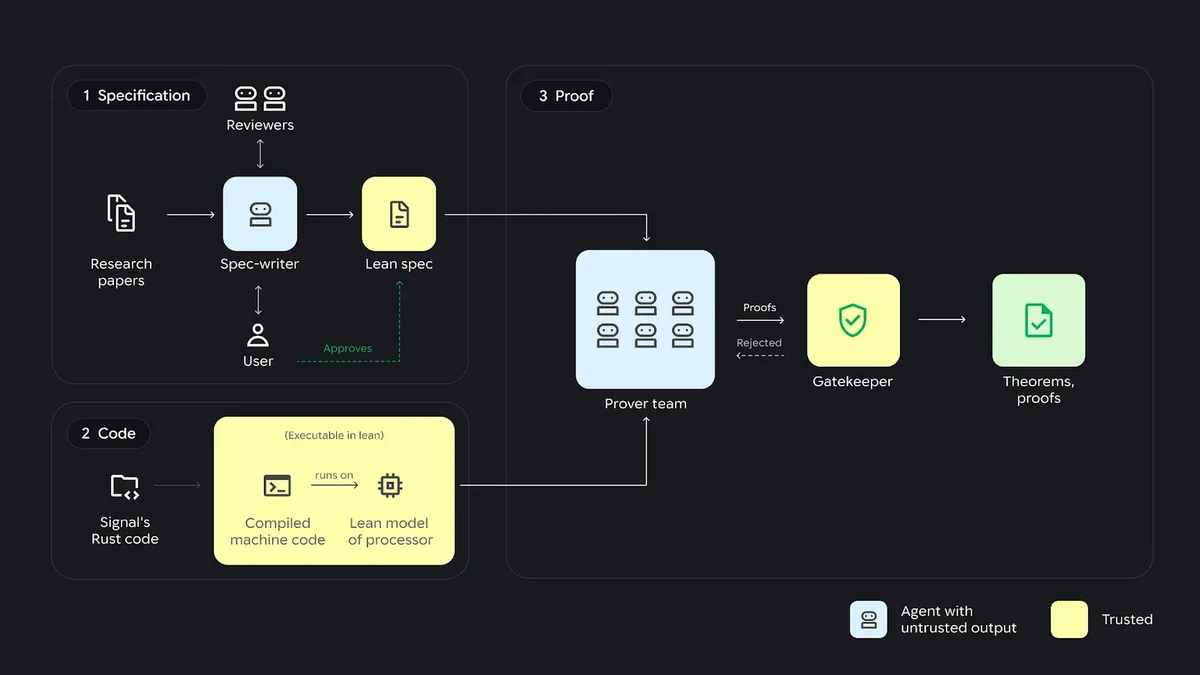
Alpöge says he and Claude also wrote the proof in Lean, a computer program that checks every step of a math proof and refuses anything that doesn't follow. That detail is why experts are reacting so fast. They don't have to take his word for it. They can run the checker themselves.
Anthropic has not commented, The Verge reports.
Has the proof been checked?
Update, November 22: The Lean and Mathlib communities, in a joint statement endorsed by the Lean FRO and the Mathlib Initiative, now say they have "full confidence" the proof is correct and certify both the statement and the proof. Details in our follow-up on the certification.
Partly, and so far it passes. Andrew Sutherland, a mathematician at MIT, runs a public page tracking the checks, which he says were "run with Claude Code" (Anthropic's coding tool). As of 4:30am ET Saturday, his page reports:
- All 175,187 pieces (Lean calls them modules) of the proof compile with zero errors.
- The five main theorems rely only on Lean's three standard axioms, the basic starting rules every Lean proof is allowed to assume. Nothing extra was slipped in.
- Two proof checkers written separately from Lean, called nanoda and con-leche, accept the full proof.
- A final end-to-end check called the "lake comparator" run, plus one more replay through Lean's own checker, were still running.
Is the Riemann Hypothesis proof official yet?
No. Under the Clay Institute's rules, a proof has to be published and then survive at least two years of scrutiny and reach "general acceptance" before the prize is awarded, per The Verge. A machine-checked proof speeds that up, but mathematicians still want to read and understand it.
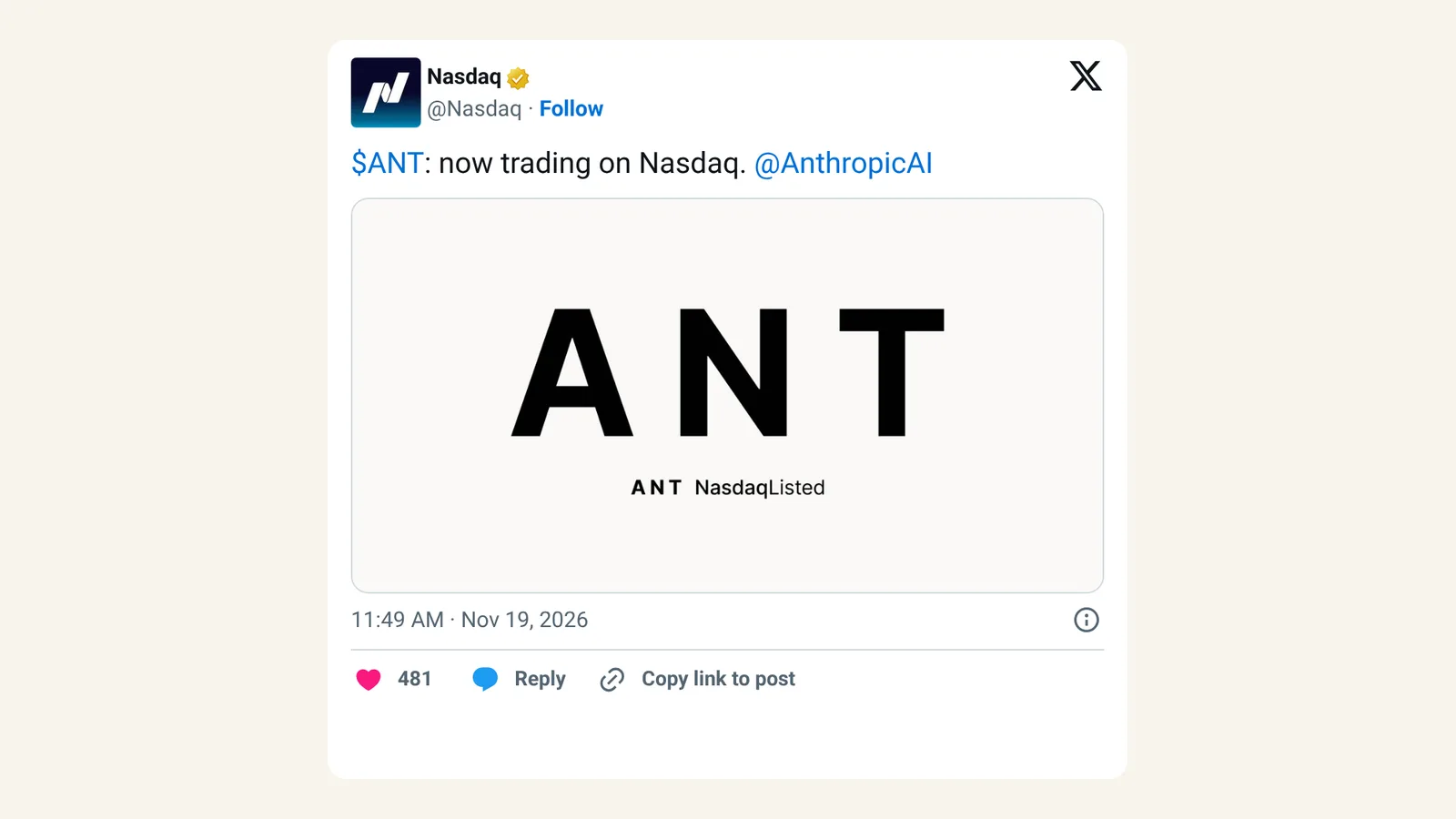
There's also an awkward backstory. In August, Anthropic said, "We don't expect that the techniques Claude used will lead to proving the Riemann hypothesis," The Verge reports. Alpöge's note says he texted Anthropic CEO Dario Amodei "late Sunday night," and The Verge says he appears to have waited until after Anthropic's stock market debut on Thursday to post it.
X reactions
Riemann Hypothesis may have been solved with the help of Claude. “what I saw during the course of progress so amazed me that I believe it is one dawn across science of something far greater.” https://t.co/sACo17cL8A https://t.co/fiv9ZvBEWI
— Ethan Mollick (@emollick) November 20, 2026
For another AI math claim, read our post on OpenAI's three new math results.
Our take
If the last checks pass, this is the strongest case yet that AI can help with real science, and we think the way it is being checked matters as much as the claim. Experts got confident in a day because a program, not a reputation, did the first round of checking.
That's the lesson we'd take into ordinary work. Chatbots still make things up, so the people getting the most out of them pair the AI with a check it can't sweet-talk: a checker program, a formula in a spreadsheet, a second source. We'd also like Anthropic to say something on the record, since its own staff member made the claim using its product.
— Artificially Nerdy
What can you do with this?
- Wait for the final checks before telling anyone it's "solved." The comparator run was still going on Saturday morning.
- Copy the habit. When AI drafts something that matters, check it with a tool or a source that doesn't care how confident the AI sounds.
- Be wary of viral posts that say the problem "has been solved." The mathematicians doing the checking are more careful than that.
FAQ
Who is Levent Alpöge?
He is a mathematician who works at Anthropic. He posted the four-page note on his own website, alpo.ge, on Friday.
Will Claude or Anthropic get the US$1 million prize?
Nobody knows yet. The Clay Institute's rules need publication and at least two years of scrutiny first, and the Institute has not commented.
Can I check the Lean proof myself?
Sutherland's MIT page lists the files and logs. Running the checks takes serious computing power, though. One outside checker needed 27 minutes on 80 processor threads.
What is the Generalized Riemann Hypothesis?
A wider version of the same idea that covers a family of related math functions. Sutherland's page notes that in this proof it means one family, called Dirichlet L-functions, only.
Sources
- Levent Alpöge: remark (PDF) — November 20, 2026. The claim, "working with Claude," Lean formalization, the text to Dario Amodei.
- Andrew Sutherland, MIT: Verification files for the Lean proof of the Riemann Hypothesis — updated November 21, 2026, 09:30 UTC (4:30am ET). Module count, axioms, nanoda and con-leche results, checks still running.
- The Verge: Anthropic mathematician claims to have solved prestigious Millennium Prize problem with Claude — Robert Hart, November 20, 2026. Clay rules and prize, Poincaré, Anthropic's August quote, no comment from Anthropic, IPO timing.