
TL;DR
Will ChatGPT for Accounting replace bookkeepers?
OpenAI launched ChatGPT for Accounting on November 18, 2026. It can draft reconciliations and month-end reports from apps like QuickBooks and Xero, and it is documented for Business and Enterprise. Small businesses get a cheaper first draft, but a person still has to check it. If you keep books, learn to review AI drafts and explain the numbers to owners.
What can ChatGPT for Accounting actually do?
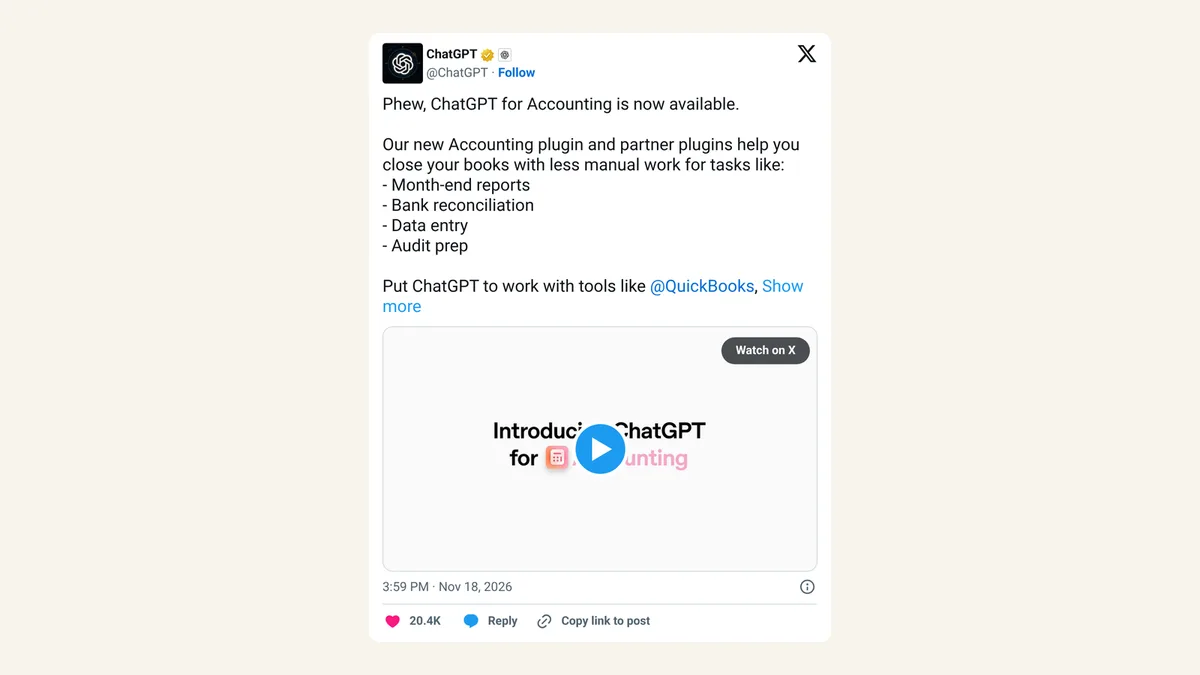
On Wednesday, OpenAI added an Accounting plugin to ChatGPT, plus partner plugins that connect it to accounting apps. A plugin here is an add-on you install from a directory inside the ChatGPT desktop app. The partner list covers BILL, Campfire, FreshBooks, Oracle NetSuite, Oracle QuickStart, QuickBooks Online, Rillet and Xero.
OpenAI's help article lists four main jobs:
- Bank reconciliation, which means matching your bank statement line by line against your own records. ChatGPT lists proposed matches separately from possible duplicates, missing transactions and fee or currency differences.
- Invoice and receipt entries. It reads invoices and receipts, suggests the vendor, amount and account, and flags missing information or uncertain coding.
- Month-end and client reports, built in your own Excel template, with notes explaining big changes.
- Audit support. It matches an auditor's request list to the documents you have and lists what's missing.
OpenAI documents the plugin for ChatGPT Business and Enterprise workspaces, and it is free to install. Not every connected app lets ChatGPT enter records. OpenAI says a connection that can read your transactions may have different permissions for writing them, so check each app's listing. On Thursday, Xero expanded its side of the deal so accountants and bookkeepers can run month-end close reviews and client portfolio reviews inside ChatGPT. Xero says that part is US-only for now. If you want the setup steps, our ChatGPT for Accounting news post walks through them.
Will AI replace bookkeepers?
Some bookkeeping work will shrink, and that was true before this launch. The US Bureau of Labor Statistics (BLS) counts about 1.53 million bookkeeping, accounting and auditing clerks, with median pay of US$50,670 a year in May 2025. It projects that number to fall 6% from 2025 to 2035, a loss of about 85,600 jobs, while jobs overall grow 3%. Its reason is plain: "Software innovations have automated many of the tasks" these workers do, so "the same amount of work can be done with fewer employees."
That's a hard thing to read if bookkeeping pays your rent, and it deserves a straight answer instead of a pep talk. The tasks OpenAI lists (matching transactions, coding receipts, building reports) are the same ones on the BLS duty list for the job.
There are two counterweights. BLS still expects about 144,100 openings a year over the decade, all from people retiring or moving to other work. And the same BLS page says the job is moving "to take on a more analytical and advisory role," with less hand entry and more reviewing clients' books for ways to save. ChatGPT for Accounting speeds up that shift. It doesn't invent it.
The draft gets cheaper. Being the person who can say "this number is wrong" doesn't.
Is ChatGPT safe to use for small business bookkeeping?
It can be, if a person checks the work before anything lands in the books. Both companies are clear about that. OpenAI's help article says ChatGPT prepares "drafts for your review" and tells you to compare proposed entries with the original invoices and check the company, destination and amounts before approving. It even warns that if an entry's status is unclear, you should look in your accounting app before trying again, so you don't create a duplicate.
Xero says the same thing in its own words: "apply your judgment to the first pass that's drafted" before making final decisions.
For an owner doing the books alone at night, that changes the math. Sorting a month of receipts or chasing a bank mismatch could take minutes instead of an evening. But a wrong entry is real money, and it can mean a wrong tax figure later. ChatGPT also can't know that a hardware store charge was half personal unless you tell it. The owners who come out ahead will be the ones who read the draft before they hit approve.
What does this mean for the bookkeepers small businesses hire?
For a freelance or small-firm bookkeeper, the pressure lands on price first. If a client can get a decent first pass of the month-end report from ChatGPT, paying by the hour for data entry gets harder to defend.
The work that holds its value is the work AI drafts can't sign off on: knowing a client's business well enough to spot a strange entry, setting up coding rules so the drafts come out right, catching duplicates, and explaining to an owner what the numbers mean for next quarter. Xero is pitching its own integration at that last part, with portfolio reviews and "client meeting preparation" for accountants.
This is the same pattern KPMG ran into when it put more than 100 AI agents on a real company's audit: the agents did the digging, and people still had to catch what they got wrong.
What should bookkeepers and small business owners do now?
- Bookkeepers: if you work in a ChatGPT Business or Enterprise workspace, try the Accounting plugin on a past month you already closed, and compare its draft with your real work.
- Write down your coding rules and review checks. OpenAI lets you save these as reusable skills (saved instructions ChatGPT follows on each run) if your workspace has them.
- Move some of your pricing from hours of entry toward monthly reviews and advice.
- Owners: keep approval in human hands, and check which of your connected apps can write entries before you let ChatGPT near them.
- Ask your bookkeeper how they plan to use AI on your books, and what they'll check by hand.
Our take
We think this is good news for small businesses and a real squeeze on bookkeepers who mostly do data entry. The tools are ready to draft, and nobody serious is claiming they're ready to sign off. Bookkeepers who become the trusted checker and the person who explains the numbers should do fine. Those who compete with ChatGPT on speed of entry are in a race they can't win.
— Artificially Nerdy
FAQ
Does ChatGPT for Accounting cost extra?
The Accounting plugin is free to install, according to OpenAI, and is documented for ChatGPT Business and Enterprise workspaces.
Can ChatGPT post entries straight into QuickBooks or Xero?
It depends on the app. OpenAI says some connections can only read transactions, so check each partner plugin's listing for supported actions. Where entry is supported, you review and approve before anything is entered.
Can my company's employees install it?
In a ChatGPT Business workspace, members can install the plugin without admin approval. In an Enterprise workspace, an admin has to approve it first.
Is bookkeeping still a good career?
BLS projects a 6% decline in clerk jobs from 2025 to 2035, but still about 144,100 openings a year as people retire or switch fields. The work is shifting toward analysis and advice, so those skills matter more than typing speed.
Sources
- OpenAI Help Center, "Using ChatGPT for accounting work"
- OpenAI, ChatGPT for Accounting solutions page
- ChatGPT on X, launch post (November 18, 2026)
- Xero blog, Diya Jolly, "Xero expands OpenAI integration, Bringing Month-End Close Review to ChatGPT for Accounting" (November 19, 2026)
- US Bureau of Labor Statistics, Occupational Outlook Handbook, Bookkeeping, Accounting, and Auditing Clerks