
TL;DR
How is ChatGPT Ads bidding changing on November 9?
New ChatGPT Ads campaigns swap hard bid caps for average cost targets starting Monday. Single clicks or sales can now cost more than your number, so old settings may spend differently. If you run ChatGPT ads, set each target from your recent real costs; regular ChatGPT users have nothing to do.
What is changing in ChatGPT Ads bidding?
OpenAI emailed ChatGPT Ads advertisers on Thursday, November 5, 2026, about new bidding options that start Monday, November 9. Its help page now lays out the details. Two new settings arrive in Ads Manager, the dashboard where advertisers build campaigns:
- Target CPA (target cost per action), the average amount you want to pay for a conversion such as a purchase or a lead. It replaces Max Bid for new conversion campaigns.
- Target CPC (target cost per click), the average amount you want to pay for a click. It replaces Max CPC for new click campaigns.
Max Bid set a ceiling on each auction bid, and Max CPC set a maximum bid per click. Existing campaigns keep those old controls for now, and you can switch them over yourself from Monday. On January 1, 2027, Max Bid and Max CPC retire for good, and OpenAI moves any leftover campaigns to the matching target.
The autobid option also gets a new name. Maximize Results (Autobid) is now called intelligent bidding, and it still sets bids for you inside your budget without any target.
Key dates for ChatGPT advertisers
| Date | What happens |
|---|---|
| Nov 5, 2026 | OpenAI emails advertisers about the change |
| Nov 9, 2026 | Target CPA and Target CPC go live in Ads Manager for new campaigns; you can start moving old ones |
| Nov 18, 2026 | API partners: using the old Max fields to create a campaign or change a bid type now sets a target instead |
| Dec 31, 2026 | Last day the old API fields are supported |
| Jan 1, 2027 | Max Bid and Max CPC retire for existing campaigns, and the API fields are deprecated |
Source: OpenAI Help Center, checked November 8, 2026.
Why can a target cost more than your old max?
A target is an average, not a cap. OpenAI says its system can bid above or below your Target CPC in any single auction, while it aims for your average over the whole campaign. Some clicks will cost more than your number and some will cost less, and the final average can land higher or lower than the target.
OpenAI gives its own example. A US$50 Target CPA tells the system to work toward an average of US$50 per conversion, but some conversions will cost more and some less. Audience bid multipliers stack on top: a US$50 target with a 1.2x new-customer multiplier gives that group of buyers a US$60 target.
That's why copying an old Max CPC number into the Target CPC box can raise what you spend per click. The old number was a ceiling. The new one sits in the middle.
How do you pick a realistic Target CPA?
OpenAI says to start from what you actually paid recently, over a steady reporting period, and to allow for conversions that get reported late. Its worked example: US$400 in spend and 10 attributed purchases gives an actual cost per purchase of US$40. That number is your starting point.
Setting a target far below what you've been paying won't cut your costs in half. OpenAI says a US$20 target in that example doesn't mean the system can deliver purchases at US$20. It can mean your ads show less often.
Will my ChatGPT ads stop showing?
They can slow down. OpenAI warns that targets that are too tight, or weak conversion tracking, can reduce how often your ads run and leave part of your budget unspent.
For conversion campaigns, the system learns from the OpenAI Pixel (a small piece of code on your website that reports sales and sign-ups) or the Conversions API (the same reports sent straight from your server). OpenAI says setting these up isn't enough on its own. You need to confirm that real events are arriving and check the Event Quality Score, a rating in Ads Manager of how useful that incoming data is.
The jargon, in one line each
| Term | What it means |
|---|---|
| Conversion | The action you're paying to get, such as a purchase, lead or sign-up |
| Max Bid | The old setting that capped each auction bid on a conversion campaign |
| Max CPC | The old setting that capped what you'd bid for one click |
| Target CPA | The new average you aim to pay per conversion; single conversions can cost more or less |
| Target CPC | The new average you aim to pay per click; single clicks can cost more or less |
| Intelligent bidding | OpenAI's new name for Maximize Results (Autobid), where the system sets all bids within your budget |
| Event Quality Score (EQS) | Ads Manager's rating of how useful your conversion data is |
X reactions
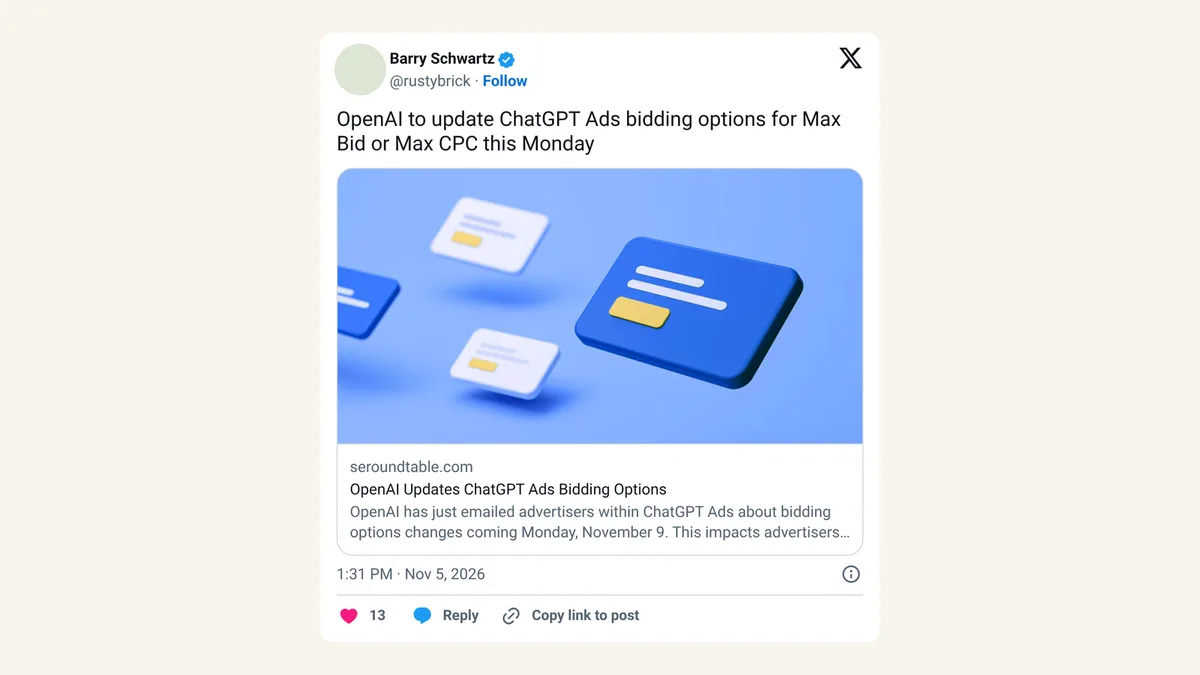
Barry Schwartz of Search Engine Roundtable flagged OpenAI's email to advertisers soon after it went out.
OpenAI to update ChatGPT Ads bidding options for Max Bid or Max CPC this Monday
— Barry Schwartz (@rustybrick) November 5, 2026
https://t.co/0z26KiF4Ie
Our take
Losing a hard cap stings most for small advertisers. A cap was the one setting that guaranteed a single click would never cost more than you'd decided, and a target hands that call to OpenAI's system. That means less control for anyone spending carefully.
The good news is that OpenAI explains the change plainly, with real examples, and gives existing campaigns until January 1 to move. Nobody gets surprised overnight. We'd move one small campaign first, set its target from real recent costs, and watch the average for a couple of weeks before switching the rest.
— Artificially Nerdy
What to do before Monday
- Pull your recent real costs. Note your actual cost per sale and cost per click for each campaign over the same recent period.
- Set targets from those numbers, not from your old Max settings. A Max figure was a ceiling, and a target sits closer to the middle.
- Check your tracking. Open Ads Manager, confirm the Pixel or Conversions API is sending real events, and fix any Event Quality Score warnings.
- Switch one campaign first and watch spend, results and the average cost together before moving the rest.
- API partners and agencies should add the new Target CPA and Target CPC fields before November 18, when the old fields start setting targets.
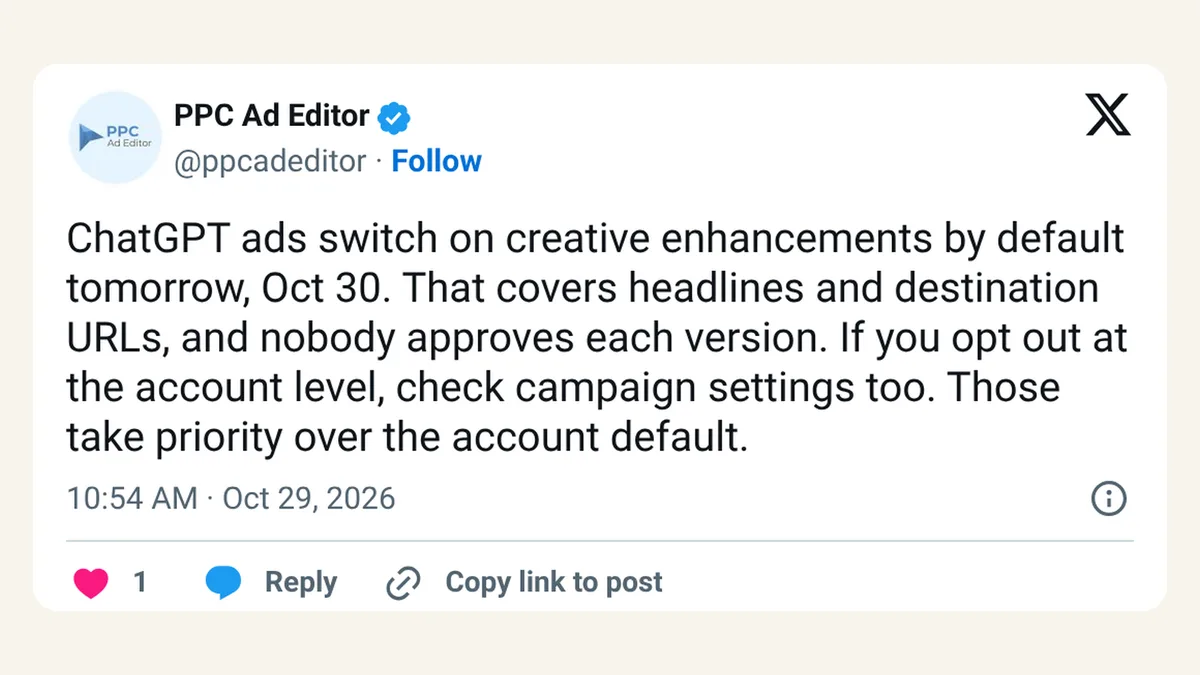
- Review your other ChatGPT Ads defaults while you're in there, such as the creative enhancements that turned on by default.
FAQ
Does Target CPA mean I only pay when someone buys?
No. OpenAI treats your bidding goal and your billing event as separate settings. A campaign can aim for conversions while you're still charged per click or per impression, depending on how billing is set.
What happens if I don't touch my existing campaigns?
They keep running on Max Bid or Max CPC until January 1, 2027. On that date, OpenAI replaces Max Bid with Target CPA and Max CPC with Target CPC.
Do I still pay the price I bid?
OpenAI says the final winning auction bid sets the price you pay, and that rule applies to every bidding option, old and new.
Is intelligent bidding a new feature?
No. It's the new name for Maximize Results (Autobid). The system still sets all bids to get the most results from your budget, and you don't give it a cost target.
Sources
- OpenAI Help Center: Bidding strategies and how pricing works in ChatGPT Ads — checked November 8, 2026. Target CPA and Target CPC definitions, November 9 start, January 1, 2027 retirement, US$50 and US$400/10 examples, 1.2x multiplier example, delivery and tracking warnings, API timeline, billing and auction pricing.
- Search Engine Roundtable: OpenAI Updates ChatGPT Ads Bidding Options For Max Bid or Max CPC — November 5, 2026. Trade coverage of OpenAI's email to advertisers, including the send date.
- Barry Schwartz on X — November 5, 2026, 1:31pm ET.