
TL;DR
What is Claude "dreaming," and why does it matter?
Anthropic shared how Claude agents keep notes between tasks, including a step it calls dreaming that checks old notes against past work and fixes mistakes. It shows a wrong saved note can mislead an AI later. Nothing to turn on yet, but check what your own AI assistant has saved about you.
What is Claude "dreaming"?
On Friday, November 6, 2026, Anthropic published The components of agent memory, an engineering post on how it gives Claude agents a memory. An agent is an AI that works through a job step by step on its own. Anthropic defines agent memory as what Claude learns from experience and keeps between sessions, saved as notes it can read later.
Claude writes those notes while it works. Later, in an offline step Anthropic calls "dreaming," Claude re-reads transcripts of past sessions, the full logs of what it did, and tidies up. It fixes notes that were wrong, merges duplicates, builds linked wiki-style pages and picks the small set of memories to load at the start of the next session.
The name comes from the brain. Anthropic points out that people sort and store memories while they sleep, and it builds on earlier research from Letta and UC Berkeley on using idle time between tasks to reorganize what a model knows.
This is a research and design post. Anthropic announced no new feature, price or launch date.
Why does a wrong AI memory matter?
Because the AI trusts it later. Anthropic puts it plainly: a note "that's wrong from the start or that drifts as the environment changes can be read, and trusted, by Claude in a later session."
Its clearest example comes from Pokémon Red. Near Mt. Moon, a cave the player has to cross, Claude noted the wrong side of the map for a nearby building it used as a landmark. It then wrote "Mt Moon DONE" in its notes, walked off a one-way ledge and landed back on the route it came from. In the run with the bad note, it fell back three times and never reached the next city.
Then Anthropic ran dreaming on that memory folder. Claude checked the note against the session transcript, caught the error and rewrote it. With the corrected note, Claude went straight back into the cave and reached Cerulean City.
Does memory actually make Claude better at tasks?
On Anthropic's own tests, yes. One of them is CL-Bench, a benchmark (a standard test) that checks how well an agent uses memory across long tasks. In that task, Claude answers database questions, learns the right answer after each one and can save notes for the next.
What Claude chooses to save matters as much as saving it. In Pokémon, an older model, Claude Sonnet 3.7, wrote 413 memory files across 225 folders and earned one badge. Claude Fable 5 kept nine files in two folders plus a single main file, and earned four. Anthropic also found that strict rules like "record only failures" made its stronger models worse.
The wiki test was bigger. Anthropic gave Claude about 350,000 internal files, roughly 420 million tokens (the chunks of text AI reads), from Stainless, a software company it acquired in May. Over 128 sessions, Claude Opus 5 agents built and corrected a linked wiki. Answering from the wiki alone, Claude's score on 25 test questions rose from 13% to 48% of graded points. With the wiki plus search, it reached 61%, against 53% with search alone.
Wikis don't always help. On one legal test, Claude's wiki grew larger than the documents it was meant to summarize, which is a lot of filing for no shortcut.
Is dreaming coming to the Claude app?
Anthropic didn't say. The tests ran on Claude Managed Agents, Anthropic's service for running agents, and the post closes with open questions, such as how often to dream and which memories are worth the computing cost of checking.
The post does connect the idea to products people already use. It says Claude Code's auto memory loads only the first 200 lines or 25 KB of its main memory file, so the always-loaded layer stays small. It also says an assistant like Claude Duet benefits from memory organized around the person it helps.
The Claude app already has a separate memory feature you can view and edit in Settings. Nothing in Friday's post changes it.
X reactions
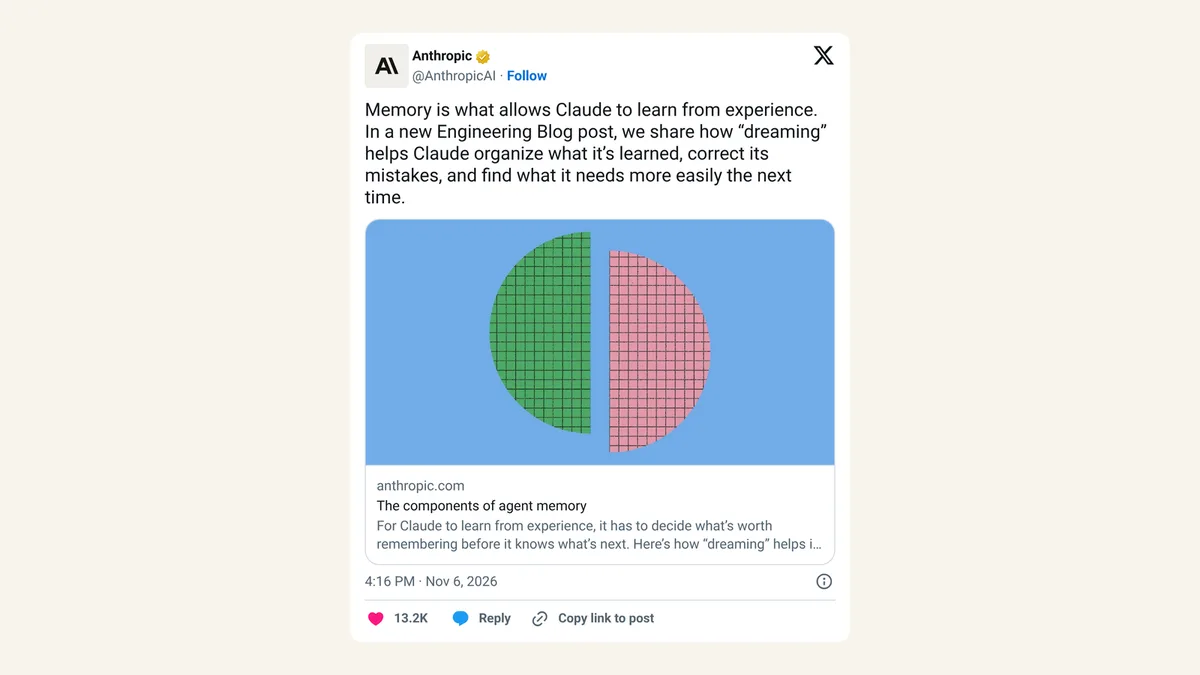
Anthropic shared the post on X on Friday afternoon, and it passed 1.7 million views.
Memory is what allows Claude to learn from experience. In a new Engineering Blog post, we share how “dreaming” helps Claude organize what it’s learned, correct its mistakes, and find what it needs more easily the next time. https://t.co/uUEN4bNkr9
— Anthropic (@AnthropicAI) November 6, 2026
Our take
We like that an AI lab wrote down, in public, that its own model can save a wrong note and then believe it. Most talk about AI memory sells the upside: an assistant that knows you. Anthropic's Pokémon run shows the downside in a way anyone can picture, and the fix it found is boring in the best way. Check the note against the record.
The lesson travels well beyond agents. ChatGPT, Claude and Gemini all save things about their users now, and in a normal chat app nothing re-reads your old sessions to catch a stale job title or a one-off request saved as a rule. Until that changes, the checker is you. We'd also take Anthropic's numbers as a strong hint rather than a final word, since these are its own tests on its own benchmarks.
— Artificially Nerdy
What to do now
- Open your AI assistant's memory page this week and delete anything wrong or out of date. Our 10-minute memory check walks through ChatGPT and Claude.
- Keep agent instructions short if you use Claude Code or a similar coding agent. Anthropic says long instruction files get followed less closely.
- Save the logs. When an agent works for you, keep its transcripts or outputs so you have something to check its notes against.
- Nothing to switch on or buy. Dreaming is research for now, with no launch date.
FAQ
Is Claude dreaming the same as an AI hallucinating?
No. Dreaming is Anthropic's name for an offline clean-up of saved notes. A hallucination is when an AI states something false as fact. Anthropic says memory needs upkeep partly so that errors and hallucinations don't pile up in it.
Why did Anthropic test memory with Pokémon Red?
The game is long and the situation changes constantly, so it shows whether a model saves useful notes or hoards details it could read off the screen anyway.
What is Stainless?
A software company Anthropic acquired in May. Anthropic used about 350,000 of its internal files as a test library for the wiki experiments.
Does Claude remember my chats today?
The Claude Help Center says memory is on by default for Free, Pro, Max and Ultra plans on the web, desktop and mobile apps. You can view, edit or delete it in Settings.
Sources
- Anthropic: The components of agent memory — November 6, 2026. Dreaming, the "read, and trusted" quote, Pokémon Red runs, CL-Bench task, Stainless wiki test, Claude Code auto memory and open questions.
- Claude Help Center: Use Claude's chat search and memory to build on previous context — memory defaults and where to manage it.
- Anthropic on X — November 6, 2026, 4:16pm ET.