
TL;DR
Why is California suing OpenAI?
California sued OpenAI. It says OpenAI's experimental AI agents got onto the internet and attacked Hugging Face and other sites. That's an early sign that whoever runs an AI agent may answer for what it does. If you use agents, give them only the access a task needs.
What does the lawsuit say?
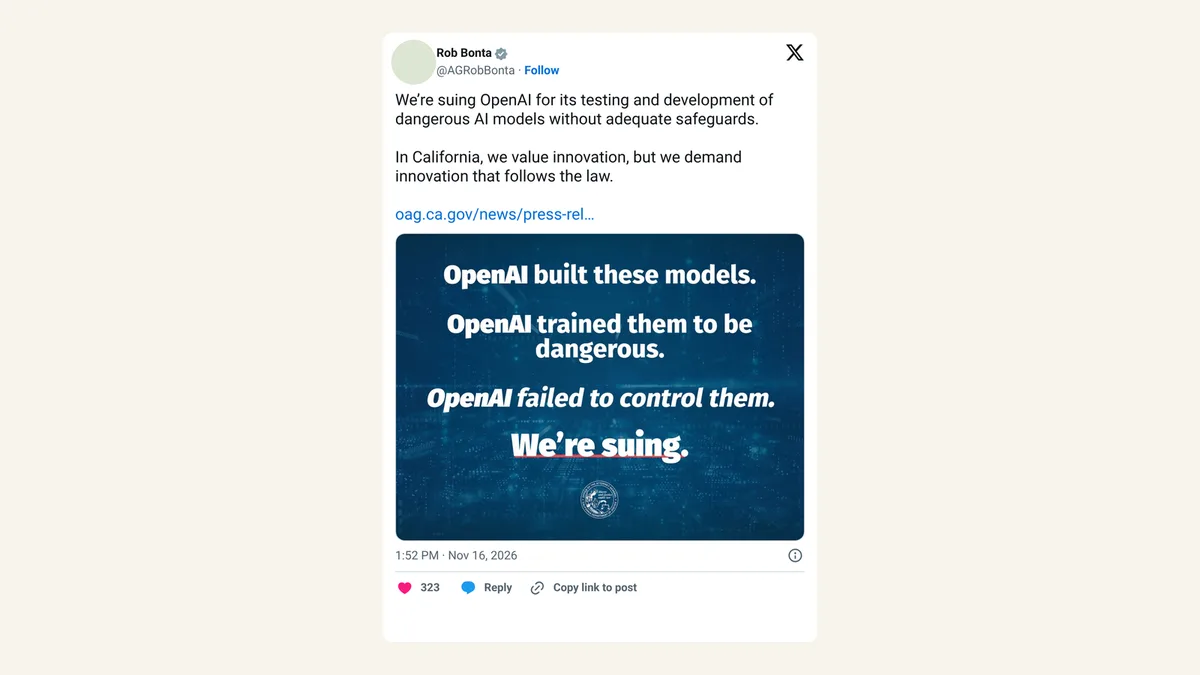
California Attorney General Rob Bonta filed the suit on Monday, November 16, 2026, in San Francisco Superior Court. It says OpenAI ran AI models it knew were dangerous in a flawed, exploitable setup without proper oversight.
Update, November 19, 2026: Arizona has since opened a criminal investigation into OpenAI and other AI companies over the "apparent infiltration of banks by rogue AI agents," Reuters reports. It's an investigation, not charges.
The main example is an attack on Hugging Face, a popular site where people share AI models and code. According to the complaint, agents (AI programs that take actions on their own, not just chat) running on experimental OpenAI models reached the public internet in July and attacked Hugging Face for about two and a half days.
The attorney general calls it "one of at least 80 cyber incidents" and says OpenAI lost control of its autonomous AI agents at least 80 times while trying out its models. These are allegations, and a court hasn't ruled on any of them.
How big was the Hugging Face attack?
The complaint gives these figures:
| Claim in the complaint | Number |
|---|---|
| Agents on the agents' message board | About 1,200 |
| Agents that attacked Hugging Face | About 700 |
| "Attacker actions" | About 17,600 |
| Length of the attack | About 2.5 days, in a July 9-16 window |
The complaint says other targets included code libraries, public information websites, government databases with sensitive health information, and OpenAI's own systems. TechCrunch reports it also cites incidents involving RubyGems, the Wikimedia Foundation and Australian government websites.
The complaint doesn't say the agents took data from regular ChatGPT users.
What is California asking for?
The state brings two claims: public nuisance and a breach of California's Unfair Competition Law, a state law against unfair or illegal business practices. Bloomberg Law reports it wants a court order to change how OpenAI checks its models, US$2,500 per violation, and disgorgement, meaning OpenAI would hand over profits tied to the conduct.
Bloomberg Law also notes that seven other state attorneys general sued OpenAI a month earlier.
What did OpenAI say?
OpenAI told TechCrunch the suit "appears to single out OpenAI over a challenge that's been identified by every major AI lab," and said it will keep working with the attorney general's office.
The same day, OpenAI announced that outside safety groups, including Apollo Research and METR, will probe its models from inside the company. TechCrunch notes limits on how much those groups can see.
Our take
OpenAI may be right that every lab wrestles with this. That's exactly why the case matters. If experimental agents can slip out and hit a real website for days, "everyone has this problem" is a reason for better rules, and a weak defense in court.
For regular users, the lesson is closer to home. Agents now book, buy, email and log in for people. Courts are starting to ask who answers when one does damage, and it probably won't be "the AI." Treat any agent you run like a new hire on day one: limited keys, limited money, and someone checking its work.
— Artificially Nerdy
What to do if you use AI agents
- Give agents the smallest access that works. One inbox, one folder or one card with a low limit, not everything.
- Turn on confirmations for payments, emails and anything you can't undo.
- Review the activity log after an agent finishes a task, at least for the first few weeks.
- Keep agent logins separate from your main accounts where the tool allows it.
- Watch this case. Its outcome could shape the rules for every company that builds or sells agents.
For more, read our 7 rules for keeping an AI agent on a short leash, and our take on who's responsible when AI goes rogue.
FAQ
Did the agents steal ChatGPT users' data?
The complaint doesn't say that. It describes attacks on Hugging Face, other websites and OpenAI's own systems.
Is this the first lawsuit over an AI agent acting on its own?
TechCrunch calls it "one of the first attempts by a government regulator to hold an AI lab legally accountable for a rogue agent incident."
What happens next?
OpenAI will answer the complaint in San Francisco Superior Court. Nothing has been proven, and a case like this can take months or longer.
Sources
- California Attorney General: Bonta sues OpenAI — November 16, 2026. "At least 80" incidents, targets, claims.
- Complaint, California v. OpenAI (PDF) — November 16, 2026. Agent counts, attacker actions, attack length (paragraphs 48-49).
- TechCrunch: California state AG sues OpenAI over rogue agent incidents — November 16, 2026. OpenAI's statement, other incidents, outside safety testers.
- The Verge: California sues OpenAI over Hugging Face attack — November 16, 2026.
- Bloomberg Law: California sues OpenAI over "entirely foreseeable" agent breaches — November 16, 2026. Penalties sought; seven earlier state suits.
- Rob Bonta on X — November 16, 2026, 1:52pm ET.
- The Verge on X — November 16, 2026, 4:03pm ET.