

TL;DR
Do AI agents really save small businesses time?
They do, but they swap doing for deciding. Claude Duet, for example, asks before it sends a message, makes a payment, signs a document or deletes anything, and every one of those requests lands on you. Too many of them cause approval fatigue: you stop reading and start tapping yes. The fix is three lists you write up front (what the agent may do alone, what it must ask about and what it must never touch), plus approvals short enough to check in three seconds.
The robot does the work. You do the permission slips.
This week Anthropic launched Claude Duet, an assistant that reads your connected apps, sends you a morning brief and gets on with tasks in the background. Meta has Muse. OpenAI has dots. The pitch is the same everywhere: stop doing the busywork and let the agent handle it.
A good agent turns your work into decisions. Duet has a short list of things it always checks with you first, which is the right call, but every one of those checks lands on you. Send this reply? Pay this invoice? You've been promoted from doer to approver, and approving is its own kind of job.
Approval fatigue is real (and very human)
Think about how you treat cookie banners. The first time, you read one. By the hundredth, your thumb finds "Accept" before your brain has loaded the page. Approval requests from an AI agent are headed the same way. When everything needs a yes, "yes" stops meaning anything.
We've already watched this happen with login prompts. The US cybersecurity agency CISA warns about "MFA fatigue": people get so many sign-in approval requests that they press accept by accident, or just to make the pings stop. That was attackers spamming on purpose, not an AI agent being helpful, but the tired thumb is the same thumb. CISA's fix was to make people actually look at each request before approving it, which is where we're headed next.
For a small business, the real risk is boring. The agent asks nicely, you're busy, and you wave through a refund to the wrong customer or a reply that sounds a bit off. The agent did exactly what it was told. You just weren't really listening when you told it.
The best AI assistant asks you the right questions at the right time.
Three lists to write before you connect anything
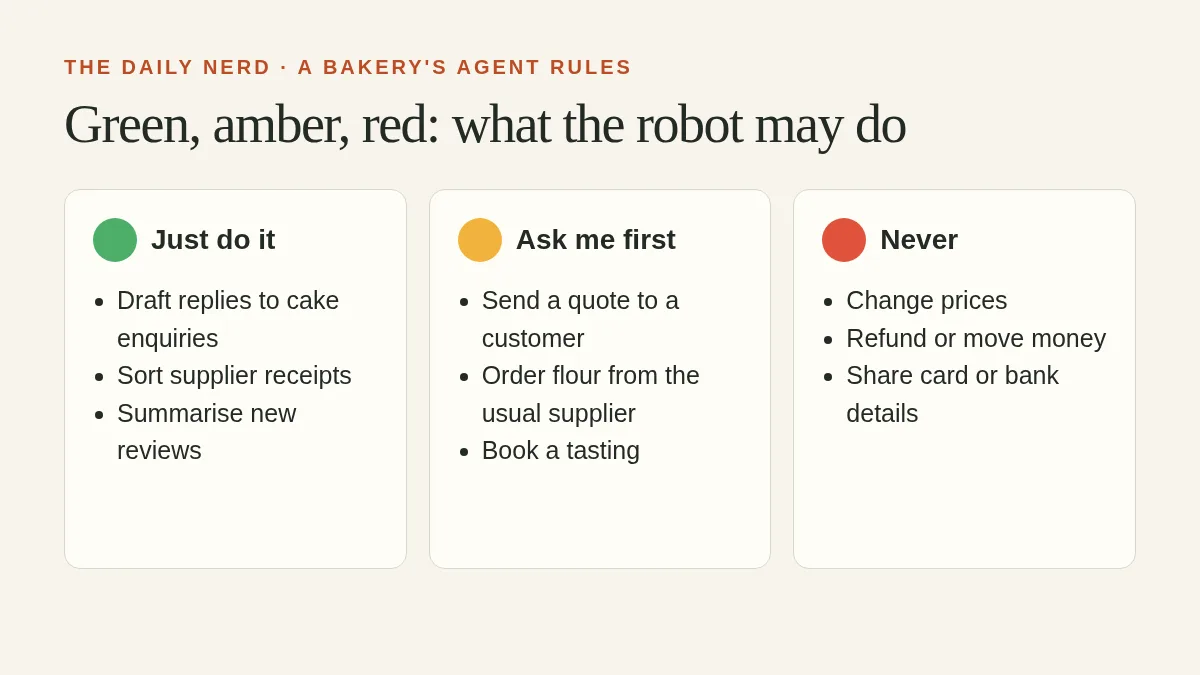
So decide the rules once, calmly, before a busy Tuesday gets in the way. We like a traffic-light system. Here's how it looks for a small bakery that takes custom cake orders:
| List | The bakery's examples | What the agent should do |
|---|---|---|
| Green: just do it | Draft replies to cake inquiries (as drafts), sort supplier receipts, summarize new reviews, tidy the order calendar | Act alone, then report in the morning brief |
| Amber: ask first | Send a quote or reply to a customer, order flour from the usual supplier, book a tasting, sign a supplier agreement | Ask, with a one-line reason and the exact message, order or document |
| Red: never | Change prices, issue refunds or move money, delete order history, share card or bank details | Refuse and flag it to the owner |
If a task isn't on any list, it's amber by default.
Duet's built-in rules (see the full list) already cover a lot of the amber column. Your lists add what's specific to your business, like prices and refunds. Paste them into your agent's instructions in plain English. Writing them down keeps you consistent too.
Make every approval cheap to read
An approval you can check in three seconds is safe. One that takes three minutes gets rubber-stamped. So ask your agent to keep each request to a fixed shape: what it wants to do, who it affects, how much it costs, and what happens if you say no. If a request can't fit in that shape, it shouldn't be approved from a phone in line at the bank.
Then batch. Microsoft says its most-pinged Microsoft 365 users get interrupted by a meeting, email or notification about every two minutes. That's the busiest fifth of office workers, not your average bakery, but nobody does careful work in two-minute slices. Two approval sessions a day beat forty interruptions. Duet finishes the rest of a task and holds the approval until you're ready, so most small-business requests can wait until late morning and 4pm. The ones that can't belong on your red list.
Start smaller than you think
The temptation with a new agent is to connect everything on day one. Don't. Give it your calendar and a single inbox for two weeks. Count how often you agree with its idea of "urgent". Anthropic itself says Duet might "miscalibrate what's urgent", which is fair warning and a good reason to keep a scorecard.
If you're agreeing nine times out of ten, widen the green list a little. If not, you've learned something useful for the price of two weeks.
The real promotion
Agents turn small-business owners into managers, whether they wanted the job or not. The owners who do well will write the clearest rules, read every amber request properly, and say no without guilt.
Being a good boss to a robot turns out to be a lot like being a good boss to people. Be clear, keep it short, check the work and don't sign anything you haven't read.
FAQ
What is approval fatigue with AI agents?
It's what happens when an AI agent asks for permission so often that you start approving requests without reading them. The safety step is still there, but it stops protecting you.
What should an AI agent never do without asking?
Claude Duet asks before it sends a message, makes a payment, signs a document or deletes anything, and never moves money between accounts. A small business should add its own red lines, such as changing prices, issuing refunds and sharing card or bank details.
How should a small business start using an AI agent safely?
Connect one low-stakes app first, such as your calendar. Write green, amber and red rules for what it may do, batch your approvals into two sessions a day, and track how often its idea of urgent matches yours.
Do AI agents save time?
Yes, mostly by turning doing into deciding. The saving comes from clear rules and approvals you can check in a few seconds.
Which tasks can an AI agent safely do on its own?
Low-stakes, easy-to-undo work: drafting replies (as drafts), sorting receipts, summarizing reviews and tidying a calendar. Anything that sends, pays, signs or deletes should wait for your yes.
What does human-in-the-loop mean for AI agents?
It means a person checks and approves certain actions before the agent carries them out. Claude Duet works this way for messages, payments, signatures and deletions.
Sources
- Anthropic: Introducing Claude Duet — approval list, blocked actions and Anthropic's note on urgency
- CNBC: Anthropic previews Claude Duet, taking on Muse and dots — coverage
- CISA: Implementing Number Matching in MFA Applications (fact sheet, October 2022) — MFA fatigue: approving login prompts by accident or out of annoyance (an analogy, not AI agent data)
- Microsoft WorkLab: Breaking down the infinite workday (June 17, 2025) — interruptions every 2 minutes, measured across the top 20% of Microsoft 365 users by ping volume