
TL;DR
Is AI paying off for businesses outside Big Tech?
Not yet, according to Apollo's chief economist, Torsten Slok, who wrote on October 24, 2026, that AI "has delivered zero financial payoff to corporate America outside of tech." US government data fits that picture: productivity is growing at its usual pace, with no AI boom visible. Where things look shakier is hiring. Employers announced their weakest September hiring plans since 2011, and job openings at the smallest firms dipped in August. For a small business, that means two things: you're not behind if AI hasn't transformed your margins, and the most useful number to watch over the next two weeks is hiring.
The "zero payoff" note
Slok's note splits the S&P 500 into two groups: the seven tech giants (Alphabet, Amazon, Apple, Meta, Microsoft, Nvidia and Tesla) and everyone else, which he calls the "S&P 493." For the giants, revenue per worker and profit margins are climbing. For the other 493, both are flat. He also sees "no signs of AI boosting productivity growth."
His most interesting line for small businesses is about attitude. He writes that "mainstream corporate America is pulling back and starting to view token spending not as a source of growth but as a cost center that weighs on margins." (Token spending is what you pay for using an AI model, priced by the amount of text it reads and writes.)
That's one economist's analysis, built on Apollo's own charts. Here's how it lines up with the official numbers.
What the official numbers show
| Measure | Latest figure | Source |
|---|---|---|
| US productivity growth, Q2 2026 | 1.4% annualized, 2.2% over the year | BLS |
| Productivity growth since late 2019 | 2.1% a year, the same as the long-run average since 1947 | BLS |
| Workers' share of output (labor share) | 52.8%, the lowest since the series began in 1947 | BLS |
| Corporate unit profits, Q2 2026 | Up 43.0% annualized | BLS |
| Job openings, August 2026 | 7.1 million (4.3% rate) | BLS JOLTS |
| Hires, August 2026 | 5.2 million (3.3% rate) | BLS JOLTS |
| Layoffs and discharges, August 2026 | 1.6 million (1.0% rate) | BLS JOLTS |
Productivity is solid and ordinary. If AI were already reshaping the average American workplace, you'd expect that 2.1% figure to be climbing above its long-run norm. It isn't, at least so far.
The labor-share and profit numbers are striking, and they'll get quoted in plenty of AI arguments. The government doesn't attribute either one to AI, so we won't either. They're the backdrop: companies are doing well, and less of what they make is going to paychecks.
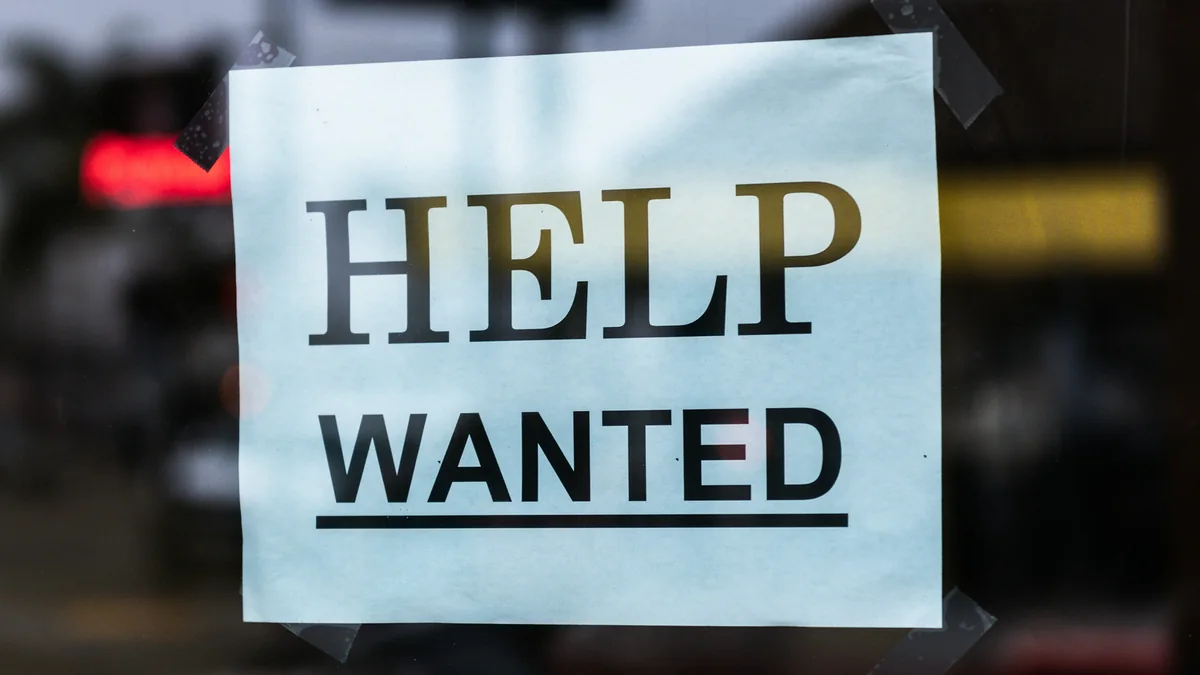
Layoffs are easing. Hiring is the soft spot
Here's where it gets more useful. The outplacement firm Challenger, Gray & Christmas tracks announced job cuts and hiring plans each month. Its September 2026 report found:
- Job cuts are down. Employers announced 43,281 cuts in September, and 573,195 for the year so far, down 39% from 2025.
- AI still tops the list of reasons for the year. AI was cited for 120,136 cuts so far in 2026, about 21% of the total. In September alone it ranked fifth, at 3,961 cuts.
- Hiring plans were thin. Employers announced plans to hire 90,787 workers in September, down 23% from September 2025 and "the lowest September total since 2011."
- The year overall is mixed. Hiring plans for 2026 so far are still up 3% on last year, though seasonal hiring announcements are muted.
Andy Challenger, the firm's chief revenue officer, called it "a wait-and-see period," and his list of reasons was energy costs, war, interest rates and healthcare costs. AI isn't on it. That's worth keeping in mind before anyone blames every soft number on chatbots.
The government's August job openings data has a small-business wrinkle too: the openings rate fell for establishments with 1 to 9 employees, the very smallest firms.
The writer Nassim Nicholas Taleb put the theory neatly on X on Sunday: "The AI impact won't be felt immediately through layoffs (existing jobs are sticky), but through a collapse in hiring (jobs that don't yet exist have no stickiness)."
That's a prediction, and "collapse" is stronger than anything in the data so far. But it explains why layoff headlines can look calm while the job market still feels tight to anyone looking for work.
The first sign of AI in the job market may be the job ad that never gets posted.
What this means for a small business
You're not behind. If you've tried AI tools and your margins haven't moved, you're in the same spot as most of the S&P 493, according to Slok. Treat AI spending the way he says big companies are starting to: as a cost that has to earn its place, one tool at a time. A good first step is to see what your AI subscriptions cost.
Watch your own "hiring that didn't happen." The low-key version of AI's job impact is a role you decide not to fill because a tool covers part of it. That can be a smart call. Write it down when it happens, along with what you expected the tool to do, and check back in three months. If the work is slipping or customers notice, the hire was the better investment.
Hiring may be a little easier for you. With bigger employers announcing fewer hires, a small business that's hiring may see more applicants than it did a year ago. That's our reading of the numbers, and your own job posts will show whether it holds where you are.
Keep the entry-level door open if you can. Entry-level roles are the easiest to skip without anyone noticing, and they're how a business trains its next manager. If an AI tool takes over the routine half of a junior job (our routine admin AI hacks show how much of it can go), consider redesigning the job around the other half before cutting it.
Dates to watch
| When | Release | What to look for |
|---|---|---|
| Early November | BLS JOLTS, September | Hires rate and openings at the smallest firms |
| Early November | BLS Productivity and Costs, Q3 | Whether productivity growth breaks above its long-run pace |
| Early November | BLS Employment Situation, October | Overall job growth |
Challenger's next monthly job-cuts report is worth a look then too. If hiring plans stay weak while layoffs stay low, Taleb's theory gets more interesting. If productivity jumps, Slok's note will need an update, and we'll happily write that one.
FAQ
Is AI paying off for small businesses?
There's no official data on that yet. Apollo's chief economist says large companies outside tech aren't seeing higher revenue per worker or margins from AI, and US productivity growth is at its normal pace. If your own AI tools haven't changed your numbers, you're in good company.
What is the S&P 493?
It's Apollo economist Torsten Slok's name for the S&P 500 minus the seven biggest tech companies: Alphabet, Amazon, Apple, Meta, Microsoft, Nvidia and Tesla.
Is AI causing layoffs?
Some. Challenger, Gray & Christmas counts AI as the most-cited reason for announced job cuts in 2026, at about 21% of the year's total. Overall announced cuts are down 39% from last year.
Why watch hiring instead of layoffs?
Layoffs are rare and visible. A job that's never posted doesn't make headlines. September hiring plans were the weakest for that month since 2011, which is the kind of signal to keep an eye on.
When is the next US jobs data?
The Bureau of Labor Statistics releases job openings data and the monthly jobs report in early November. Check its release schedule for exact dates.
Sources
- Apollo: No signs of AI payoff outside the tech sector — Torsten Slok's Daily Spark note, October 24, 2026.
- TechCrunch: AI delivers 'zero financial payoff' to most companies, Apollo economist says — coverage, October 25, 2026.
- BLS: Productivity and Costs, second quarter 2026, revised — productivity, labor share and unit profits.
- BLS: Job Openings and Labor Turnover Survey, August 2026 — openings, hires, layoffs and the openings rate at small establishments.
- Challenger, Gray & Christmas: September 2026 job cuts report (PDF) — announced cuts, AI-cited cuts, hiring plans and Andy Challenger's comments.
- Nassim Nicholas Taleb on X — the hiring-versus-layoffs post, October 25, 2026.