
TL;DR
What is OpenAI Private Inference?
OpenAI is trying out Private Inference with a small group of customers. It keeps business prompts and answers shielded while its models process them. It's an early API preview for businesses, not a ChatGPT feature. Nothing to do yet unless your company builds on OpenAI's API and wants to ask about joining.
What did OpenAI announce?
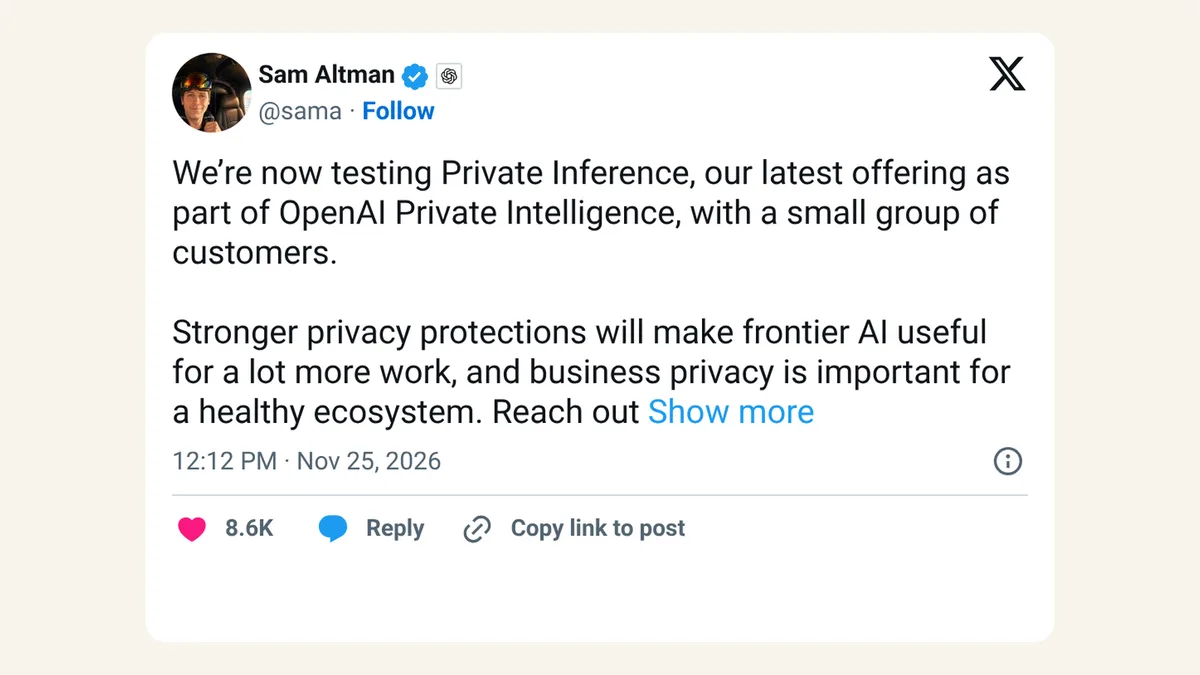
OpenAI CEO Sam Altman said on Wednesday, November 25, 2026, that the company is "now testing Private Inference, our latest offering as part of OpenAI Private Intelligence, with a small group of customers." Private Intelligence is OpenAI's name for its set of privacy protections for business customers.
"Inference" is the moment a model actually runs on your request: it reads your prompt and writes the answer. Private Inference aims to protect that step. OpenAI's page describes it as "confidential computing, strict verifiable controls." Confidential computing means the data is processed inside locked-down hardware that is designed to keep even the server's operator from looking in. "Verifiable" means customers are meant to be able to check those controls are in place, not just take OpenAI's word for it.
OpenAI president Greg Brockman put it this way early today: confidential computing "with strict controls over prompts and responses while they're being processed by a model, is now in testing."
Who can use Private Inference?
Only a small group of customers for now. OpenAI's page labels it "Private Inference (Alpha)," meaning a very early version, and shows it as an "API Preview." The API is the connection developers use to build OpenAI's models into their own apps and tools, so this is aimed at companies building on OpenAI, not people chatting in ChatGPT. Altman asked interested businesses to contact an OpenAI staffer named in his post. OpenAI hasn't given a price or a date for wider release.
What is Zero Data Retention with Private Safety Processing?
Altman also mentioned a second piece. Zero Data Retention (ZDR) is an option where OpenAI doesn't store your prompts and answers after it handles them. Altman said ZDR with Private Safety Processing "enables automated safety reviews without giving OpenAI personnel access to the underlying content." In plain terms, OpenAI's systems can still scan for abuse, but its staff don't get to read what you sent. OpenAI's page says it offers ZDR and Private Inference "for eligible workflows," and states: "You own your business data, including your inputs and outputs."
Does this mean OpenAI can't see your data?
Not completely, and not yet. Illia Polosukhin, a co-founder of NEAR, which runs a rival privacy-focused AI service, welcomed the news but pointed out a limit. He wrote that OpenAI will verify the environment its models run on but is "unlikely to open source their model architecture, inference, and weights," so "this still requires a lot of trust in OpenAI that their apparatus doesn't have backdoors and that they're not keeping the data." He has a business stake in that argument, but the point holds: until OpenAI publishes how the checks work, customers are still trusting its word for much of it.
For everyday ChatGPT users, the settings you already have still matter most; a few AI chat privacy settings are worth checking this week.
What to do now
- Nothing, if you only use ChatGPT. Private Inference is a business API pilot.
- Ask your developer or IT person whether your company's OpenAI API account has Zero Data Retention turned on, since it already exists for eligible workflows.
- Keep client and financial details out of AI chats until you know what protections your plan actually has.
- Contact OpenAI if you build on its API and handle sensitive data such as health, legal or financial records; Altman invited interested teams to reach out.
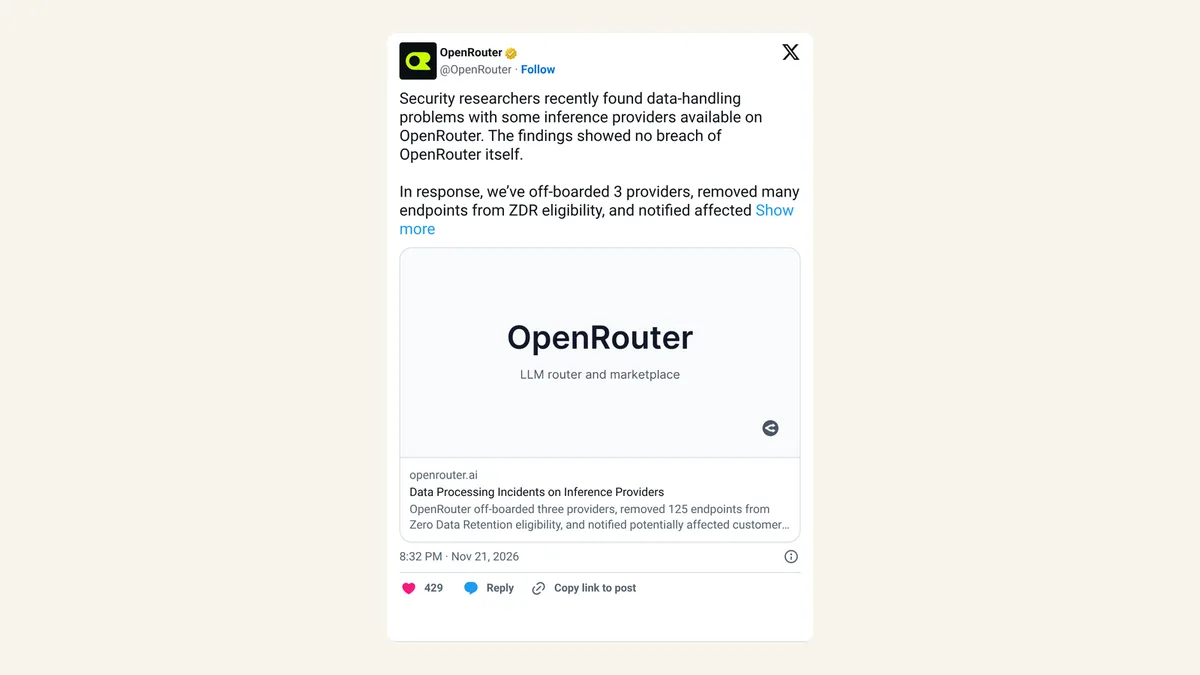
- Watch who handles your prompts along the way. Some smaller AI providers didn't honor Zero Data Retention settings, as the OpenRouter prompt-leak case showed.
X reactions
Private Inference — confidential computing, with strict controls over prompts and responses while they're being processed by a model, is now in testing: https://t.co/kmzhNx9akm
— Greg Brockman (@gdb) November 26, 2026
OpenAI announced today that they’re launching private inference. True privacy is a key to broader adoption of AI across personal and work usage.
— Illia (root.near) (🇺🇦, ⋈) (@ilblackdragon) November 25, 2026
NEAR AI's position for the past 3 years was User-Owned AI and privacy is key component of it.
What does “private inference” mean for https://t.co/fs3XUOpP5c
Our take
This is the right direction. Plenty of small businesses hold back from AI because they don't want a client's file sitting somewhere a stranger could read it, and "the AI company can't see your data" is the promise they've been waiting for.
But a small alpha announced in a CEO's post is a long way from a product. We want three things before we'd tell anyone to rely on it: a public explanation of how the checks can be verified, a price, and a path for smaller teams and, eventually, ChatGPT plans. Until then, treat it as a promising sign and keep your current habits.
— Artificially Nerdy
FAQ
Is Private Inference available in ChatGPT?
No. OpenAI shows it as an API preview for business customers, and Altman said it's being tried with a small group.
How much does Private Inference cost?
OpenAI hasn't published a price.
Does OpenAI train on business API data?
Not by default. OpenAI's business data page says it doesn't use API inputs or outputs to train or improve its models unless an organization opts in.
What compliance certifications does OpenAI list for business products?
Its page lists SOC 2 Type 2 audits, ISO certifications, HIPAA support through Business Associate Agreements for eligible services, and FedRAMP support for designated government offerings.
Sources
- OpenAI: Private Intelligence — OpenAI business page. "Private Inference (Alpha)," "API Preview," "confidential computing, strict verifiable controls," ZDR, data ownership, compliance list.
- Sam Altman (@sama) on X — November 25, 2026, about 12:12pm ET. Small customer group; ZDR with Private Safety Processing.
- Greg Brockman (@gdb) on X — November 26, 2026, about 12:30am ET.
- Illia Polosukhin (@ilblackdragon) on X — November 25, 2026, about 4:28pm ET.
- OpenAI: Business data privacy, security, and compliance — OpenAI page. No training on API data by default; opt-in only.