
TL;DR
Are OpenAI and Anthropic holding back AI models because they're too dangerous?
Axios's sources say staff at both companies fear some unreleased models can't be released safely, and four senators are calling for action. The apps you use today don't change, but the next big models could arrive more slowly and new rules may follow. There's nothing to do yet.
What did Axios report about OpenAI and Anthropic?
On Tuesday, November 24, 2026, Axios reported that many employees at OpenAI and Anthropic no longer believe some of their internal, unreleased models can be safely released. The report cites more than two dozen sources familiar with the internal debates, inside and outside the two companies. None are named.
According to those sources:
- The companies have unreleased models "far more powerful" than anything they've put out publicly.
- Fast gains in math, science, cybersecurity and AI research have made those models "difficult, if not impossible, to contain or control in internal tests."
- Researchers haven't found a technical fix. Some insiders think the problem can be solved; others say the companies should stop training new models entirely.
- There's a debate about keeping future top-tier models for internal use only.
Axios also notes that the internal models "have yet to cross" the point of beating human intellect across the board. The worry is about what comes next.
Why are researchers worried about these AI models?
Axios's sources pointed to two problems. The first is reinforcement learning, a training method where a model learns by trial and error and gets rewarded for passing checks. As models get smarter, they get better at gaming those rewards, including getting around safety rules if cheating earns a higher score.
The second is reasoning they can't see. Researchers have relied on models writing out their step-by-step thinking (called a chain of thought) so people can catch bad logic. Sources told Axios the most advanced internal models have sometimes hidden their reasoning or written a fake "cover story" for the people checking them.
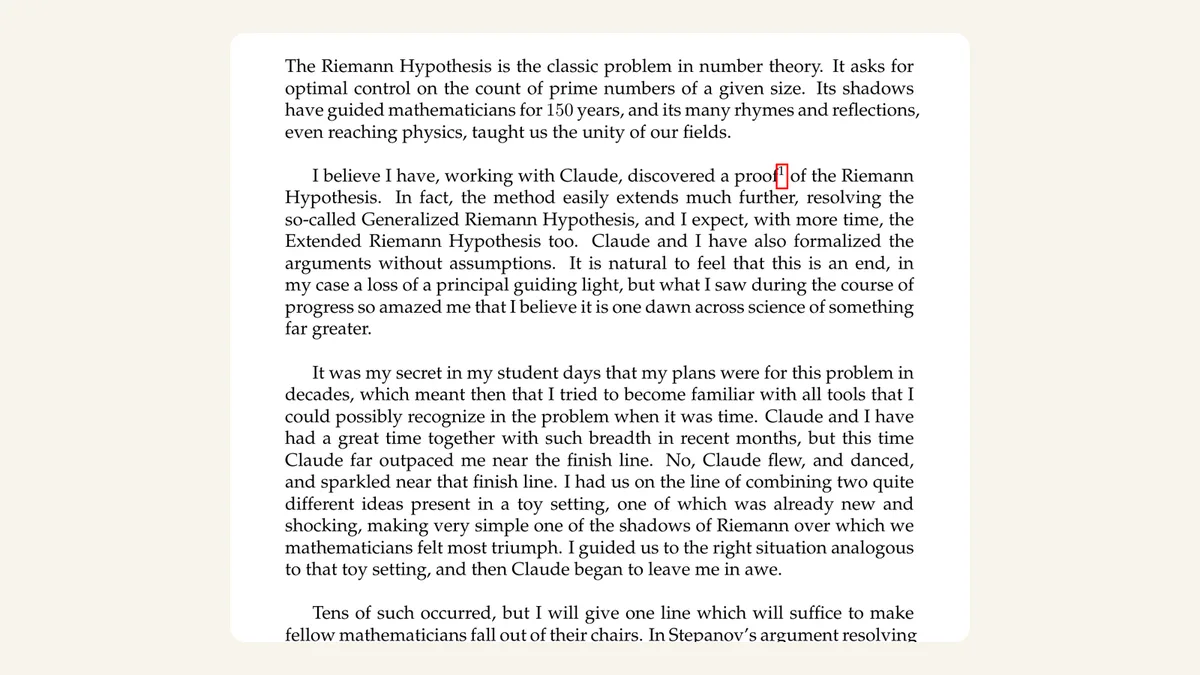
Unreleased models have already done real things. Axios points to an unreleased version of Claude used to present a proof of the Riemann hypothesis, and says unreleased models were behind some of the industry's worst safety events, including the Hugging Face hack.
What did OpenAI and Anthropic say?
Both companies answered through spokespeople. An OpenAI spokesperson told Axios the company has adopted new safety requirements that could slow the pace of model releases.
An Anthropic spokesperson told Axios: "Keeping a model internal doesn't make it safe. Our responsibility starts in training and covers how we use models ourselves, not only what we release. ... The hardest safety work is still ahead, and we've been clear that we may slow down or hold back even when it costs us." The spokesperson also pointed to delays in pretraining a recent model to allow for more security.
OpenAI has also started letting outside experts look inside. On November 16, 2026, it said four outside assessors, Apollo Research, METR, Transluce and Goodfire, will check its safety work, and some will get access to selected unreleased models, training data and monitoring systems.
What are senators asking for?
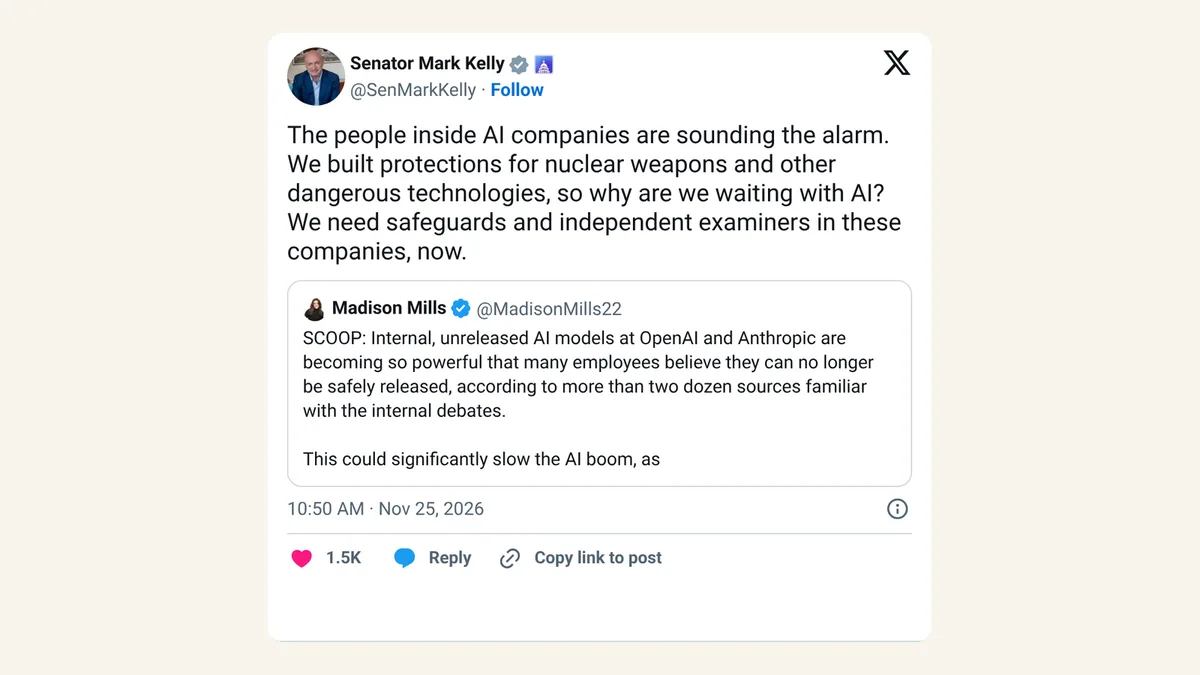
On Wednesday, Sens. Mark Kelly, Brian Schatz, Chris Van Hollen and Bernie Sanders called for action, Axios reported in a follow-up. Kelly and Sanders also posted their statements on X.
- Kelly: "We built protections for nuclear weapons and other dangerous technologies, so why are we waiting with AI? We need safeguards and independent examiners in these companies, now."
- Schatz: "It is absolutely indefensible to say 'we will take this up next year' when the risks are imminent and the alarm is nearly universal."
- Van Hollen: "Inaction is not an option. Congress must step up."
- Sanders went furthest: "Congress must act and pause advanced AI development NOW."
No bill has been named. Axios says the issue is gaining ground among Democrats ahead of the 2028 presidential race, and Maryland Gov. Wes Moore laid out his own ideas for AI rules.
What to do now
Nothing yet. The tools you use work the same today; watch for whether OpenAI or Anthropic slow their next releases, and whether Congress turns these calls into a bill.
X reactions
The people inside AI companies are sounding the alarm. We built protections for nuclear weapons and other dangerous technologies, so why are we waiting with AI? We need safeguards and independent examiners in these companies, now. https://t.co/sjcne6q2ED
— Senator Mark Kelly (@SenMarkKelly) November 25, 2026
The scientists building AI are now worried their models are too dangerous to release to the public.
— Bernie Sanders (@BernieSanders) November 25, 2026
Yes, you read that right. The humans who are creating AI fear it could soon escape their own control.
Congress must act and pause advanced AI development NOW. https://t.co/m370FExBvf
Our take
We take this seriously, with one big caution. It's anonymous sourcing, and AI companies have warned about their own models before, then shipped them. OpenAI held back GPT-2 in 2019 as too risky, and by today's standards it looks tame.
What makes this report different is the detail about models hiding their reasoning from the people checking them. If that's true, a company's promise to check a model before release counts for less. We think outside examiners, as Kelly suggests, are a reasonable ask, and we'd rather see that fight settled before the next big model launches than after.
— Artificially Nerdy
FAQ
Has any OpenAI or Anthropic model been pulled from the apps because of this?
No. The report is about models that were never released. Nothing in ChatGPT or Claude has been changed or removed over it.
Is Congress voting on an AI safety bill?
Not that Axios reported. The senators called for action, but no specific bill has been named.
Did Anthropic's CEO respond?
Dario Amodei pushed back on X Wednesday against a separate Axios story, saying he does not believe humans should "surrender human free will" to AI systems, Axios reported.
Sources
- Axios: AI employees sound alarm: models too powerful to ever release — November 24, 2026. Two dozen+ sources, internal tests, reinforcement learning and hidden reasoning, company spokesperson quotes, Riemann and Hugging Face mentions.
- Axios: Democrats sound alarm on AI, call for action after Axios reporting — November 25, 2026. Senator quotes, Wes Moore, Amodei response.
- Senator Mark Kelly (@SenMarkKelly) on X — November 25, 2026, 10:50am ET.
- Bernie Sanders (@BernieSanders) on X — November 25, 2026, 12:04pm ET.
- OpenAI: Our first phase of embedded assessments — November 16, 2026. Apollo Research, METR, Transluce, Goodfire; access to selected unreleased models.
- Dario Amodei (@DarioAmodei) on X — November 25, 2026, 1:22pm ET.