
TL;DR
What is Inkling 2 Mini and can I run it on my laptop?
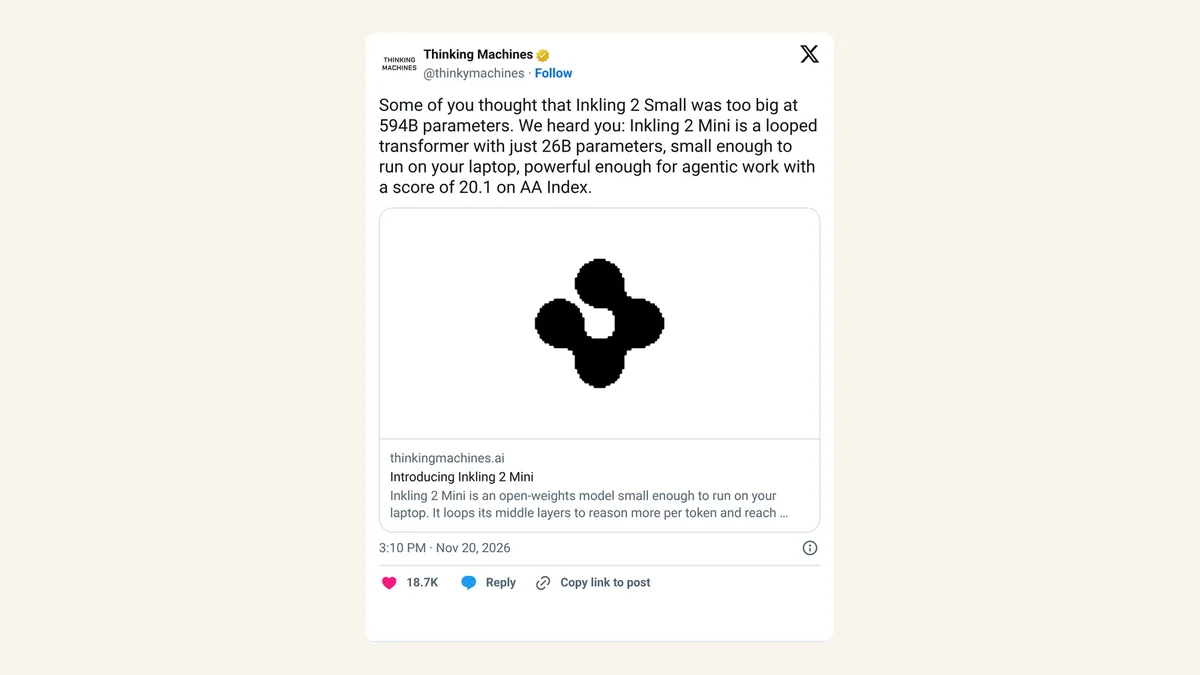
Thinking Machines released Inkling 2 Mini, a free open AI model that can run on a laptop with no internet. If you have a Mac with at least 32GB of memory, you can use a strong coding helper that keeps your data on your machine. Most people don't need to do anything yet; Mac owners can try it through Ollama.
What did Thinking Machines release?
On Friday, November 20, 2026, Thinking Machines Lab, the AI company led by Mira Murati, released Inkling 2 Mini. It's an open-weights model, meaning anyone can download the trained model files and run them on their own hardware. The Hugging Face model card lists its license as Apache 2.0, a standard open-source license that permits commercial use, and says the weights are meant to support research, fine-tuning and use inside other companies' products. The card also links Thinking Machines' model acceptable use policy.
The whole model takes up about 20GB of memory. To show what that allows, the company's researchers took it on a flight and ran it offline on a MacBook Pro (M5 Pro chip, 48GB of memory) in airplane mode. In a few minutes it built a playable flight simulator.
How good is Inkling 2 Mini at coding?
Thinking Machines says Inkling 2 Mini leads every open-weights model under 100 billion total parameters (parameters are the numbers a model learns during training, a rough measure of size) on coding and agent benchmarks. Those include DeepSWE v1.1, where it solved 48.2% of tasks, and the Vals Index v2.2, at 46.5%. These are scores Thinking Machines reports itself.
The company is also open about weak spots. Inkling 2 Mini isn't the best small model for long back-and-forth chats or for instructions with many rules at once, where Qwen3.8-27B scores higher. Because it's small, it also stores fewer facts. Thinking Machines says it makes up for that by using web search and other tools well, so expect it to be at its best when it can look things up.
What is a looped transformer?
Most AI models pass each word through their layers once. Inkling 2 Mini is a "looped" transformer: it runs its middle layers three times for every token (a token is a small chunk of text, often part of a word). That gives it more thinking per word, so it can reach a good answer while writing less.
It's also a Mixture-of-Experts model, which means only part of the model works on each token. Of its 26.4 billion parameters, 3.4 billion are active at a time, according to the model card. That split is a big reason it can run fast on a laptop.
Looping raises a safety question. A model that thinks more inside its layers writes less of its reasoning out where people can read and check it. Thinking Machines says that at this size, its reasoning stayed readable, and it's releasing a separate research version so others can study the effect.
What do I need to run it on my own computer?
At launch, Thinking Machines supports Inkling 2 Mini on any Mac (MacBook or Mac Mini) with at least 32GB of memory through Ollama, a free app for running AI models on your own machine. Smaller, compressed versions are available through Unsloth and llama.cpp, two other tools for running models locally. It also runs on Nvidia's DGX Spark desktop AI computer, and you can chat with it online in the Tinker Playground if your computer isn't up to it.
The big draw is privacy. When a model runs on your laptop, your prompts and files never leave it, and there's no subscription. If you like that idea for everyday browsing, Opera's browser has gone the same way with AI that runs on your device.
X reactions
Inkling 2 Mini is a looped transformer that runs on a laptop. Looping lets a model think more and write less. At this scale, its thought process remains monitorable; this may not stay the case. We're also sharing a variable-loop research model to enable further study. https://t.co/7FRkwHYAlv
— Mira Murati (@miramurati) November 20, 2026
This model is so so so good. They legit gave us Sonnet 5.5 that runs on 16GB of RAM lol
— Pietro Schirano (@skirano) November 20, 2026
Schirano's 16GB figure is his own. Thinking Machines puts the model at about 20GB and officially supports Macs with 32GB or more.
Our take
This is the kind of release that matters more than its benchmark chart. A model that can write real code with the Wi-Fi off means your work files don't have to go to anyone's server, and that's a bigger deal for most people than another point or two on a leaderboard.
It's still a tool for people with expensive laptops. A 32GB Mac is a high-end machine, and setting up Ollama is easy for a developer but not for everyone. We'd hold off on calling it "Sonnet on a laptop" until outside reviewers check the company's scores. If the numbers hold up, though, the gap between paid cloud AI and free AI on your own computer just got a lot smaller.
— Artificially Nerdy
What to do now
- Check your memory first. On a Mac, open Apple menu > About This Mac. Under 32GB, stick with the online Tinker Playground for now.
- Try it through Ollama if your Mac qualifies. It's the setup Thinking Machines supports at launch.
- Give it search access for fact-heavy questions, since the company says it knows fewer facts on its own.
- Treat the scores as claims. Wait for outside reviews before you swap out a paid coding assistant.
- Read the acceptable use policy before you build anything for work with it.
FAQ
Is Inkling 2 Mini free?
The model files are free to download under the Apache 2.0 license, and running it on your own computer has no subscription. Using it on Thinking Machines' Tinker service is a separate matter, and the announcement doesn't list prices.
Does Inkling 2 Mini work on Windows PCs?
The announcement names Macs with 32GB or more and Nvidia's DGX Spark as supported at launch. The model card says other graphics cards and platforms are possible, with 32GB or more of graphics memory (VRAM) recommended, but it doesn't spell out Windows laptop requirements.
Who is behind Thinking Machines Lab?
Mira Murati leads the company. Besides its models, it runs Tinker, a service where you can use and customize AI models online.
Can Inkling 2 Mini read images?
Yes. The model card says it accepts text and image inputs and writes text back. The announcement focuses on coding, agent tasks and tool use, so that's where the company's claims are strongest.
Sources
- Thinking Machines Lab: Introducing Inkling 2 Mini — November 20, 2026. Looping design, parameter counts, ~20GB footprint, benchmarks, limitations, flight demo, Mac/Ollama support, Tinker.
- Hugging Face: thinkingmachines/Inkling-2-Mini — model card, release date November 20, 2026. Apache 2.0 license, acceptable use policy, text and image input, hardware and parameter counts.
- Thinking Machines Lab on X — November 20, 2026, about 3:10pm ET.
- Mira Murati on X — November 20, 2026, about 3:14pm ET.
- Pietro Schirano on X — November 20, 2026, about 4:22pm ET.