
TL;DR
Is the US banning Chinese AI models?
Two House committees on Friday urged Congress to keep AI models built in China out of federal systems and contract work. Nothing changes for everyday users, since this is a report, not a law. If you sell to the government or run critical systems, find out which AI models your tools use.
What does the House report on Chinese AI models say?
On Friday, November 20, 2026, the House Homeland Security Committee and the House Select Committee on China released a joint report on US companies using open-weight AI models developed in China. Open-weight means the model's weights, the trained numbers that make it work, are published so anyone can download and run the model on their own computers.
The committees opened the investigation in April 2026. The report ends with 12 recommendations to Congress and federal agencies. A classified annex goes with it for people with security clearances.
The committees argue that these models are cheap and capable, which is why American companies pick them, and that growing dependence carries security risks. They want to act "while the cost of switching remains manageable," in the words of the report's foreword.
What does the report want Congress to do?
The main asks, from the report's recommendations section:
- Ban PRC-developed models from federal systems. PRC means the People's Republic of China. The report says Congress should bar federal agencies from using AI models from developers under Chinese jurisdiction or control, including models built on top of them, with a narrow waiver for research, evaluation and defensive security work.
- Keep them out of federal contract work. Contractors would be barred from using these models on federal jobs or in systems holding federal information. The rule would hit the largest contractors first, with extra time and help for small businesses.
- Phase them out of high-risk critical infrastructure. Critical infrastructure means systems like power, water and transport. The report calls for a phased ban in their most sensitive functions and no federal cybersecurity grant money spent on these models.
- Go beyond DeepSeek. The Department of Homeland Security (DHS) has already ordered federal civilian agencies to drop DeepSeek products. The report says other Chinese developers should be checked for similar orders.
- Build an American alternative. Recommendation 1 is a national American open-weight AI initiative, so companies have a trusted option to switch to.
- Label where models come from. The report asks for a model provenance standard, a record of which model a product is built on. It would be required for federal contractors and the riskiest critical infrastructure jobs, and voluntary for everyone else.
None of this is law yet. Congress would have to pass bills, or agencies would have to issue orders, for any of it to take effect.
Which companies are named in the report?
The committees used three companies as case studies of how Chinese models end up inside American products, drawing on what the companies told them. The report doesn't accuse them of breaking any law.
- Airbnb runs customized versions of Alibaba's Qwen models in customer support, including an AI assistant the report says handles roughly 80,000 guest and host interactions a day.
- Anysphere, the company behind the Cursor coding app, built Composer 2, Cursor's flagship model, on a base model from Moonshot AI. The report says that became public only after an outside developer identified the underlying model.
- DoorDash told the committees that 25 Chinese model families had been authorized and deployed in a "non-trivial manner," which it defined as at least US$5,000 in computing and serving costs. It said replacing one of them could take up to six months, while most other uses could switch almost immediately.
How common are Chinese AI models in the US?
More common than spending figures suggest, according to the report. It cites an analysis finding that Chinese models made up more than 30 percent of weekly token use by American companies on OpenRouter, a site that routes requests to many AI models, starting in February 2026. Tokens are the chunks of text AI usage is measured in. The same analysis put the peak at 46 percent, up from 4.5 percent in the first half of 2025.
The report also says Chinese models accounted for 41 percent of downloads on Hugging Face, the biggest site for sharing AI models, over the past year. Once a company downloads a model and runs it on its own servers, the report notes, there may be no bill that shows it's in use.
X reactions
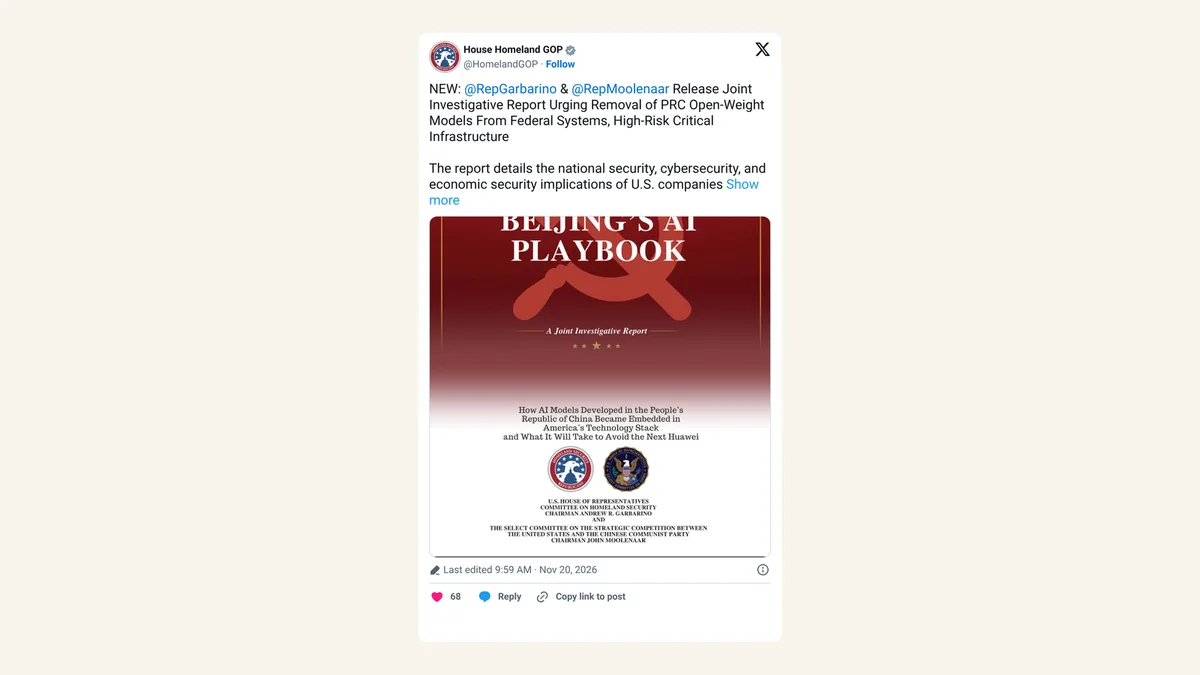
NEW: @RepGarbarino & @RepMoolenaar Release Joint Investigative Report Urging Removal of PRC Open-Weight Models From Federal Systems, High-Risk Critical Infrastructure The report details the national security, cybersecurity, and economic security implications of U.S. companies https://t.co/i5syqJipW9
— House Homeland GOP (@HomelandGOP) November 20, 2026
For more on one of these model families, read our look at Cohere's Qwen finding.
Our take
The provenance idea is the most useful thing in here, for everyone and not only the government. Plenty of people use AI apps every day with no idea which model sits underneath, and the Cursor example shows even paying customers can be the last to know. A plain label telling you what a product is built on would help buyers make their own call.
The bans are a bigger ask. Cheap open models are a big reason small AI startups can afford to exist, and the report itself admits trusted American options are only starting to catch up. We'd like to see the American open-weight push funded before contractors are told to rip things out, or small vendors will be the ones paying for the switch.
— Artificially Nerdy
What to do now
- Sell to a federal agency or contractor? Ask your AI vendors in writing which models their products run on, and keep the answers.
- Make a simple list of the AI tools your team uses and the model behind each one, where the vendor says.
- Expect the question from clients in government and regulated fields, and have your answer ready.
- Everyday users and small shops outside government work have nothing to change today.
- Watch for bills. The report points to the No Adversarial AI Act, introduced in June 2025, as moving in this direction.
FAQ
Can I still use DeepSeek, Qwen or Kimi myself?
Yes. The report's recommendations target federal systems, federal contract work and high-risk critical infrastructure. It doesn't propose limits for personal use.
Does this affect Cursor users?
Not directly. Anysphere is a case study in the report, and nothing in it changes how Cursor works today. A federal contractor using Cursor might face questions later if Congress adopts the contractor rule.
Would a model trained on Chinese AI output count as Chinese?
No, under the definition the report proposes. Only models whose original weights were trained by a Chinese entity, and models built from those weights, would count. Training data made by a Chinese model would have to be documented but wouldn't trigger the ban.
Is DeepSeek already banned in the US government?
On some systems. The report says DHS ordered federal civilian agencies to exclude DeepSeek, and Congress barred it on intelligence community systems and for Department of War contractors' contract work.
Sources
- House Homeland Security Committee: Chairmen Garbarino, Moolenaar release joint investigative report — November 20, 2026.
- Joint report PDF: PRC AI models — House Committee on Homeland Security and Select Committee on China, November 20, 2026. Recommendations, company case studies, usage figures, proposed definition.
- Select Committee on China: Joint investigation report — November 20, 2026.
- House Homeland GOP on X — November 20, 2026, ~9:59am ET.