

TL;DR
What is Entire?
Entire is a new "Git forge," a place to store, review and work on code, built for people and AI coding agents working together. GitHub's former CEO Thomas Dohmke launched it on Monday, October 26, 2026. Instead of pull requests, it uses "Trails," where agents score every code change against checks you set. It also saves each agent's chat history with the code, so you can see why a change was made. It works with Claude Code, OpenAI Codex, Cursor, GitHub Copilot and other agents, and you can sign up at entire.io today. Entire hasn't confirmed public pricing.
What happened
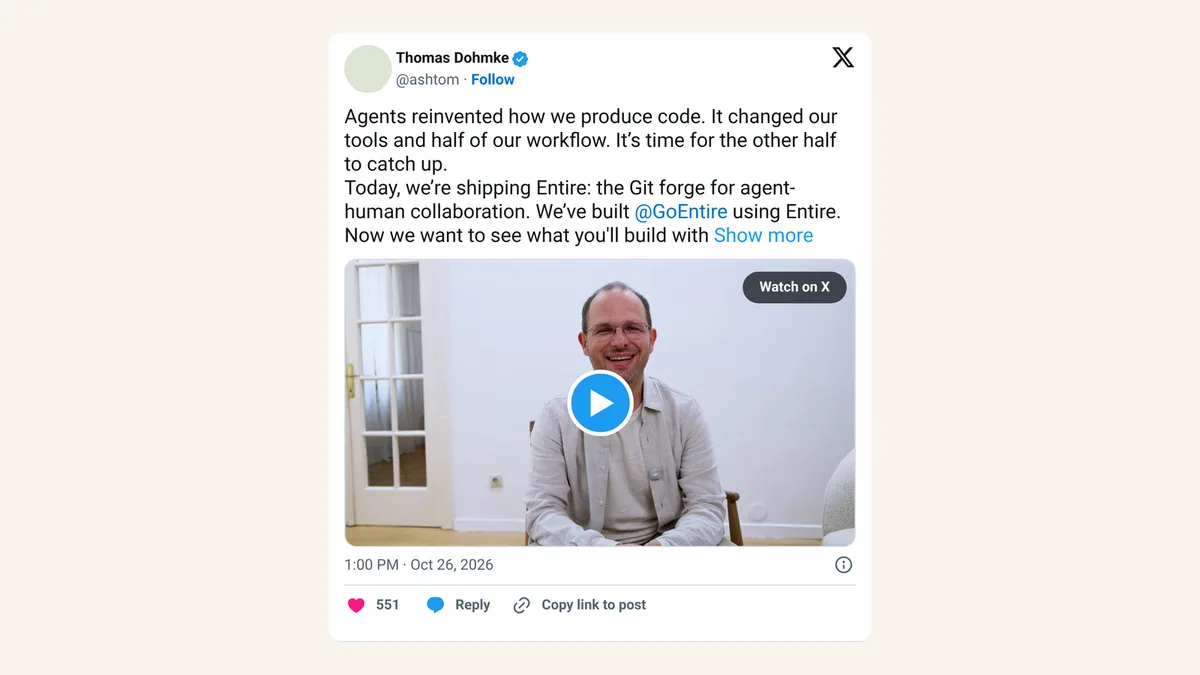
Dohmke announced Entire on X at 1:00 PM ET on Monday, October 26, 2026. He said the team built Entire's own product using Entire. The Verge covered the launch the same day as a competitor to GitHub, the company he used to lead.
Eight minutes later, Dohmke followed up with a claim about Entire's memory feature. He says it gives agents the context they need "with up to 71% fewer tokens." That's his figure, and nobody outside the company has published a test of it yet.
What Entire does
These are Entire's descriptions, from its website:
- Trails instead of pull requests. You write the goal first, or start from something an agent pushed. Agents keep working "until evals are green," meaning every check you set passes.
- Agent-scored evals on every push. Custom checks flag errors on each change, so human reviewers can focus on the parts that need a person.
- Session logs stored in the repo. The prompts, decisions and tool steps from each agent session are kept with the code. Entire says it detects and removes passwords and keys before anything is stored.
- Continuous memory. Entire turns your project's history into a shared "brain" agents can search, so they don't reread everything at the start of each session.
- Agentic search. One search covers code, past changes and agent sessions together.
- Fast hosting in several regions. Entire says its servers are available in the US, the EU, India and Australia, and handle code pushes much faster than rivals, by its own benchmark.
Why it matters if you don't code
You've probably never opened GitHub, and that's fine. But if you've built a website, an app or a small tool by chatting with an AI, your project lives in a place like this, whether you see it or not.
Today, most of those tools were designed for humans reading every line. Agents now write code faster than people can check it. Entire's bet is that you'll review a list of scores and a short story of what the agent tried, instead of reading code you don't understand.
For a vibe coder, the session log is the interesting part. Picture a bakery owner whose AI-built order form suddenly stops sending emails. With the agent's notes saved next to the code, the next agent (or a freelancer you hire) can see what changed and why.
How Entire compares to the usual way
| Usual Git hosting (like GitHub) | Entire (as Entire describes it) | |
|---|---|---|
| How changes get approved | A pull request a person reviews | A Trail with evals that agents score on every push |
| Why code changed | Whatever the author wrote in a short note | The full agent session, saved with the code |
| Agent memory | Agents start fresh and search the files | A shared memory agents can query, using up to 71% fewer tokens, per Entire |
| Which agents | Many work with it | Claude Code, OpenAI Codex, Cursor, GitHub Copilot and others |
The jargon, in one line each
| Term | What it means |
|---|---|
| Git | Free software that tracks every change to a set of files, mostly code |
| Git forge | A website that hosts Git projects and adds review and teamwork tools. GitHub is the best known |
| Repo (repository) | One project's folder of code plus its full change history |
| Push | Sending your latest code changes up to the shared copy |
| Pull request | A request to add your changes to the main project, which someone reviews first |
| Trails | Entire's replacement for pull requests, built around automatic checks |
| Evals | Automatic tests that score whether a change does what it should |
| AI coding agent | An AI tool that writes and edits code on its own, like Claude Code or Cursor |
| Tokens | The small chunks of text AI models read and write. More tokens usually means more cost |
| Vibe coding | Building software by describing what you want to an AI instead of writing the code yourself |
X reactions
Dohmke introduced Entire on X with a short pitch about the half of coding that agents haven't changed yet.
Our take
Dohmke has spotted a real problem. Agents can now produce more code in an afternoon than a solo builder can read in a week, and skimming before you merge is how bugs get in. Saving the agent's reasoning next to the code is a smart, simple idea, and we expect the bigger platforms to copy it.
Moving your code is a big decision, though, and Entire is one day old with no published pricing. The 71% token saving and the speed numbers are Entire's own. If your project already lives on GitHub and works, there's no rush.
For non-coders, the useful lesson is about habits. Whatever tool you use, ask your AI to write down what it changed and why, and keep those notes with your project. Future you will be grateful.
— Artificially Nerdy
What to do this week
- If you vibe code a site or app: at the end of each AI session, ask the agent to add a short "what I changed and why" note to a file in your project.
- If you build with Claude Code, Codex, Cursor or Copilot: look at Entire's website and try it on a small side project before moving anything that matters. Our AI coding assistant picks show which agents it works alongside.
- If you pay for AI coding tools: keep an eye on your token use. If Entire's memory claim holds up, it could mean smaller bills.
- If you hire freelancers to build for you: ask them how they record what their AI tools changed. A clear answer is a good sign, and so are short-leash rules for their AI agents.
- If you don't code at all: no action needed. This one is mostly for builders. If you want a site without code, start with our website builder picks.
FAQ
What is the Entire Git forge?
Entire is a code hosting and review platform built for people and AI coding agents working together. It replaces pull requests with "Trails," scores each change with automatic checks and stores agent session logs with the code.
Who is behind Entire?
Thomas Dohmke, GitHub's former CEO, launched it on October 26, 2026.
Is Entire a GitHub alternative?
Yes. It hosts Git code like GitHub does, but it's designed around AI agents doing much of the work, with people reviewing scores and session notes.
Which AI coding tools work with Entire?
Entire works with Claude Code, OpenAI Codex, Cursor, GitHub Copilot and other agents.
How much does Entire cost?
Entire hasn't confirmed public pricing. Check entire.io for the latest.
Does Entire really use 71% fewer tokens?
That's Dohmke's and Entire's claim, phrased as "up to 71% fewer tokens." No outside tests have been published yet.
Sources
- Entire — the official site describing Trails, session storage, continuous memory, agentic search, hosting regions and the "up to 71% fewer tokens" claim.
- The Verge: GitHub's former CEO launched a competing platform for AI agents — news coverage of the October 26, 2026, launch.
- Thomas Dohmke on X — the October 26, 2026, 1:00 PM ET launch post.
- Thomas Dohmke on X, follow-up — the 1:08 PM ET post on continuous memory and "up to 71% fewer tokens."