
TL;DR
Should you join Apple's Health AI Study?
Apple opened a free iPhone study where up to 200,000 US adults can ask health questions and get answers with sources. It's an early look at health AI that shows its work, but it can't diagnose you. If you're curious, check that your iPhone qualifies and read the privacy terms first.
What is the Apple Health AI Usage Study?
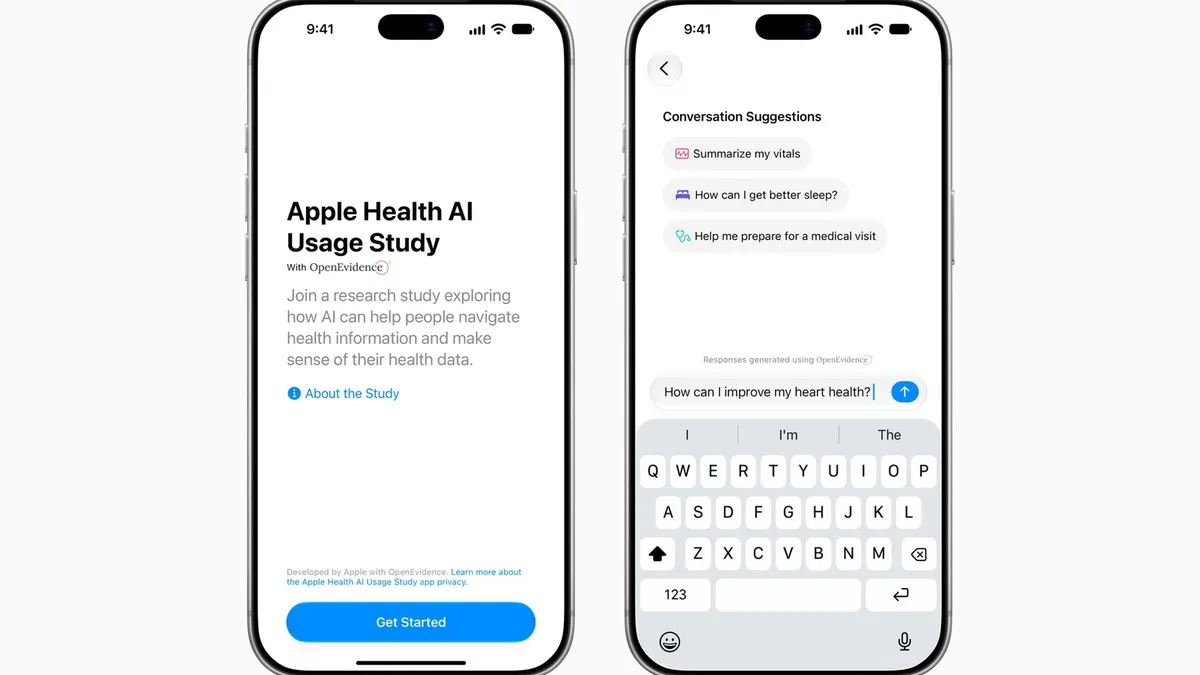
Apple launched the Apple Health AI Usage Study on Sunday, November 15, 2026. It's a virtual research study that runs through its own iPhone app, the Apple Health AI Study App on the App Store.
People in the study ask everyday health questions and get plain-language answers from OpenEvidence, a clinical AI tool that doctors already use. Each answer links to peer-reviewed sources, from journals such as NEJM, JAMA and Nature. Participants rate the answers and fill out monthly surveys. TechCrunch reports the study runs for more than 12 months.
Apple is clear that the app isn't meant to diagnose or treat anything. It has guardrails that flag certain worrying questions and point people to a health care provider. The Verge reports the app doesn't use Apple Intelligence and isn't tied into Siri, so this is separate from Apple's own assistant.
Who can join, and which iPhones work?
- Up to 200,000 participants
- Age 21 or older, in the US only
- An iPhone 15 Pro or later, running iOS 26 or later
- Free to join
Some early reports said any iPhone 15 works. Apple's own wording says iPhone 15 Pro or later, so a regular iPhone 15 won't qualify.
What happens to your health data?
Sharing is opt-in. You can choose to connect HealthKit, the store on your iPhone that holds data from the Health app, such as resting heart rate, activity, sleep and lab results. The study wants to see whether personal data makes the answers more useful. You can also skip it and just ask questions.
Apple says study data won't be used to train AI models. TechCrunch, citing Apple, reports that OpenEvidence deletes question and answer data after 24 hours.
Why Apple is going slow on health AI
Lots of people already ask chatbots about symptoms and lab results. OpenAI said earlier this year that users ask more than 300 million health questions a week, according to TechCrunch. Apple is starting with a study that uses cited sources, opt-in data and no model training, before health answers show up anywhere near Siri or the Health app.
For small health and wellness businesses, it sets a bar. Customers will soon expect any health AI to show its sources and explain what it does with their data. AI is also moving into insurance paperwork; here's what AI prior authorization means for patients.
For more on Apple's AI plans, read our Apple Intelligence usage packs story.
X reactions
The Verge shared the news, and OpenEvidence's CEO didn't hold back on the pairing:
The study will be conducted through a new app where participants can ask health questions and rate the responses. https://t.co/5TZUq17d1Z
— The Verge (@verge) November 15, 2026
“OpenEvidence is the most trusted and loved brand product among doctors. Apple is the most trusted and loved brand and product among consumers, and especially health consumers. So you have to bring these two things together. It’s like peanut butter and jelly.”
— OpenEvidence (@OpenEvidence) November 15, 2026
--OpenEvidence CEO Daniel Nadler
Our take
We like the approach. Health is where a confident wrong answer does real harm, and Apple chose linked sources, opt-in data and a long study over a flashy Siri feature. That's the right order.
The trade is your data and your time. You're helping Apple learn, and the answers still aren't medical advice. If you join, treat it as a smarter way to read up before a doctor's visit. Keep lab results unshared until you've read the consent screens, and take anything serious to a real person.
— Artificially Nerdy
What to do this week
- Check your phone first. You need an iPhone 15 Pro or newer on iOS 26 or later.
- Read the consent screens before you connect HealthKit, and share only what you're comfortable with.
- Click the sources on any answer that matters to you, then bring questions to your doctor.
- Run a health or wellness business? Plan to show sources and explain data use in any AI tool you offer customers.
FAQ
Does the Apple Health AI Study cost anything?
No. It's free to join.
Can I join from outside the US?
No. The study is open only to people in the US who are 21 or older.
Is OpenEvidence the same as ChatGPT?
No. OpenEvidence is a separate clinical AI tool used by doctors. In this study, it writes the answers and links them to peer-reviewed journals.
Will Apple use my questions to train its AI?
Apple says study data won't be used to train AI models.
Sources
- Apple Newsroom: Apple launches research study to explore the use of AI for health — updated November 15, 2026. Participants, eligibility, iPhone and iOS needs, HealthKit, no training, guardrails.
- App Store: Apple Health AI Study App
- The Verge: Apple's new study looks to improve the effectiveness of AI health tools — Andrew Liszewski, November 15, 2026. No Apple Intelligence, no Siri.
- TechCrunch: Apple launches new app to study how people use AI for health — Ivan Mehta, November 15, 2026. 12+ months, 24-hour deletion, 300M+ weekly health questions.
- The Verge on X — November 15, 2026, 8:30pm ET.
- OpenEvidence on X — November 15, 2026, 11:08pm ET.