
TL;DR
Should I tell customers when I use AI in my work?
A GDC survey says 40% of game developers now use AI at work, yet one studio got over 400 negative reviews for about 10 lines of AI-assisted code. Using AI is becoming normal, but customers may still react hard. Write down what you use AI for, and what you'll disclose, before anyone asks.
Skip the details: Lots of creators use AI now, some customers hate it, so decide your rules and how you'll explain them ahead of time.
How many game developers use AI at work?
On Thursday, November 12, 2026, the organizers of the GDC Festival of Gaming (the yearly game developers conference) released their annual State of the Game Industry survey. According to The Verge, 40% of developers surveyed say they use generative AI, meaning tools that write text, code or images from a prompt, "as part of their job." That's up from 36% in 2025.
Use is much higher in some corners. It reached 58% among people working on free-to-play games and 70% at mobile-only studios. Most of it is behind-the-scenes work: 73% of AI users said they use it for research and brainstorming, 62% for data analysis and summaries, and 56% for writing or fixing code. Only 22% used it for concept art, and 8% for final art that ships in a game.
One X user summed up the numbers with "the tools are in the building. the debate isn't over" (peter on X). GamesIndustry.biz shared the report on Thursday, noting that survey project lead Beth Elderkin "lays bare the mood of the industry, the job market, and how people are making games" (@GIBiz on X).
The same survey has hard news on jobs: 34% of respondents said they had been laid off at some point in the past two years. The survey reports layoffs and AI use as separate findings, and it doesn't say one caused the other. For the people behind that number, it's a tough stretch whatever the reason.
What happened with Big Walk and AI?
Big Walk is a co-op puzzle game from House House, the small studio behind Untitled Goose Game. This week, the studio said publicly that large language models (LLMs, the tech behind chatbots like ChatGPT) were "used sparingly" near the end of development. Ars Technica reports the use came after a stubborn Unity engine bug was causing shadow problems. A chatbot suggested a possible fix, the team reworked it heavily, and about 10 lines of code made it into the game. House House says that's "well under 0.1%" of Big Walk's code.
The reaction was loud anyway. The game's Steam page picked up over 400 negative reviews, though its overall rating there stayed "Very Positive." House House apologized that the game's AI use may not meet the standards of people working to limit AI's harm to games, and it said the disclosure was not an argument for using these tools.
To be fair to the studio, it told people about something many teams would never mention. Some critics and judges still found any AI use unacceptable, while others said a last-resort bug fix is very different from a game built on AI art.
Is AI going to replace big game teams?
Nobody knows yet, but at least one industry leader expects big changes. In a post this week, Xbox CEO Asha Sharma said:
"A small team will be able to build worlds that today demand hundreds of developers and hundreds of millions of dollars."
That's a forecast from one company's leader, not a finding from the survey. Put it next to the Big Walk story, though, and you can see the squeeze creators are in. Industry leaders are talking up what AI can do, while a vocal share of the audience treats even small use as a broken promise.
Should I disclose AI use to my customers?
We think that's your call to make, and the mistake is leaving it unmade. Ars Technica calls House House's disclosure belated: the studio didn't mention the AI help when the game came out on Steam earlier this year, so fans heard about it only once it became public news. A freelance designer, a YouTuber, a small app maker or a writer can land in the same spot when a client asks "Did you use AI on this?" and there's no ready answer.
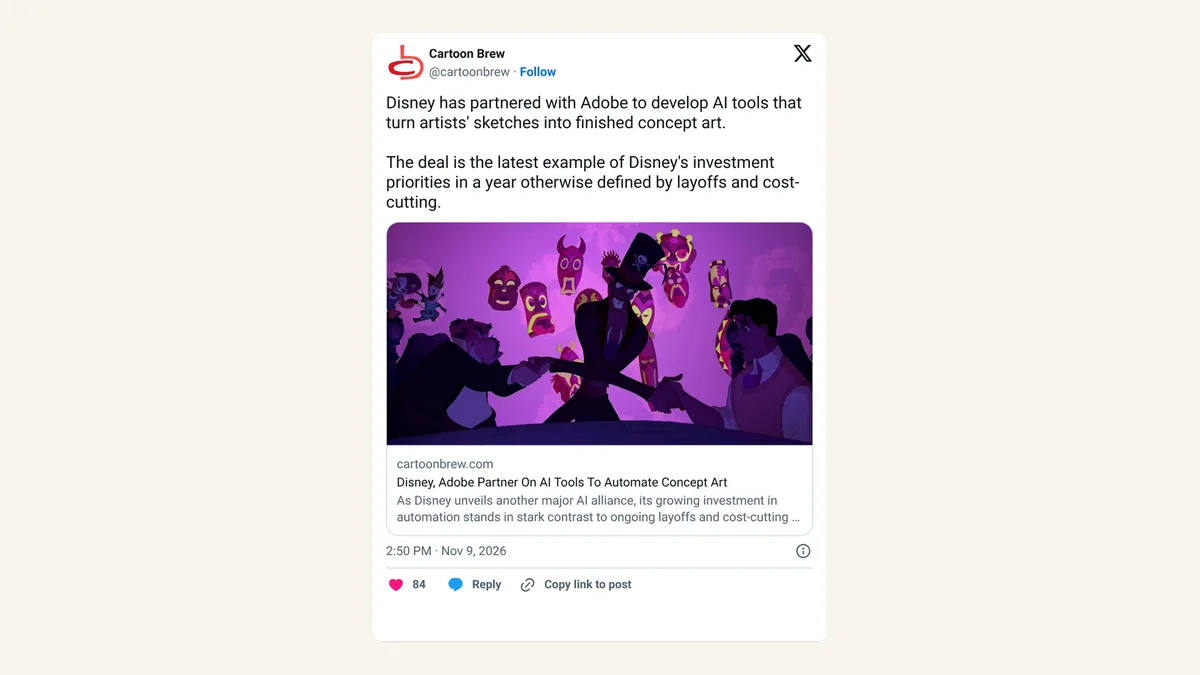
Deciding early gives you a calm, clear reply instead of a scramble. It also lets you match your rules to your audience. A mobile game team, where 70% of workers use AI, faces different expectations than an indie artist whose fans chose them for handmade work. Our earlier look at Disney training AI on its own art shows the same pressure from the big-company side.
How do I write a simple AI policy?
A one-page note is enough. Fill in this table for your own work, save it, and put a short version on your site, FAQ page or proposal template.
| Question to answer | Example answer | Why it matters |
|---|---|---|
| Where do I use AI? | Research, summaries, fixing code | Matches the top uses in the GDC survey |
| Where do I never use it? | Final art, voice, anything a client pays for as handmade | Draws the line your audience cares about most |
| What do I disclose, and where? | A line on the FAQ or in every proposal | Tells people before they find out on their own |
| Who checks AI output? | A person reviews and edits everything | Shows the work is still yours |
| What if I change my mind? | Update the note and say so | Keeps your note accurate as tools and views shift |
Then rehearse your answer to "Did you use AI?" in two sentences. If the true answer would embarrass you, that's a sign to change the practice or the policy now, while it's quiet.
FAQ
What share of game developers use AI?
The GDC Festival of Gaming survey found 40% use generative AI as part of their job, up from 36% in 2025, with 70% at mobile-only studios.
How much AI was used in Big Walk?
House House says LLMs helped with about 10 lines of code, "well under 0.1%" of the game's code, after a Unity engine bug.
Did AI cause the game industry layoffs?
The survey doesn't say that. It reports that 34% of respondents were laid off in the past two years as a separate finding from AI use.
Do I legally have to disclose AI use in creative work?
That depends on where you sell and what you make, and it isn't covered by this survey. This piece is about the trust side: deciding what you'll tell customers before they ask.
Sources
- The Verge: More game developers are starting to use generative AI — November 12, 2026. 40% vs. 36%; 58% free-to-play, 70% mobile-only; 73% / 62% / 56% / 22% / 8% uses; 34% laid off in the past two years; Asha Sharma quote.
- Business Wire: GDC Festival of Gaming's 15th State of the Game Industry Report Reveals AI Adoption Rate, Labor Realities, and More — November 12, 2026. The organizers' own release of the survey.
- Ars Technica: Big Walk used AI to fix a bug. Now the indie gaming world is having a reckoning. — November 11, 2026. "Used sparingly," Unity bug, about 10 lines, "well under 0.1%," apology, 400+ negative Steam reviews, "Very Positive" overall.
- GamesIndustry.biz (@GIBiz) on X — November 12, 2026.
- peter (@stpete69) on X — November 12, 2026.