
TL;DR
What does Disney's own AI mean for people who make art for a living?
Disney and Adobe will build AI models trained on Disney's own characters and styles. Big clients will want AI that copies their look, and creators with AI skills say they get more work. Keep the rights to your past work clear, learn one AI tool well, and stay the one who makes the final call.
What did Disney and Adobe announce?
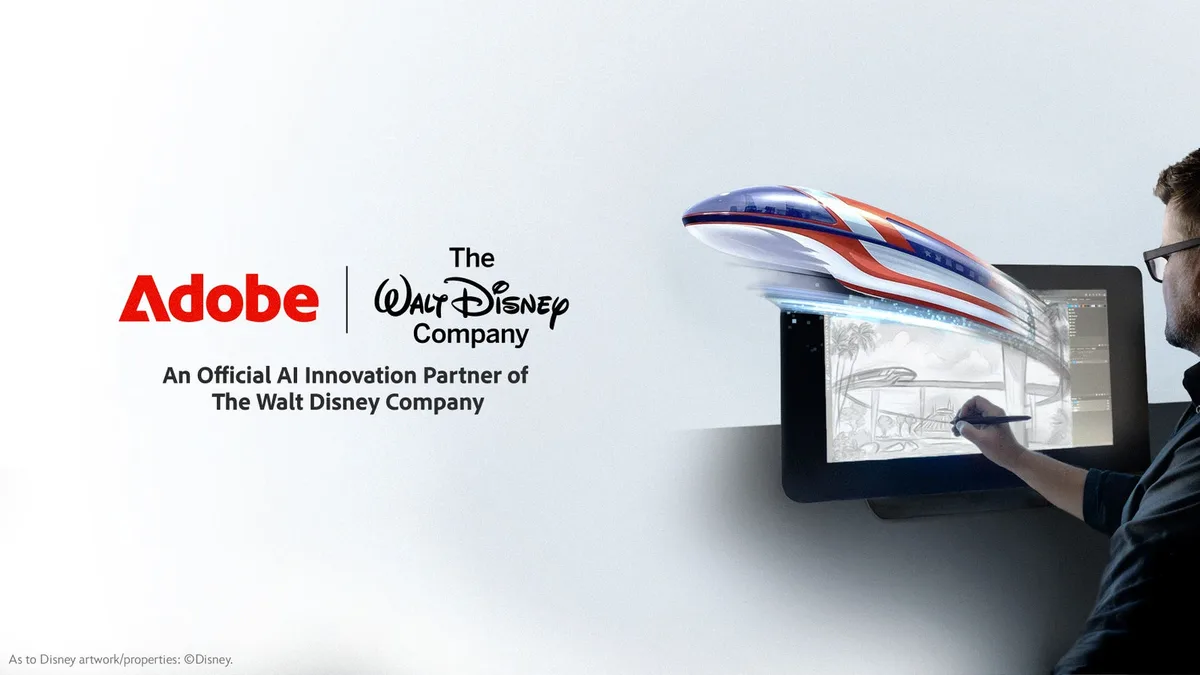
On Monday, November 9, 2026, at Adobe's MAX conference, Adobe and Disney announced a multi-year alliance. Adobe becomes Disney's "Official AI Innovation Partner," and Disney will work with Adobe Firefly Foundry on private generative AI models "trained on unique world knowledge (character attributes, environments, visual styles)." The goal, in Adobe's words, is "commercially safe and production-ready outputs." The Disney and Adobe deal details cover the rest.
One part is already working. Walt Disney Imagineering, the team that designs Disney's parks, uses a Firefly Foundry sketch-to-image model that turns hand-drawn concepts into rendered 2D concept art. The artist still draws the sketch. The model does the rendering.
The same day, The Verge, citing Bloomberg, reported that Disney is preparing to lay off thousands of people and is targeting 20% annual cost savings, which would be its fourth round of cuts this year. That is Bloomberg's reporting, and Disney hasn't announced it. Nothing ties those cuts to the Adobe deal. For the people who may lose their jobs, the timing still stings, and it's fair to say so.
Why train AI only on your own art?
Many popular image generators learned from pictures gathered across the internet, and that has led to lawsuits from artists and studios. A model trained only on art a company owns sidesteps much of that fight. Disney can use what comes out with far less worry that it borrowed someone else's style.
We expect a lot of companies to copy this. If you have decades of characters, product photos or brand art, a private model that knows your look is very tempting. For freelancers, that changes the brief. A client may soon hand you their own AI along with the style guide and ask you to work with both.
It also makes your back catalog more valuable. If a client can train a model on art they own, the question of who owns the work you made for them stops being paperwork.
Are creators who use AI getting more work?
Adobe released its Creators' Toolkit Report the same day. The Harris Poll surveyed 2,000+ US creators in October 2026. Adobe sells AI tools, including Firefly, so read the numbers with that in mind. Here is what it found:
| What creators said | Share |
|---|---|
| Creative AI accelerated growth of their business or following (creators who use it) | 78% |
| Same, full-time creators | 89% |
| Creators with advanced AI skills get opportunities they don't | 60% |
| Expect that gap to widen | 51% |
| Full-time creators who turned down a paid video job in the past three months for lack of skills | 34% |
| Gave up on AI mid-project in the past three months | 47% |
| The final creative decision should always stay with the human | 77% |
The headline is upbeat, and plenty of creators clearly are getting more done. The smaller numbers matter as much. More than a third of full-time creators turned down paid video work because they lacked the skills, and nearly half gave up on AI partway through a project. Those are people losing income or time to a learning curve, often while paying for the tools.
AI is helping some creators take on more work, while big studios use it to do more with fewer people.
Both trends are happening at once, and which side you land on depends a lot on skills and on who owns the work.
What are creators saying about Disney's AI deal?
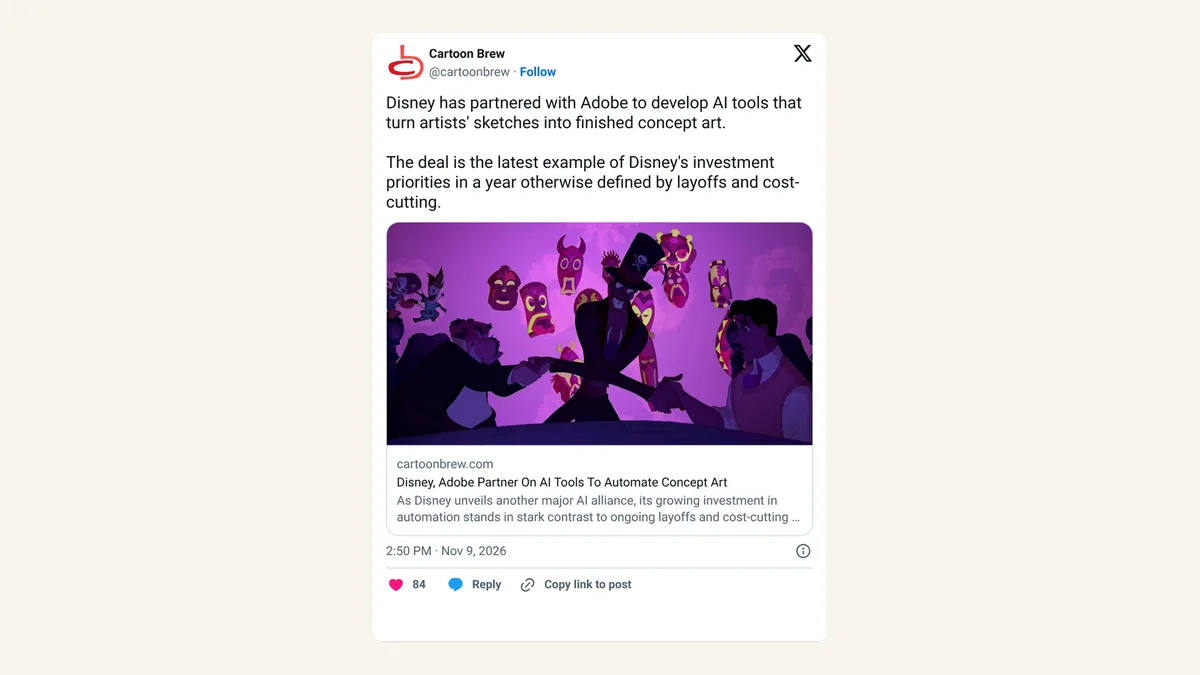
Reactions split along familiar lines. Cartoon Brew wrote on X that the deal "is the latest example of Disney's investment priorities in a year otherwise defined by layoffs and cost-cutting" (Cartoon Brew on X). Dani Bowman (@DaniMationEnt) drew a line many artists care about: "Remember Disney, there's a big difference between AI Assisted and AI Generative" (Dani Bowman on X).
Freelancers are asking practical questions too. One r/editing thread is titled "Which AI tools are actually safe for paid client work? (2026)." That's the right worry. Clients care whether the output is safe to use, and models trained on owned art are one answer big companies are choosing.
How can creators protect their work and income?
The wider job market isn't giving much cushion. The US added 165,000 jobs in October and unemployment was 4.1%, but the average unemployment spell hit 27.1 weeks, the longest since September 2021, according to the October jobs report via CNBC. Finding the next gig can take a while, so it pays to prepare before you need to.
A few steps we'd take this month:
- Read your contracts for AI and training clauses. Know whether a client can use your past work to train a model, and ask for that to be spelled out and priced in new deals.
- Learn one AI tool well enough to finish a project. The survey's 47% who gave up mid-project suggests depth beats dabbling.
- Offer the human part by name. Direction, taste, client calls and final sign-off are what 77% of creators say should stay human, and clients pay for them.
- Keep your own archive organized. Dated files and clear ownership notes help if a client asks to train on your work, or if you want to train your own.
- Price AI-assisted work honestly. Faster doesn't have to mean cheaper if the result and the rights are what the client needs.
If you've lost work this year, none of this is a judgment on you. Big studios are making cost choices well above any single artist's head. What you can control is how ready you are for the next brief, and that's worth a little time each week.
FAQ
Will Disney's AI replace its artists?
Disney hasn't said that. The one tool described so far turns artists' sketches into rendered concept art, so a person still starts the work. Reported layoffs are separate and not linked to the deal.
Can a company train AI on work I made for them?
It depends on your contract. Work-for-hire deals often give the client ownership, so check the wording and ask about training rights in new contracts.
Is Adobe's survey trustworthy?
It was run by The Harris Poll with 2,000+ US creators, but Adobe sells AI tools and published it. Treat it as one useful signal rather than the full picture.
What does "commercially safe" mean for AI images?
Generally, that the output is unlikely to copy someone else's protected work, because the model learned from material the company has rights to.
Sources
- Adobe: Adobe and The Walt Disney Company alliance — November 9, 2026.
- Adobe: Creators' Toolkit Report — November 9, 2026. The Harris Poll, 2,000+ US creators, October 2026.
- The Verge: Disney and Adobe generative AI partnership — November 9, 2026, citing Bloomberg on planned layoffs.
- CNBC: October 2026 jobs report — November 6, 2026.
- X posts: Cartoon Brew and Dani Bowman — November 9, 2026.
- r/editing thread title via Google search results: Which AI tools are actually safe for paid client work? (2026).