
TL;DR
What's happening to ChatGPT's Standard and Advanced voice?
OpenAI will remove Standard and Advanced voice from ChatGPT on December 11, 2026, and voice chats will run on GPT-Live. If you talk to ChatGPT out loud, the voice you know may sound and behave differently next month. Try GPT-Live this week so you have time to adjust before the switch.
What did OpenAI announce?
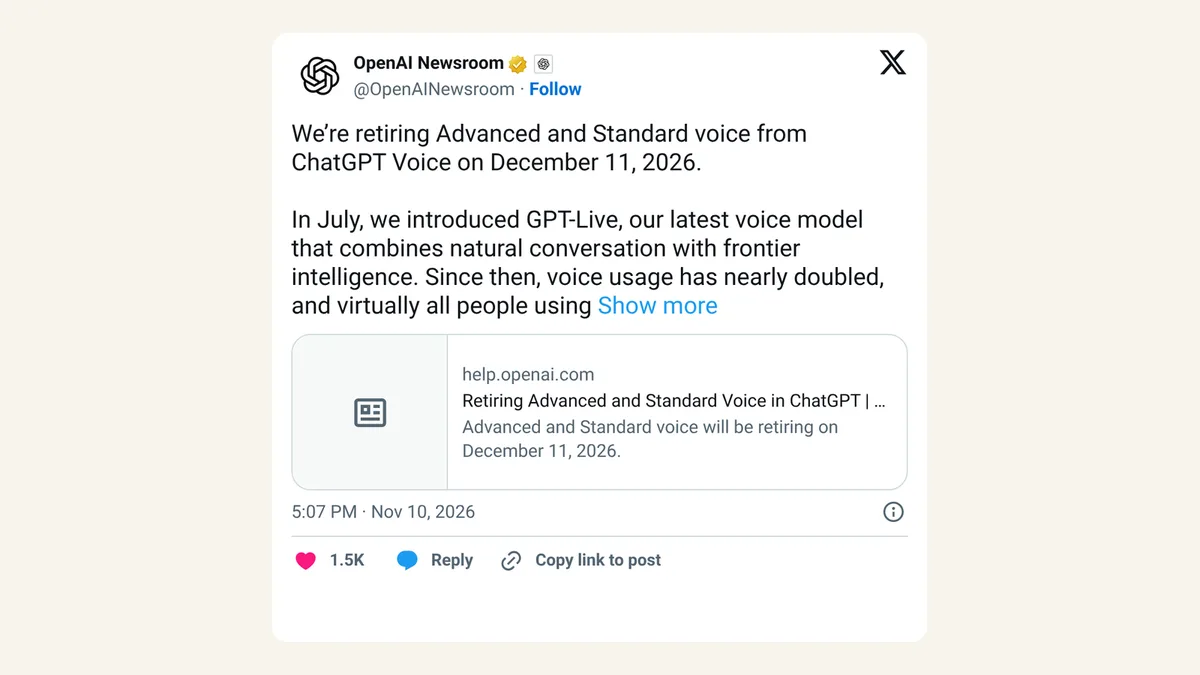
On Tuesday, November 10, 2026, at 5:07pm ET, OpenAI said it is retiring Advanced and Standard voice from ChatGPT Voice on Friday, December 11, 2026. After that, voice chats in ChatGPT run on GPT-Live, the voice model OpenAI introduced in July. The news came from the OpenAI Newsroom account on X, with the details in a Help Center article.
OpenAI gave two numbers to explain the move. Since GPT-Live launched, voice usage in ChatGPT has "nearly doubled," and "virtually all people using voice in ChatGPT now use GPT-Live," by OpenAI's count. The company says dropping the older modes lets it simplify voice and focus on improving GPT-Live.
What changes, and what stays
- Until December 11: nothing changes. You can keep using Advanced or Standard voice during the transition.
- On December 11: Advanced and Standard disappear from the model picker in Settings > Voice. Anyone who had picked one of them gets moved to Live voice automatically.
- Live video and screen-sharing: these stay on Advanced voice until GPT-Live can do them. OpenAI hasn't given a date for that.
- Custom GPTs: voice chats with custom GPTs keep using Advanced voice until custom GPTs themselves are retired on December 11, 2026. If you built any, save your setup now.
- Your old chats: conversations you had in Advanced or Standard voice stay in your ChatGPT history. You can pick them up again in text or voice, which will be GPT-Live after December 11.
OpenAI says it is bringing lessons from the older modes into GPT-Live, naming the depth and detail of answers, remembering context across conversations, and better personalization as areas it is working on.
Live, Advanced and Standard voice compared
| Live voice (GPT-Live) | Advanced voice | Standard voice | |
|---|---|---|---|
| How it works | Listens and speaks at the same time (OpenAI calls this "full-duplex") | Handles audio directly, but waits for you to stop talking before it answers | Three models in a chain: speech to text, a text model writes the reply, then text to speech |
| Conversation feel | Quick back-and-forth; can say "mhmm" or "yeah," or stay quiet while you think | Turn by turn, which OpenAI calls "rigid back-and-forth" | Slower replies, by OpenAI's description |
| Extra skills | Can hand hard questions or agent tasks to OpenAI's text models while it keeps talking | Still runs live video and screen-sharing | None listed |
| After Dec 11, 2026 | The only voice option in ChatGPT | Removed from the picker (still runs live video and screen-sharing until GPT-Live can) | Removed |
Who this affects
Anyone who talks to ChatGPT instead of typing. That includes people brainstorming hands-free on a walk, practicing a new language, rehearsing a sales call or a tricky conversation, and people who rely on voice for accessibility.
The biggest shift is pace. Advanced voice waited for you to stop speaking before it answered, and OpenAI describes Standard voice's replies as slow. GPT-Live talks more like a person on the phone: it listens and speaks at the same time, and it can chime in with small sounds. Some people will love that. People who need a slower, turn-by-turn rhythm may find it harder, and they have about a month to figure out what works.
X reactions
Among the replies to OpenAI's post on X was this one, from a user who says Standard voice is the only option that works for many neurodivergent people. It's one person's view, and a useful reminder of who relies on the older mode.
@OpenAINewsroom Higher usage doesn’t make GPT Live accessible. Standard Voice is the only usable option for many neurodivergent users, and it needs to stay
— 𝐸𝓁𝓁𝑜𝒮𝓊𝓃𝓈𝒽𝒾𝓃𝑒☀️ (@ElloSunsh1ne) November 10, 2026
Our take
For most people this will barely register. OpenAI says nearly everyone using voice is already on GPT-Live, so the likely reaction is a shrug. A month's notice is fair, and keeping live video and screen-sharing running until GPT-Live catches up is the right call.
The people to think about are the ones who chose Standard voice on purpose. A slow, predictable rhythm can matter more than a clever reply if you're learning a language, processing what you hear at your own speed, or using voice because typing is hard. "Most people moved" is a good reason to simplify, and a poor comfort if you're in the group that didn't.
So spend ten minutes with GPT-Live this week, in the kind of conversation you actually have. If it talks over you, tell it how you like to talk and see whether it adapts. Better to find the rough edges now than on December 11.
— Artificially Nerdy
What to do this week
- Open Settings > Voice in ChatGPT, check which voice model is picked, switch to Live if it isn't already, and have one real conversation with it.
- Use voice for language practice or role-play? Run your usual session in GPT-Live and note anything that feels off, such as pace or interruptions.
- Tell GPT-Live how you want it to behave, for example "wait until I say I'm done before you answer," and see how well it sticks.
- Rely on live video or screen-sharing? Keep using it. That still runs on Advanced voice for now.
- Built custom GPTs you talk to? Copy their instructions and files somewhere safe before December 11.
- Looking at other talking AI tools? See the voice and audio tools guide.
FAQ
Will I lose my old voice conversations?
No. OpenAI says conversations from Advanced and Standard voice stay in your ChatGPT history and can be continued in text or voice.
What happens if I still have Standard voice selected on December 11?
ChatGPT moves you to Live voice automatically. Advanced and Standard won't appear in the picker anymore.
Can GPT-Live do live video or share my screen?
Not yet. Those features keep running on Advanced voice until GPT-Live has them, according to OpenAI.
Can I download a copy of my ChatGPT data before the change?
Yes. OpenAI's Help Center article points to its data export option for eligible ChatGPT data.
Sources
- OpenAI Help Center: Retiring Advanced and Standard Voice in ChatGPT — read November 10, 2026. Retirement date, transition period, Settings > Voice picker change and automatic move to Live voice, how Live, Advanced and Standard voice differ, live video and screen-sharing, custom GPTs, conversation history, data export.
- OpenAI Newsroom (@OpenAINewsroom) on X — November 10, 2026, 5:07pm ET. The announcement, GPT-Live's July launch, "nearly doubled" and "virtually all" usage figures, areas OpenAI is improving.
- 𝐸𝓁𝓁𝑜𝒮𝓊𝓃𝓈𝒽𝒾𝓃𝑒☀️ (@ElloSunsh1ne) on X — November 10, 2026, 5:10pm ET. Reply about Standard voice and neurodivergent users.