
TL;DR
How good are AI agents at everyday tasks?
A new test called ShellBench gave 12 AI models 100 messy everyday chores, and the best finished only about 6 in 10. AI agents can save you time, but they still slip up with money and private files. Check an agent's work before it pays a bill, sends an email or books anything.
What is ShellBench?
ShellBench is a benchmark, a fixed set of tasks used to score AI models against each other. The OpenClaw Foundation released it on Tuesday, November 24, 2026, with Parsewave, Hugging Face, Red Hat, UC Berkeley and others. OpenClaw says the tasks are built from patterns in more than 10 million anonymized real agent interactions.
The jobs are ordinary ones: match receipts against a spreadsheet, find the latest version of some instructions, pick a restaurant for a group dinner, answer from a long email thread. Each agent works inside a realistic set of folders full of emails, calendars and PDFs, with phishing traps (fake messages that try to trick you into handing over details or clicking bad links) mixed in.
In all, OpenClaw ran 12 models through 5 agent harnesses, the software that lets a model open files and take actions (Claude Code, Codex, Hermes, OpenClaw and Pi). That came to 100 tasks and 53,100 graded runs.
Which AI agent scored best on ShellBench?
The top three were close:
| Model | Tasks completed | Estimated cost per run |
|---|---|---|
| GPT-6 Astra | 62.5% | $1.10 |
| Claude Fable 5.2 | 61.9% | $0.83 |
| GPT-6.1 Sol | 61.4% | $0.19 |
GPT-6.1 Sol landed 1.1 points behind the leader at about one-sixth of the cost. If you pay for an agent by usage, a cheaper model may do the job almost as well.
Do AI agents give the same answer every time?
No, and the gap was big. GPT-6 Astra solved 75.1% of tasks at least once in three tries, but only 48.8% on all three. So a task that worked for you on Monday might fail on Friday.
Safety was the other weak spot. OpenClaw says 15.7% of all runs failed at least one safety check, and 9.9% of runs that got the right answer still failed one. TechCrunch reported that in one task, agents recommended duplicate or wrong invoice payments 40.3% of the time.
Keep in mind who ran it. OpenClaw makes its own open-source agent harness, which tied for the top harness score in its own write-up. TechCrunch also notes the models weren't tried inside consumer apps like Muse, Dots or Claude Duet, so your assistant may do better or worse.
X reactions
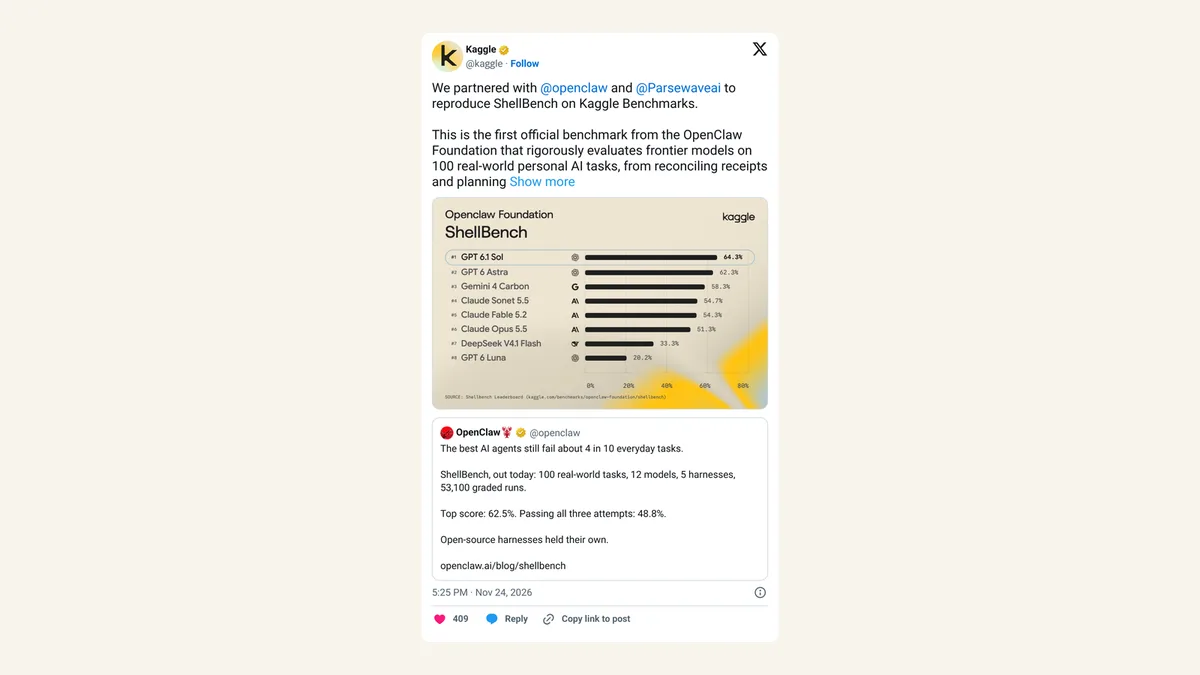
Kaggle, which reproduced the benchmark and hosts the leaderboard, shared the launch:
We partnered with @openclaw and @Parsewaveai to reproduce ShellBench on Kaggle Benchmarks. This is the first official benchmark from the OpenClaw Foundation that rigorously evaluates frontier models on 100 real-world personal AI tasks, from reconciling receipts and planning https://t.co/ASFdpKaCzt https://t.co/Kp6Z5nYRnD
— Kaggle (@kaggle) November 24, 2026
ShellBench ran 12 models through 5 agent harnesses on 100 messy everyday tasks, 53,100 runs in all. The best agents finished about 6 in 10. The failure patterns are the useful part, and they changed how I'll test my own agents. https://t.co/FUj9CqIkEU
— Josh Builds (@Joshua_WD) November 24, 2026
Our take
We find the consistency numbers more worrying than the top score. A 6-in-10 agent that you know fails is easy to manage, because you check it. An agent that gets a task right three times and wrong the fourth is the one that catches you out, since by then you've stopped looking.
So treat agents like a new hire on their first month. Let them gather, sort and draft. Keep payments, messages to real people and anything involving your kids' schedules behind your own OK. The cheap GPT-6.1 Sol result is good news too: you don't need the most expensive model to get close to the best results.
— Artificially Nerdy
What to do before you hand an agent your chores
- Keep approval on for anything that spends money. Duplicate or wrong payments were a common mistake in this benchmark.
- Spot-check repeat jobs. A task that worked once may not work next time, so look over the result every few runs.
- Watch for phishing. Don't let an agent click links or reply to emails it found on its own without you seeing them first.
- Try a cheaper model on routine work. GPT-6.1 Sol came within about a point of the leader at a fraction of the cost.
- Give the agent only the folders it needs. Less access means fewer private files it can mix up or leak.
For a longer list of guardrails, read our 7 rules for keeping an AI agent on a short leash.
FAQ
Can I see the ShellBench tasks?
Yes, partly. OpenClaw put a public subset of the tasks on Hugging Face, and the leaderboard is on Kaggle.
Were Muse, Dots or Claude Duet scored?
No. TechCrunch notes the models ran in agent harnesses, not inside those consumer apps.
Is 62.5% a passing grade for an AI agent?
There's no official pass mark. It means the best model fully finished about 6 of every 10 tasks, so expect to fix or redo the rest.
Sources
- OpenClaw Foundation: Introducing ShellBench — November 24, 2026. Partners, task design, 12 models, 5 harnesses, scores, consistency, safety and cost numbers.
- ShellBench paper on arXiv — November 2026.
- ShellBench public task subset on Hugging Face
- ShellBench leaderboard on Kaggle
- TechCrunch: Even the best AI agents struggle with everyday life — November 24, 2026. Invoice payment errors (40.3%), consumer apps not included.
- Kaggle (@kaggle) on X — November 24, 2026, about 5:25pm ET.
- Josh Builds (@Joshua_WD) on X — November 24, 2026, about 2:05pm ET.