
TL;DR
What is Meta Muse Ember?
Meta released Muse Ember on Monday, its smallest and cheapest AI model for repeat jobs inside apps and automations. That can cut the cost of AI-powered chatbots and workflows. If you pay for an AI model in a tool you use, ask your developer to price Ember against it.
What happened
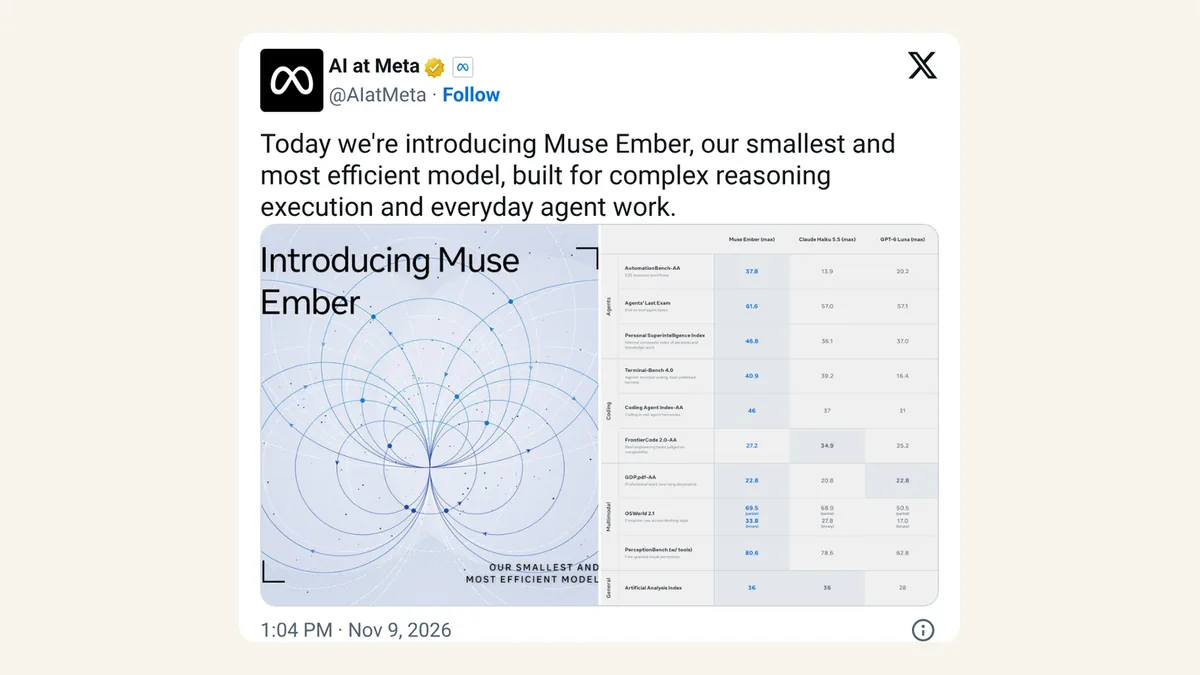
Meta introduced Muse Ember on Monday, November 9, 2026, and posted it on X at 1:04pm ET. Meta calls it its "smallest and most efficient model," made for "the work agents repeat all day: tool calls, coding subtasks, routing, extraction, and long document parsing." An agent here means AI that carries out a task step by step, like sorting support emails or filling in a spreadsheet.
Ember is live now on the Meta Model API, Meta's paid service for developers, and in Muse Code, Meta's coding tool. TechCrunch notes it's the fourth model under the Muse name, after Spark, Glimmer and Wonder.
What Muse Ember does
- Handles the busywork. Meta built it for the many small steps an agent repeats: calling tools in order, pulling data out of documents, routing requests and making targeted code fixes.
- Reads a lot at once. A 1M-token context window, meaning it can take in a full codebase or a big stack of documents in one go, and write up to 512,000 tokens back.
- Understands more than text. It reads images, audio and video natively, so an agent can work from a screenshot, a scanned document or a voice memo without a second model.
- Works as the helper. Meta pairs it with its biggest model: "Muse Wonder plans, Muse Ember handles the volume."
What it costs
Prices are per million tokens (the chunks of text AI is billed by), in US dollars, before tax, from Meta's Model API pricing page.
| Usage | Requests up to 200K input tokens | Requests over 200K input tokens |
|---|---|---|
| Input | US$0.10 | US$0.30 |
| Cached input (repeated text it has seen before) | US$0.004 | US$0.012 |
| Output | US$0.50 | US$1.50 |
Watch the 200K line. A request with more than 200K input tokens is billed at the higher rate in full, not only for the tokens past the line. Ember runs only in Meta's Standard mode, where Meta says your content is not used to train its models. Web search adds US$2.50 per 1,000 searches.
For tips on picking cheaper models without a surprise bill, read our guide to model routing and spending limits.
How it compares
These are Meta's own figures, built on scores from Artificial Analysis, an AI benchmarking firm.
| Model | Artificial Analysis Intelligence Index (max effort) | Cost per index task | List price per 1M tokens (input/output) |
|---|---|---|---|
| Muse Ember | 36 | about US$0.14 | US$0.10 / US$0.50 |
| Claude Haiku 5.5 | 36 | US$0.41 | not on our sources |
| Muse Spark 1.3 | 37 | US$2.39 | US$1.25 / US$4.25 |
Meta says Ember "beats every Luna setting," meaning OpenAI's GPT-6 Luna. It isn't best at everything. On FrontierCode 2.0, a benchmark of real engineering fixes, Haiku 5.5 scored 34.9% to Ember's 27.2%, by Meta's own chart.
Where you can get it
- Meta Model API and Muse Code, as
muse-ember-1.0. - Google Cloud and Oracle Cloud, which Meta says now carry Ember, Spark and Wonder.
- Vercel's AI Gateway, per Vercel's developer account on X.
Meta announced no change to the Meta AI app.
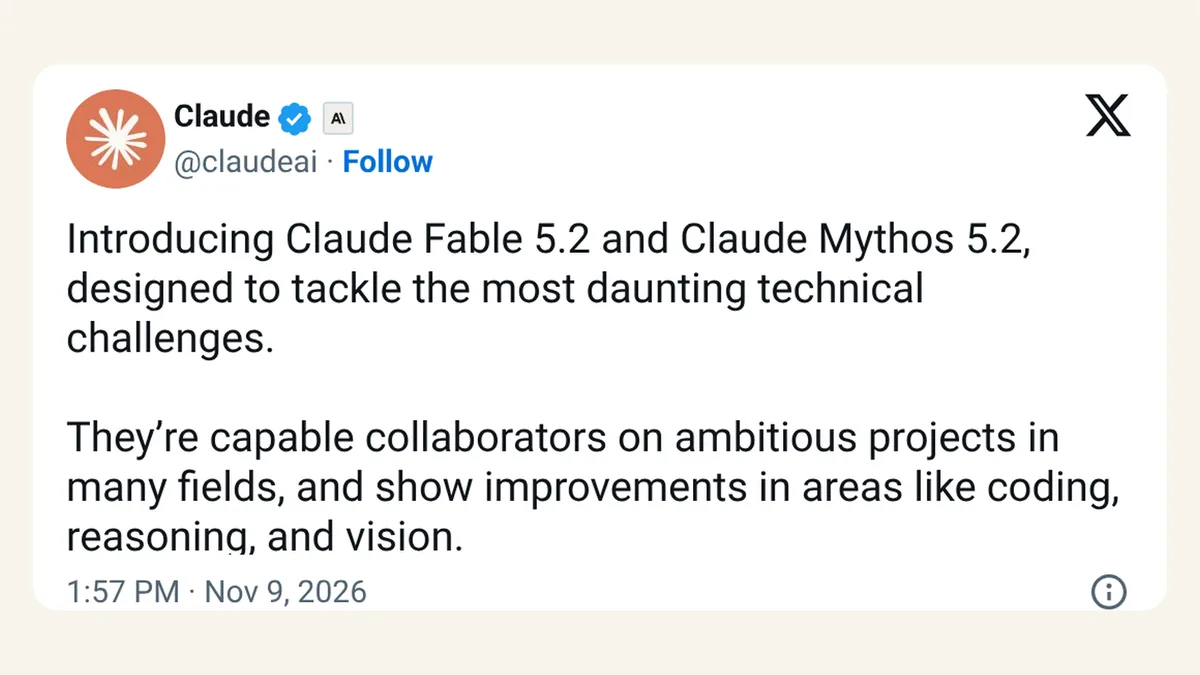
Anthropic cut the price of its top public model the same day; read our Claude Fable 5.2 story.
X reactions
The benchmarking firm behind Meta's comparison and a major developer platform both posted within hours.
Meta's newest model Muse Ember scores 36 on the Artificial Analysis Intelligence Index, matching Claude Haiku 5.5 (max) at a third of the Cost per Task
— Artificial Analysis (@ArtificialAnlys) November 9, 2026
Muse Ember is now available on AI Gateway.
— Vercel Developers (@vercel_dev) November 9, 2026
A lightweight reasoning model by @AIatMeta for repeatable work like coding sub-tasks, tool calls, and document summaries.
Our take
Small models do most of the work inside the AI tools people already pay for: the support bot that tags tickets, the app that reads invoices, the automation that sorts leads. When that layer gets cheaper, the savings can show up in your subscription or in how much you can automate before the bill bites.
Two cautions. Artificial Analysis found Ember's knowledge is its weak spot: it declines to answer 64% of questions on the firm's AA-Omniscience knowledge benchmark, which keeps its hallucination rate at half of Haiku 5.5's. Great for a careful helper, less great as your only source of facts. And the 200K pricing cliff can surprise anyone feeding it giant documents. Run it on your real tasks for a week and compare the invoice, not the chart.
— Artificially Nerdy
What to do this week
- Using an AI chatbot or automation tool at work: ask the vendor which model it runs and whether a cheaper one like Ember is on its list.
- Building on the API: price Ember against your current small model on a week of real traffic.
- Sending long documents: keep requests under 200K input tokens where you can, or budget for the higher rate.
- Everyone else: nothing to do yet. This launch is for developers.
FAQ
Is Muse Ember free?
No. It's pay as you go on the Meta Model API, starting at US$0.10 per million input tokens and US$0.50 per million output tokens.
Can I use Muse Ember in the Meta AI app?
Meta launched it for developers on the Meta Model API and Muse Code. It didn't announce any change to the Meta AI app.
Does Meta train on what I send to Muse Ember?
Ember runs only in Standard mode, where Meta says your content is not used to train its models.
Is Muse Ember better than Claude Haiku 5.5?
It depends on the job. Both score 36 on the Artificial Analysis Intelligence Index, with Ember costing about a third as much per task, but Haiku 5.5 scored higher on the FrontierCode 2.0 coding benchmark.
Sources
- Meta: Introducing Muse Ember — November 9, 2026. Launch, uses, context window, multimodal, benchmark table, cost per task, availability, Spark 1.3 comparison.
- Meta Model API: Pricing and rate limits — price tiers, 200K rule, Standard mode, web search price.
- TechCrunch: Meta releases Muse Ember — November 9, 2026. Fourth Muse model.
- AI at Meta on X: launch post — November 9, 2026, 1:04pm ET.
- Artificial Analysis on X — November 9, 2026, 1:07pm ET. Index score, Haiku 5.5 cost per task, knowledge and hallucination figures.
- Vercel Developers on X — November 9, 2026, 1:46pm ET.