
Hello fellow nerds,
A lot of people typed the same question into Google this week: can I buy the Anthropic IPO? If you have a US brokerage account, the real answer is maybe, a little, if you're lucky. We think that's worth sitting with before the excitement peaks next week, because there's a more useful question underneath it. How much of your money already rides on AI?
A door that's open wider than usual
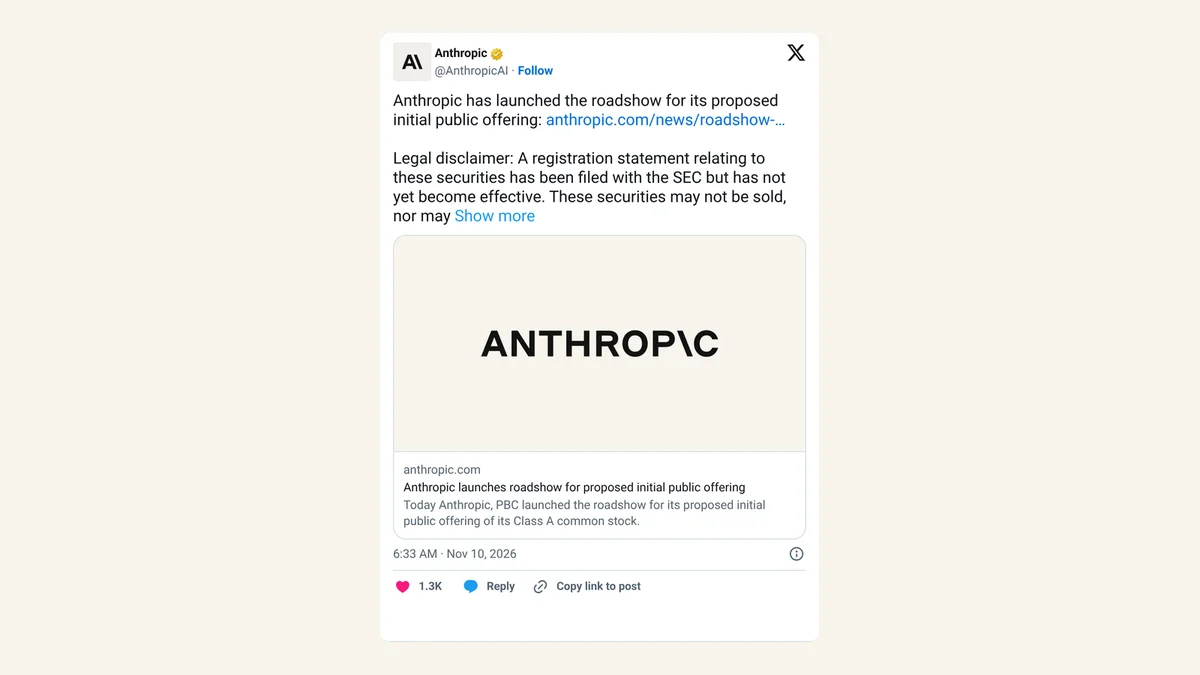
Anthropic, the company behind Claude, plans to price its shares on November 18 and start trading on Nasdaq the next day, CNBC reported, citing people familiar with the plans. The same report says Anthropic is aiming to hand about 20% of the shares to regular investors, when a typical IPO gives them 5% to 10%. In the prospectus, the co-founders wrote that they hope to "bring forth an age of miracles" and that "everyone who owns our stock, whether an institution or an individual, becomes part of that effort."
We'll admit that line got to us a little. For years, regular people have used these tools, paid for them, worried about them and argued about them over dinner, while the actual ownership sat with venture funds and tech giants. A big AI lab saying individuals are welcome feels like a door opening, and we're glad it exists. We'd still read the sign on the door before walking through. (The share counts and price range are in our news story on the roadshow.)
What getting in really looks like
According to a November 2 filing, Anthropic is offering some IPO shares through customers of Charles Schwab, Fidelity, Robinhood, SoFi and Morgan Stanley's E-Trade, and CNBC walked through how that works. Each broker sets its own rules. Fidelity only lets in customers with at least $25,000 in retail assets at the firm. SoFi has no minimum, but you need a particular account type and you have to fill out a suitability questionnaire. Everywhere, you place what's called an indication of interest, a request that doesn't commit anyone to anything, and then you wait.
Robinhood is blunt about what happens next. "If customer demand is higher than our supply, we can't fulfill every request in full," it says on its website. For a lot of people, the realistic result is fewer shares than they asked for, or none at all.
After that, the stock opens and anyone can buy at whatever the market price is that morning, which may sit well above the IPO price or below it. SoFi's own explainer warns that early trading "often comes with sharp price swings." It also has a flipping policy: sell IPO shares within the first month and you can be shut out of future IPOs on the platform for six months, then a year, then for good. That's normal for a big IPO, and a reminder that the IPO price is mostly a deal built for big institutions, with regular investors invited to a corner of it.
FOMO has great marketing and a lousy record as a financial planner. We'd keep that in mind while the headlines get louder.
Buying in, with very little say
We also looked at what a regular share actually gets you. Anthropic is a public benefit corporation, a company legally allowed to weigh a stated mission alongside profit. According to TechCrunch's read of the filing, the founders hold a special Class F share with 50.1% of the voting power, and a separate body called the Long-Term Benefit Trust elects a majority of the board. The Class A shares on offer come with limited influence.
We don't find that sinister. Plenty of well-known companies keep control with their founders, and Anthropic has been open that it wants its safety mission shielded from short-term pressure. Some readers may even see that as a reason to like it. But it does mean a person buying in is signing up for the ride, with almost no hand on the wheel. If part of the appeal is having a voice in how AI gets built, this share won't give you much of one.
You may already own a piece
This is where we'd slow down the most. CNBC reports that 50 Fidelity funds already hold stakes in Anthropic worth roughly $5 billion, according to Morningstar, and Capital Group funds hold even more. Some ETFs list it among their holdings too. On top of that, Google, Microsoft and Nvidia, three companies that every S&P 500 index fund owns, are among the firms buying Anthropic stock in a private deal at the IPO price, TechCrunch reports. If you have a 401(k) or an IRA, there's a decent chance some of your money is already tied to Anthropic or to the companies betting on it, whether you've ever bought a single stock or not.
That's why a speech from Tuesday stuck with us. Federal Reserve Vice Chair for Supervision Michelle Bowman, speaking for herself and not the Fed, said AI-related debt is "on track to exceed $800 billion this year." Among the risks she named was "a large correction in equity valuations, if returns on AI investment fall short of expectations." We looked at how that risk could reach your 401(k) earlier this week. She wasn't predicting a crash, and neither are we. We really don't know whether ANT will soar or slump in its first week, and we'd be wary of anyone who sounds sure.
What we do feel is a bit uneasy about how much of ordinary people's futures is starting to lean on one technology at once. Many of you run a business on AI tools, write with them, or sell work that AI is changing. Your income may already depend on AI going well. Putting your savings on the same bet doubles down on that, and it's worth doing on purpose rather than by accident.
What we'd do before the 19th
If we were in your shoes, we'd start by opening our retirement account and looking at the top holdings of each fund, which usually tells you more than any IPO headline. Then we'd decide how much of our savings we want riding on AI overall, and only after that ask whether one more stock changes the picture.
If you still want to request shares, that's a perfectly reasonable thing to do. Read the risk factors in the prospectus, ask only for an amount you'd be fine watching drop, and check your broker's rules on selling early before you click anything. Leave your emergency fund alone, whatever the ticker does on day one. And if you get no shares at all, we'd treat that as a non-event. The company will still be there on Thursday afternoon, at a price everyone can see.
We're hopeful that more people getting a real stake in AI is a good thing in the long run. We just want that stake to be a choice you made with your eyes open.
So here's the question we'll leave you with: if AI already shapes how you earn your money, how much of your savings do you want riding on it too?
— Artificially Nerdy
THE NERD SIGNAL
Enjoyed this? Rocky has more where that came from.
Get The Nerd Signal in your inbox every Tuesday and Friday: the AI news that matters, a hack you can try and a way to save money, in plain English.
Sources
- CNBC: Anthropic sets IPO price range of $70 to $78, looks to start trading Nov. 19, sources say (November 10, 2026)
- CNBC: Anthropic's trillion-dollar IPO is coming, but retail investors could have owned AI stock much earlier (November 10, 2026)
- TechCrunch: Anthropic sets IPO price range of $70 to $78 per share to reach an implied valuation of $1.404 trillion (November 10, 2026)
- SoFi: Anthropic IPO, explained (updated November 10, 2026)
- Federal Reserve: Speech by Vice Chair for Supervision Bowman, The U.S. Economy and Considerations for Monetary Policy (November 10, 2026)