
TL;DR
What is the "ghost student" scam the DOJ announced?
The Justice Department charged five people in a scheme that used stolen IDs to sign fake students up for college aid. Your name could be used even if you never went to college. Check your credit report for student loans you didn't take out, and report any you find.
What did the Justice Department announce?
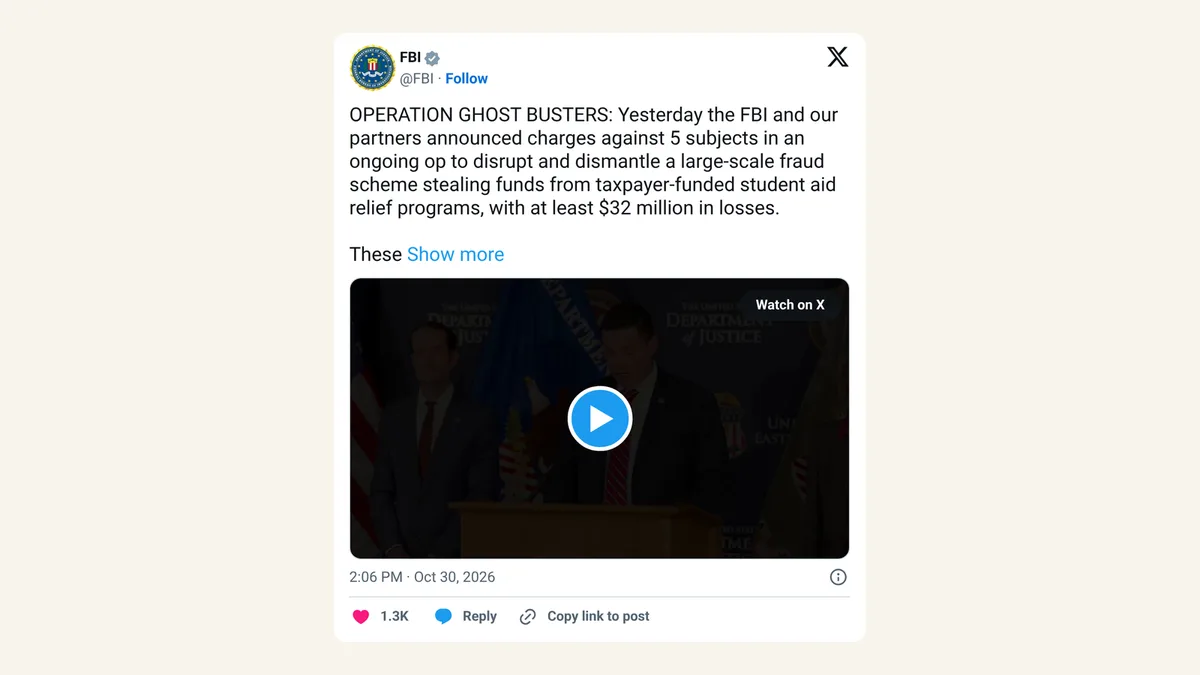
On Thursday, October 29, 2026, the Justice Department announced the first results of "Operation Ghostbusters," a nationwide investigation into student-aid fraud. Prosecutors in New Jersey, Virginia and Nebraska charged five people in total. Officials say the scheme used stolen American identities to file FAFSA forms (the Free Application for Federal Student Aid), enroll fake "ghost students" at colleges and send the leftover aid to accounts tied to a network in Kenya.
The FBI says it has found more than US$32 million in losses so far, with "millions more suspected," and investigators seized over US$750,000 in cryptocurrency. The DOJ calls that the first international seizure of its kind in Kenya. Everyone charged is presumed innocent until proven guilty in court.
How did AI help fake the students?
Officials laid out the money trail at a press conference. Colleges get federal aid first to cover tuition and fees. Whatever is left over is paid out to the "student," and in these cases prosecutors say it went to bank accounts run by money mules (people who move stolen money through their own accounts for a cut).
To keep the payments coming, the fake student has to look real. According to Ars Technica's report on the DOJ press conference, the rings used AI to fill out applications, finish coursework and even make it look like a student was attending online classes. "It looks like the ghost student is actually completing the class," Assistant Attorney General Colin M. McDonald said, adding that the goal is to keep the fake student enrolled "semester after semester after semester."
That's why AI matters here. A human scammer can't sit through hundreds of online classes, but software can keep many fake students looking busy at once.
Who gets hurt, and how big is it?
The DOJ says the fraud has run since at least 2021 and that victims are often people who never went to college, which makes cross-checks harder. Many known victims have only a high school diploma and were "shocked by their faked attendance at an institution hundreds of miles away," the department said.
The damage can land on them years later. Ars reports that victims may not find out until the government asks them to repay loans, and their credit can be hurt in the meantime.
The bigger numbers are estimates, not proven losses:
- 830,840 federal student aid IDs flagged as "potentially fraudulent" in September and October, linked to nearly US$130 million if all were fraud (DOJ).
- More than 40 open cases across 26 FBI field offices (DOJ).
- Overall scale estimated at "well over US$200 million" (DOJ).
X reactions
The FBI and Ars Technica both posted about the case on Friday.
Our take
This is the less fun side of AI agents. The same tools that draft an email or summarize a lecture can also fake a whole student, cheaply and at scale. Fraud that once needed a room full of people now needs stolen data and a few scripts.
The people hit hardest are the ones least likely to notice: young workers who skipped college and never think about student loans. And real students pay too. Ars reports that new ID checks and automated fraud flags can slow aid for low-income students who don't have a driver's license handy. Stopping fraud matters, and so does a fast, human way out for real people who get flagged by mistake.
— Artificially Nerdy
What to do now
- Pull your free credit reports at AnnualCreditReport.com and look for student loans you don't recognize.
- Got a letter from the FBI? The DOJ says it has written to many identified victims. Follow the instructions in the letter.
- Report suspected aid fraud to the Department of Education's inspector general hotline, which the DOJ names for victims.
- Report identity theft at the FTC's IdentityTheft.gov to get a recovery plan.
- Applying for aid yourself? Keep a government photo ID ready, since online identity checks can ask for it in real time.
FAQ
Have the five people been convicted?
No. They've been charged, and in one New Jersey case arrested on a criminal complaint. The DOJ notes that all defendants are presumed innocent until proven guilty.
Why are people who never went to college targeted?
The DOJ says it's because they have no existing college or aid records, which makes it harder for the Department of Education to cross-check a new application.
Is the 830,000 figure the number of victims?
No. Those are aid accounts flagged as potentially fraudulent. Officials said the total would come close to US$130 million only if all of them turn out to be fake.
Will this make FAFSA harder for real students?
It may slow some down. Ars reports that automated ID checks can wrongly flag real applicants, and the school then has to follow up before aid is released.
Sources
- U.S. Department of Justice: Justice Department Unveils Indictments in Nationwide 'Ghost Student' Fraud Scam Linked to Kenyan Network — October 29, 2026; five defendants, US$32M+ losses (FBI), US$750K+ crypto seized, 830,840 flagged IDs and ~US$130M, 40+ cases in 26 field offices, victim profile, FBI letters, OIG hotline, presumption of innocence.
- Ars Technica: Thousands of "ghost students" use AI to steal millions in student loans, DOJ says — October 30, 2026; AI use described at the press conference, McDonald quotes, credit damage, ID checks and false flags.
- FBI on X — October 30, 2026, 2:06pm ET.
- Ars Technica on X — October 30, 2026, 12:54pm ET.
- AnnualCreditReport.com and IdentityTheft.gov — official free credit reports and FTC identity-theft reporting.