
TL;DR
Is OpenAI pausing AI development?
OpenAI asked rival AI labs to agree on a shared limit for how far they train their models, and Microsoft backed the idea hours later. Nothing changes in ChatGPT or Copilot today, but the companies expect much stronger AI soon. Nothing to do yet.
What did OpenAI propose?
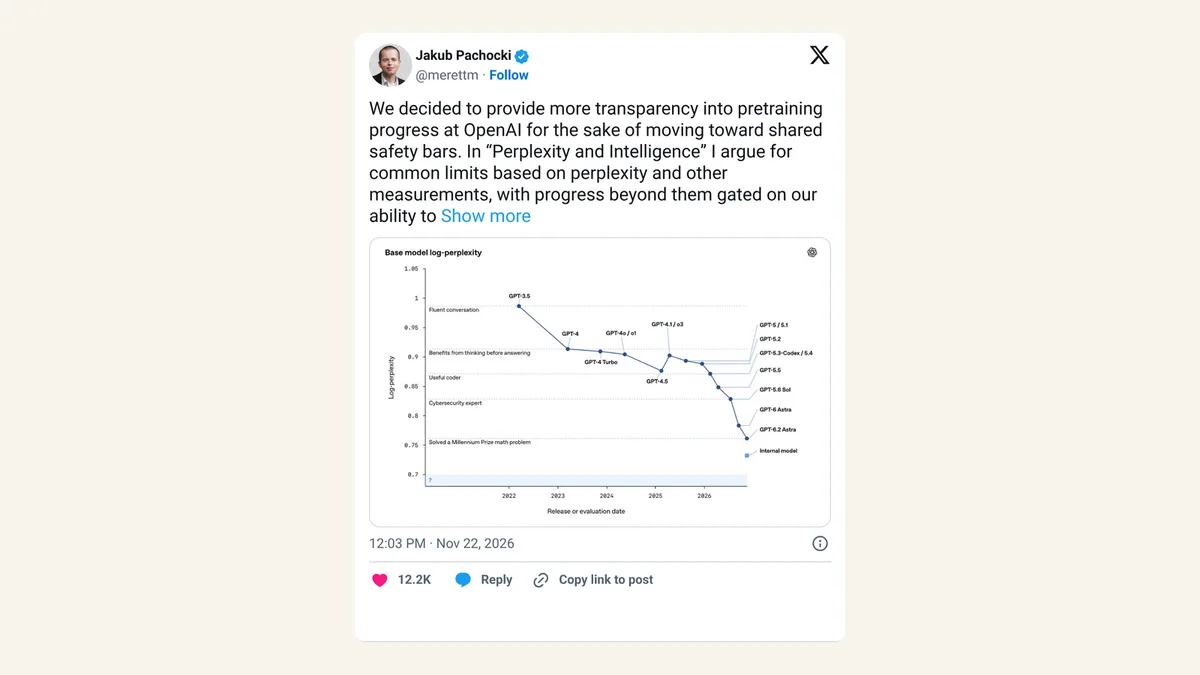
On Sunday, November 22, 2026, OpenAI chief scientist Jakub Pachocki published a post on OpenAI's blog called "Perplexity and Intelligence." It does two things. First, it shares OpenAI's internal pretraining progress numbers, a step Pachocki says took some consideration because it gives competitors a clearer picture of where OpenAI stands. Pretraining is the first, biggest stage of building a model, where it reads huge amounts of text and learns to predict what comes next.
Second, it proposes "common limits" for the whole industry. Every lab would report the same measurement, and all of them would agree not to train past a set point "until our ability to understand and monitor AI behavior achieves a certain concrete milestone (such as the development of a successor to CoT monitors)." CoT monitors are tools that read a model's chain of thought, the step-by-step reasoning it writes out before answering, to catch bad behavior.
Sam Altman called it "the most important thing OpenAI has published in awhile."
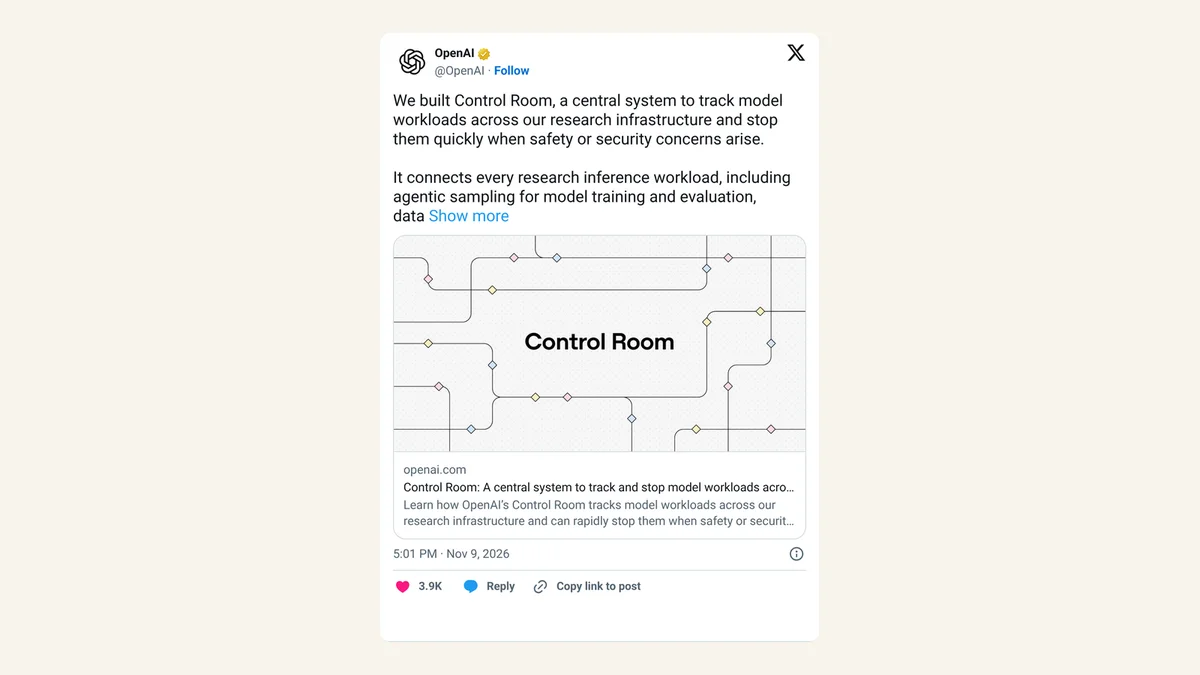
For another OpenAI safety system, read our post on how OpenAI's Control Room AI kill switch works.
What is perplexity in AI?
Perplexity here is a score for how well a model predicts the next token, a token being a chunk of text a few characters long. Lower is better. It has nothing to do with Perplexity, the AI search company.
OpenAI's post gives these log-perplexity scores on its main internal dataset:
- GPT-3.5: about 0.99
- GPT-4: about 0.91
- OpenAI's latest models: "below 0.8"
OpenAI says its models started "producing groundbreaking results" in math at around 0.76, and it expects "further transformative capabilities" somewhere around 0.68 to 0.7. The post also says a pretraining "avalanche" could come "as soon as 2027." The post doesn't name a limit number. It asks the labs to agree on one together.
Did Microsoft agree to the AI speed limit?
Microsoft AI CEO Mustafa Suleyman posted on X on Sunday evening that Microsoft "fully support[s] OpenAI's transparency initiative" and is "committed to sharing our pre-training progress on a common held-out evaluation set." With OpenAI's permission, he reported that Microsoft's MAI-2 Base model scores 0.819 on OpenAI's evaluation set, which he said puts it "in the same ballpark as the GPT-5.6 Sol base model." Because Microsoft's model breaks text into tokens the same way OpenAI's does, he said the numbers are "directly comparable."
That number comes only from Suleyman's post. Microsoft hadn't published a blog post or filing on it as of early Monday. Anthropic, Google DeepMind and xAI hadn't responded officially either, and no lab has signed anything.
What are the weak spots?
Pachocki lists them himself. Labs use different evaluation data and train on different data mixes, so their scores are hard to compare. Suleyman added that labs split text into tokens differently, so future comparisons might need a different unit. Perplexity also misses gains that come from reasoning, the extra thinking models do after pretraining. And nobody knows how low the score can go. TechCrunch, which covered the post Sunday afternoon, noted that Anthropic CEO Dario Amodei has published his own plan to "pace the frontier."
X reactions
This is the most important thing OpenAI has published in awhile.
— Sam Altman (@sama) November 22, 2026
We are providing a lot of transparency into our pretraining progress and hope we can agree as a frield to common limits. I think that would be very wise and help ensure safety and control.
We fully support OpenAI's transparency initiative. Thanks to @merettm @markchen90 @gdb @sama for leading the way.
— Mustafa Suleyman (@mustafasuleyman) November 22, 2026
We're committed to sharing our pre-training progress on a common held-out evaluation set. With OpenAI's permission, we report MAI-2 Base on their evaluation set. Its log-perplexity is 0.819, putting it in the same ballpark as the GPT-5.6 Sol base model. Our model uses the same tokenizer as OpenAI, so the numbers are directly comparable.
Our take
We like this more than we expected to. Labs usually keep progress numbers secret, and OpenAI just put its own on the table and asked rivals to do the same. A shared number is the first thing any limit needs, because you can't agree to stop at a line nobody can see.
Still, a proposal in a blog post is easy. The real question is whether Anthropic, Google and xAI publish their numbers, and whether anyone agrees to a limit that actually costs them a lead. Until a lab names a number and holds to it, treat this as a promising opening offer.
— Artificially Nerdy
What to watch this week
- Read the post. Pachocki's post is linked in Sources, and its chart of OpenAI's scores is easier to follow than the math suggests.
- Watch for other labs' numbers. Anthropic, Google DeepMind or xAI posting a score would make this a real industry effort.
- Mind the name. Headlines about "perplexity" this week are about the score, not the search app.
- Keep using your AI tools as usual. No product, plan or price changed.
FAQ
Does this slow down ChatGPT or Copilot?
No. The proposal is about training future models, and no limit has been set. Nothing about today's apps changed.
Who is Jakub Pachocki?
He's OpenAI's chief scientist and the author of the post. He announced it on X on Sunday around 12:03pm ET.
Is this a binding agreement?
No. It's a proposal in a post on OpenAI's blog. Microsoft said it supports OpenAI's transparency push, but no lab has signed a pact or agreed to a specific limit.
What is MAI-2?
It's a Microsoft AI model. Suleyman shared the score for its base version, the model before extra tuning, measured on OpenAI's evaluation set.
Sources
- OpenAI: Perplexity and Intelligence — Jakub Pachocki, November 22, 2026. Proposal, quoted milestone, log-perplexity figures, 2027 "avalanche," limits of the metric.
- TechCrunch: OpenAI's chief scientist has thoughts on how to limit AI development — Anthony Ha, November 22, 2026. Context, Amodei's "pace the frontier."
- Jakub Pachocki (@merettm) on X — November 22, 2026, about 12:03pm ET.
- Sam Altman (@sama) on X — November 22, 2026, about 12:12pm ET.
- Mustafa Suleyman (@mustafasuleyman) on X — November 22, 2026, about 7:37pm ET. MAI-2 Base score.